

Death Knell for the Rural Job Guarantee
The Hindu
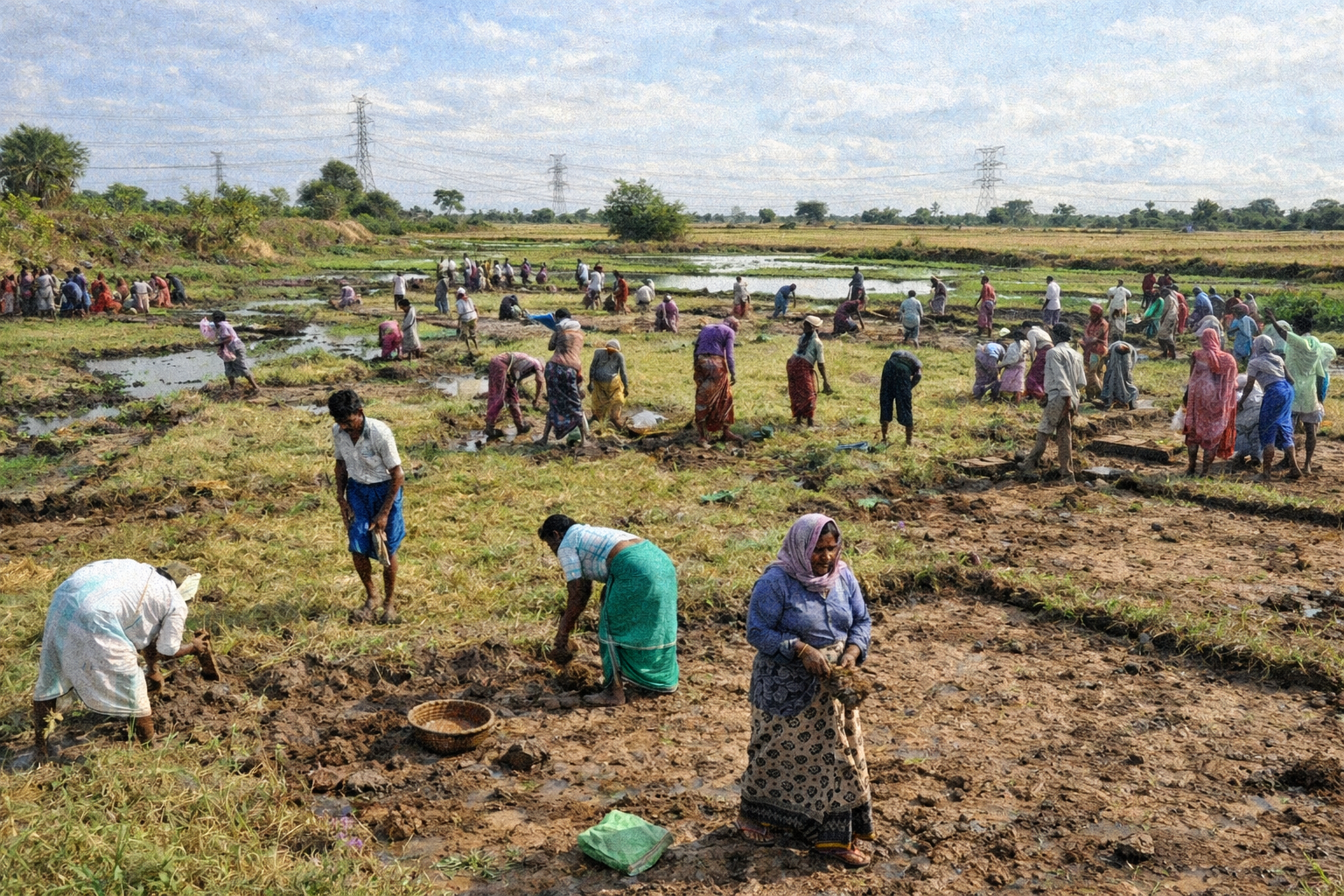
I. Context and Central Theme
The article critically examines the Viksit Bharat–Gramin Rozgar Adhiniyam (VB-GRAM), which seeks to replace the Mahatma Gandhi National Rural Employment Guarantee Act (MGNREGA). It argues that the proposed legal shift marks a fundamental retreat from a rights-based employment guarantee to a discretionary, state-controlled welfare framework, with deep constitutional, social, and economic implications for rural India.
The central concern is not merely administrative reform, but the erosion of the “right to work” as a justiciable entitlement that has underpinned rural livelihood security since 2005.
II. Key Arguments Presented
1. Dilution of the Right to Work
The article contends that VB-GRAM removes the legally enforceable guarantee of employment, transforming it into a policy promise without statutory backing. This undermines the Supreme Court’s consistent interpretation of MGNREGA as integral to the right to life under Article 21.
2. Shift from Demand-Driven to Command-Driven Framework
MGNREGA’s demand-based design—where citizens seek work as a matter of right—is contrasted with VB-GRAM’s top-down, executive-controlled allocation of work, reducing citizen agency.
3. Fiscal Prudence over Social Justice
The proposed changes are interpreted as fiscally motivated, prioritising budgetary control over social protection. Chronic underfunding, delayed payments, and reduced person-days are presented as precursors to legal dismantling.
4. Impact on Vulnerable Groups
The article highlights that women, SCs, STs, and landless labourers—groups that disproportionately depend on MGNREGA—will face heightened insecurity if employment is no longer guaranteed.
5. Federal and Democratic Concerns
By increasing central discretion and weakening local accountability, the new framework risks marginalising Panchayati Raj Institutions and weakening grassroots democracy.
III. Author’s Stance
The author adopts a clearly oppositional and rights-centric stance, viewing VB-GRAM as a regression from constitutional morality and social justice. The tone is cautionary and normative, rooted in constitutional jurisprudence, labour rights, and welfare economics.
The article frames MGNREGA not as a welfare scheme, but as a social contract between the State and the rural poor.
IV. Biases and Editorial Slant
1. Strong Rights-Based Bias
The article privileges constitutional and moral arguments over fiscal or administrative considerations, leaving limited space for efficiency-based reform arguments.
2. Skepticism of Executive Intent
There is an implicit distrust of the government’s motives, with reform interpreted primarily as withdrawal rather than restructuring.
3. Limited Engagement with Implementation Failures
While underfunding and delays are noted, the article underplays genuine governance issues such as leakages, asset quality, and local capacity constraints that reform advocates cite.
V. Strengths of the Article
1. Constitutional Grounding
The linkage between employment guarantee and Article 21 is a major analytical strength, especially for UPSC aspirants.
2. Historical and Legal Continuity
The article situates MGNREGA within Supreme Court judgments, COVID-19 experience, and long-term rural distress trends.
3. Focus on Social Justice Outcomes
It effectively foregrounds the distributive and stabilising role of MGNREGA in times of agrarian stress and economic shocks.
VI. Weaknesses and Gaps
1. Absence of Alternative Reform Pathways
The article critiques VB-GRAM but offers limited constructive suggestions for improving MGNREGA without dismantling it.
2. Fiscal Reality Underplayed
Concerns of ballooning expenditure, state capacity, and sustainability are not analysed in depth.
3. Binary Framing
The debate is framed as rights versus rollback, leaving little room for nuanced middle-ground reform.
VII. Policy Implications
For Social Policy
• Weakening of statutory guarantees may increase rural distress and distress migration
• Loss of automatic stabiliser during economic downturns
For Federal Governance
• Reduced autonomy of states and Panchayats
• Centralisation of welfare decision-making
For Labour Markets
• Increased informalisation and vulnerability of rural labour
• Potential downward pressure on rural wages
VIII. Real-World Impact
Likely Negative Outcomes
• Reduced employment security for millions
• Higher exposure to market volatility and climate shocks
• Erosion of trust in state welfare commitments
Possible Administrative Gains
• Greater fiscal control
• Reduced legal liabilities for delayed payments
• Flexibility in targeting and allocation
However, the article argues these gains come at an unacceptably high social cost.
IX. UPSC GS Paper Alignment
GS Paper II – Polity & Governance
• Rights-based legislation
• Welfare state and constitutional obligations
• Centre–State relations
GS Paper III – Economy & Inclusive Growth
• Rural employment
• Poverty alleviation
• Labour market dynamics
GS Paper IV – Ethics & Social Justice
• State responsibility towards vulnerable sections
• Equity versus efficiency in public policy
X. Balanced Conclusion
The article makes a compelling case that VB-GRAM represents a paradigmatic shift away from rights-based welfare, with serious constitutional and social implications. While the need for reform in MGNREGA is undeniable, replacing a legal guarantee with executive discretion risks hollowing out one of India’s most consequential social protections.
Reform, the article implies, should strengthen accountability and delivery—not dismantle entitlement.
XI. Future Perspectives
• Courts may be called upon to test VB-GRAM against Article 21
• States may resist dilution of employment guarantees
• Political economy of rural distress could sharpen
• The broader debate will shift from “how to improve MGNREGA” to “whether the State still guarantees work”
