

Death Penalty in India

Death Penalty in India
Source: The Hindu
Why in News?
- Recent Supreme Court judgments have reinforced procedural safeguards in death penalty cases, particularly the need to assess the possibility of reformation and provide meaningful opportunities to present mitigating circumstances during sentencing.
Constitutional and Legal Framework
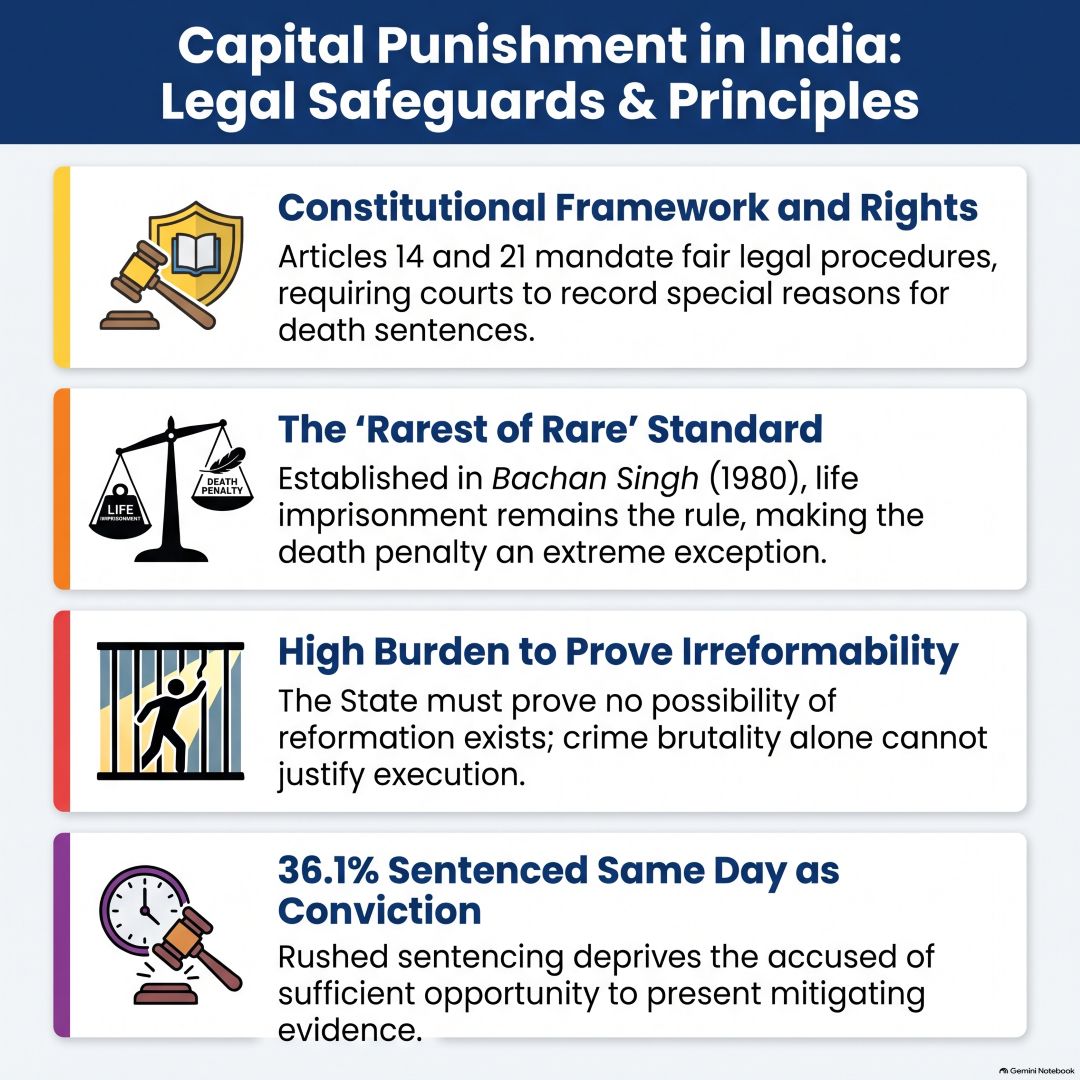
- The death penalty is the highest form of criminal punishment in India. It is constitutionally permissible but subject to strict judicial safeguards.
- Article 14: Guarantees equality before the law and protects against arbitrary state action.
- Article 21: Protects life and personal liberty. Any deprivation of life must follow a fair, just and reasonable procedure.
- Section 393(3) of the Bharatiya Nagarik Suraksha Sanhita (BNSS), 2023, requires courts to record special reasons for imposing a death sentence. It replaces the earlier Section 354(3) of the Code of Criminal Procedure (CrPC).
Bachan Singh Judgment and Rarest of Rare Principle
- In Bachan Singh v. State of Punjab (1980), a Constitution Bench upheld the constitutional validity of the death penalty and established the rarest of rare doctrine.
- Life imprisonment must remain the rule, while the death penalty is an exception.
- Courts must record special reasons before imposing capital punishment.
- Both the circumstances of the crime and those of the accused must be considered.
- Death should be imposed only when life imprisonment is unquestionably foreclosed.
Individualised Sentencing and Reformation
- Individualised sentencing requires courts to examine the personal, social, psychological and structural circumstances of the accused.
- The objective is to assess the individual's moral culpability and determine whether there is a genuine possibility of reformation.
- The State bears the burden of establishing through evidence that there is no reasonable possibility of reformation.
- The death penalty cannot be imposed solely on the basis of the gravity or brutality of the crime.
Evolution of Judicial Approach
|
Judgment |
Key Principle |
|
Machhi Singh v. State of Punjab (1983) |
Emphasised the nature and circumstances of the crime. This approach risked shifting attention away from the accused's circumstances. |
|
Ravji v. State of Rajasthan (1995) |
Held that the nature and gravity of the offence were decisive, rather than the circumstances of the accused. This was later held contrary to Bachan Singh. |
|
Santosh Kumar Bariyar v. State of Maharashtra (2009) |
Held that Ravji was decided in ignorance of Bachan Singh and reaffirmed the importance of reformation. |
|
Sangeet v. State of Haryana (2013) |
Highlighted how the approach in Machhi Singh risked reversing the original sentencing inquiry. |
- Ravji and Surja Ram were executed in 1996 and 1997, respectively, under the erroneous principle followed in the Ravji judgment.
- Santosh Kumar Bariyar clarified that life imprisonment could be considered unquestionably foreclosed only when reformation was unachievable.
Reformation and Sentencing Practices
- The 262nd Report of the Law Commission of India (2015) reinforced the importance of reformation in death penalty cases.
- A nationwide study of 306 death sentences imposed between 2018 and 2020 found:
- 36.1% were pronounced on the same day as conviction.
- 18.4% were pronounced on the following day.
- In most cases, the defence neither presented arguments nor submitted evidence on mitigating circumstances.
- Trial courts sentenced 128 individuals to death in 2025, highlighting concerns about the implementation of procedural safeguards.
Way Forward
- Ensure meaningful sentencing hearings and strict compliance with procedural safeguards.
- Provide adequate time and legal assistance to the accused to present mitigating circumstances.
- Assess mental health, personal background, prison conduct and the possibility of reformation.
- Strengthen forensic investigations and ensure the reliability of evidence.
- Maintain individualised sentencing in accordance with Articles 14 and 21.