

Decoding India’s GDP Base Revision

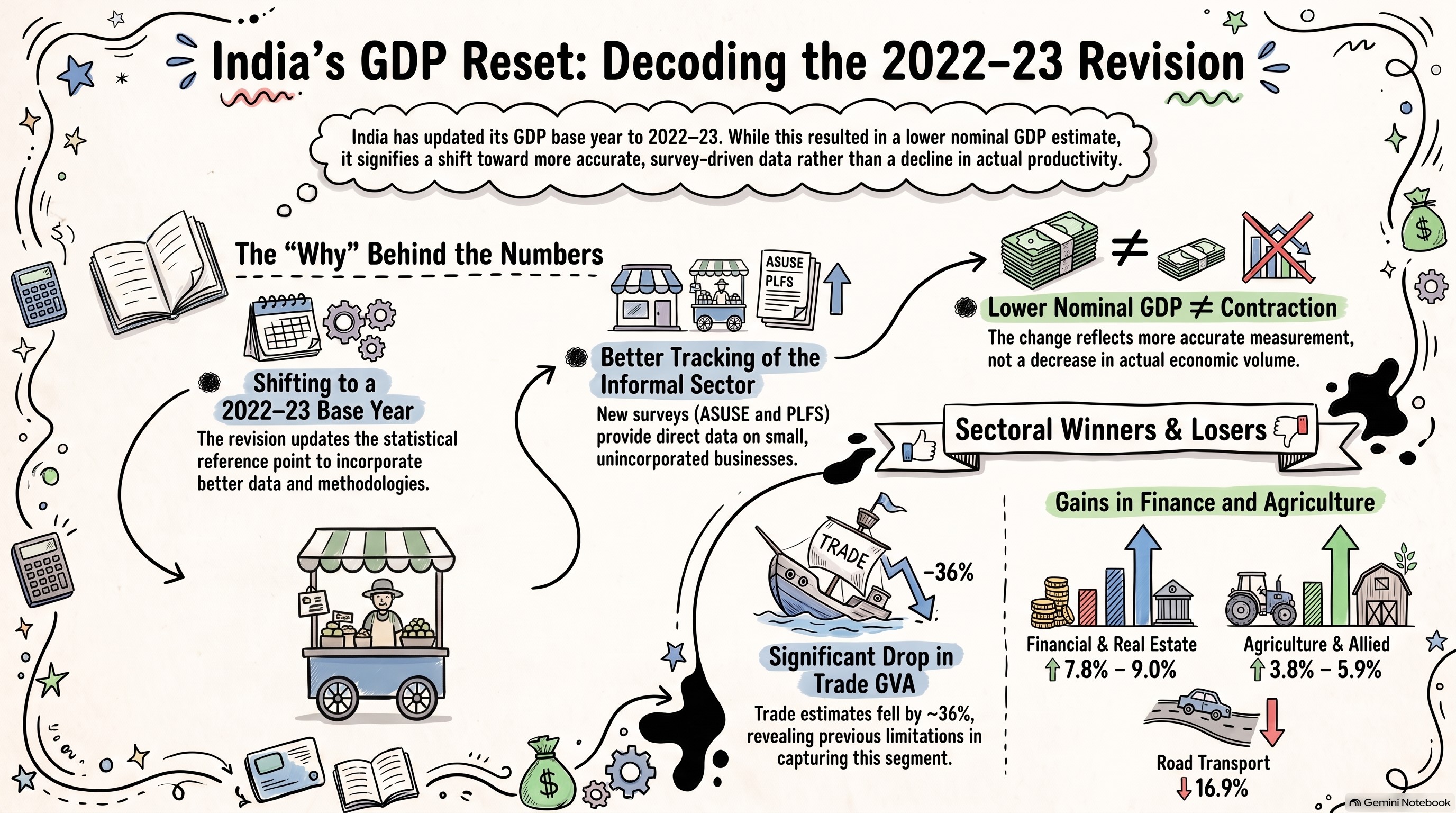
Source: The Hindu
Context and GDP Rebasing
- GDP measures the value of goods and services produced within an economy and is periodically revised to incorporate better data, methodologies and structural changes.
- India has introduced a new GDP series with 2022–23 as the base year, resulting in revisions to both growth estimates and the nominal size of the economy.
- GDP rebasing changes the statistical reference point; therefore, a lower estimated GDP does not automatically imply that actual economic activity has contracted.
- Under the revised series, nominal GDP was approximately:
- 7% lower in 2022–23.
- 3.5% lower in 2023–24.
- 3.8% lower in 2024–25.
- Similar revisions have occurred internationally and in India’s earlier shift from the 2004–05 to the 2011–12 base year.
Sector-wise Impact of the Revision
|
Sector |
Broad revision |
|
Agriculture & allied activities |
↑ 3.8%–5.9% |
|
Financial, real estate & professional services |
↑ 7.8%–9.0% |
|
Hotels & restaurants |
↑ 5.7% |
|
Trade GVA |
↓ ~36% |
|
Road transport |
↓ 16.9% |
- The revisions are therefore not uniformly downward; they reflect a substantially different measurement of individual sectors.
- The sharp revision in trade and transport indicates that previous estimates had limitations in capturing activity in these segments.
- The revised series provides a more differentiated picture of the structure and contribution of various sectors to the economy.
Unincorporated Sector: Major Source of Change
- A major reason for the revision is improved measurement of the unincorporated sector, which includes numerous small businesses and informal enterprises.
- Under the previous 2011–12 series, benchmark estimates for this sector were often updated using indirect proxy indicators.
- The new methodology makes greater use of:
- Annual Survey of Unincorporated Sector Enterprises (ASUSE).
- Periodic Labour Force Survey (PLFS).
- These datasets provide more direct information on enterprises, employment and economic activity in the informal sector.
- The World Bank’s April 2026 India Development Update attributed a 3%–4% downward revision in nominal GDP across FY23–FY26 to reassessment of the informal economy.
Why Lower Nominal GDP ≠ Economic Contraction?
- Nominal GDP measures output at current prices, while real GDP adjusts for price changes and is more relevant for assessing actual volume growth.
- GDP estimates are periodically revised as more comprehensive information becomes available, including data from GST collections and industrial production.
- When the estimate for the base year is revised, subs