

Defining industry : In with the old, on with the new

Defining industry : In with the old, on with the new
Context:
Navigating the landscape of Indian industry today requires moving past old textbooks; the "old" definitions have been fundamentally redrawn to accommodate a high-growth, digital-first economy. As a mentor, I want you to focus on two major shifts: the 2025-26 revision of MSME thresholds and the adoption of NIC-2025, which together define how we measure and support business today.
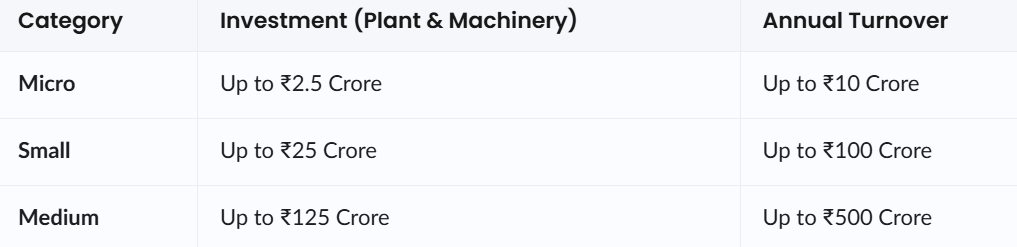
1. The New Thresholds: MSME Reclassification (2025-2026)
To prevent firms from losing government benefits as they grow, India has significantly raised the ceilings for what qualifies as a "Micro, Small, or Medium" enterprise. The most critical change is the Composite Criterion, where both Investment and Turnover must stay within limits.
2. Measuring the Modern Economy: NIC-2025
The "New" also involves how we categorize activities. In November 2025, the Ministry of Statistics (MoSPI) released the NIC-2025, replacing the older 2008 version.
- Granularity: It moved from a 5-digit to a 6-digit coding system, allowing for roughly 1,900 sub-classes (up from 1,303).
- Modern Inclusion: It explicitly categorizes emerging activities like Cloud Services, Blockchain, Fintech, and Green Hydrogen that were previously clubbed under generic "others."
- Global Alignment: It is now synchronized with the UN's ISIC Revision 5, making India’s industrial data comparable with global standards.
3. The "Sunrise" Shift
The definition of industry is also expanding through "Sunrise Sectors"—industries in their infancy but with massive future potential. These are the current favorites for Mains value-addition:
- Semiconductors: Driven by the India Semiconductor Mission (ISM) 2.0 (outlay of ₹76,000 Cr).
- E-Mobility: Transitioning from vehicle assembly to Cell Localization (Advanced Chemistry Cells).
- Green Energy: Focus on BESS (Battery Energy Storage Systems) and Green Hydrogen.
· Ultimately, defining industry in 2026 is no longer just about factory smoke; it is a blend of high-tech manufacturing, digital intermediation, and sustainable energy, all supported by more flexible, growth-oriented regulatory buckets.
