

Development means expansion of choices in Amartya Sen’s capabilities approach
The Hindu
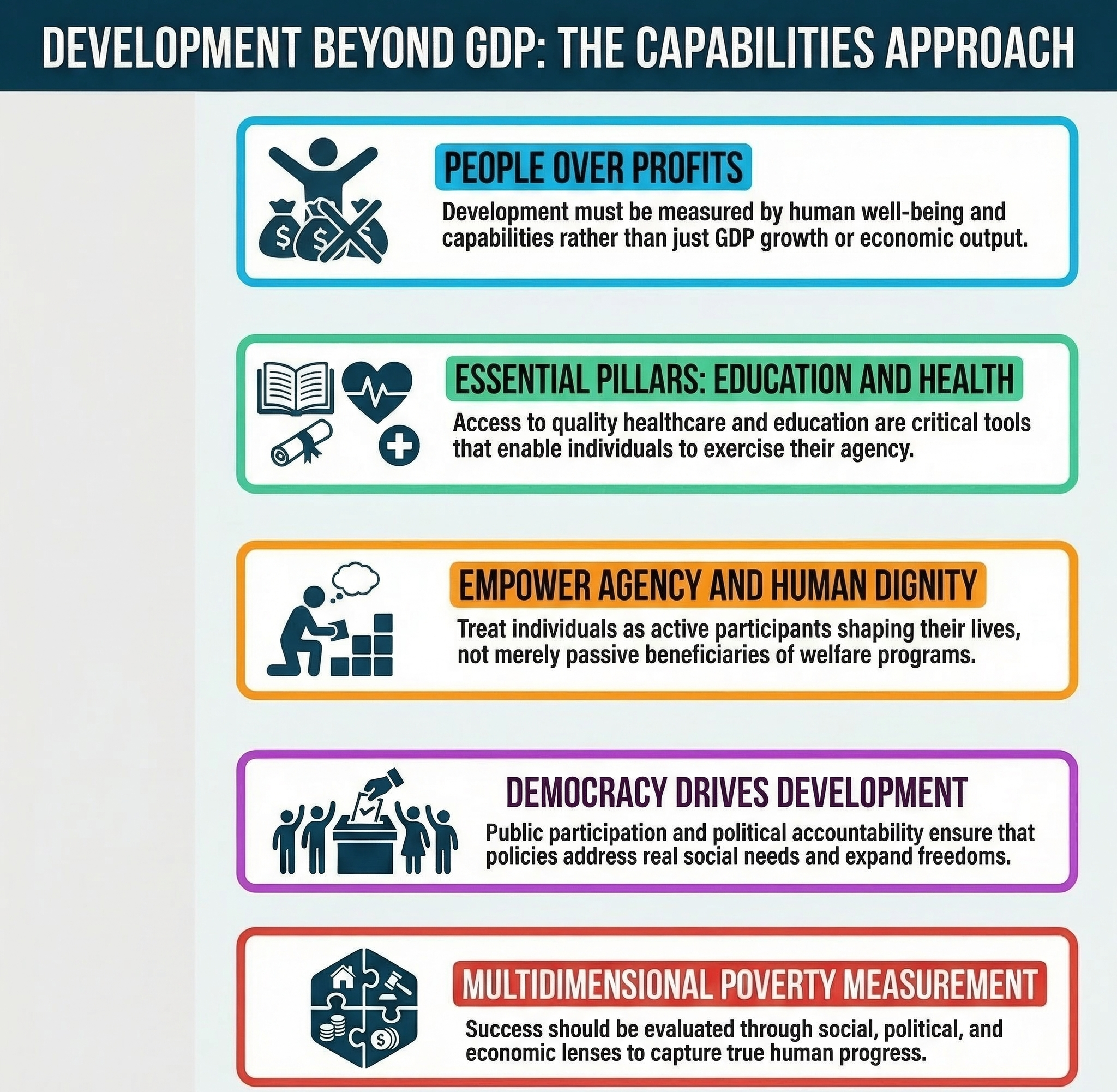
Key Arguments of the Article
Development as Expansion of Human Capabilities
The central argument is that development must be measured by the expansion of people’s capabilities—such as access to education, healthcare, and social participation—rather than solely by indicators like GDP growth.
Economic resources are important, but they are only means to achieve broader human well-being.
Critique of Income-Centric Development Models
The article emphasises Sen’s critique of traditional development models that equate development with economic output. According to Sen, focusing exclusively on GDP ignores inequalities, social deprivation, and structural barriers that limit human freedom.
Development must therefore be evaluated through a multidimensional lens.
Role of Democratic Institutions
Another key argument is that democracy plays a crucial role in expanding capabilities. Public participation, political freedoms, and accountability mechanisms help ensure that development policies address real social needs.
Democratic governance strengthens transparency and responsiveness.
Importance of Education and Social Opportunities
Education is highlighted as a critical capability that enables individuals to exercise agency and participate in economic and social life. Expanding educational access and quality is therefore central to human development.
Similarly, access to healthcare, employment opportunities, and social security enhances individual freedoms.
Agency and Human Dignity
The article stresses that individuals should not be seen merely as beneficiaries of development programmes but as active agents who shape their own lives and societies.
This emphasis on agency distinguishes the capabilities approach from purely welfare-oriented frameworks.
Author’s Stance
The author adopts a strongly supportive and interpretive stance toward Amartya Sen’s framework. The article emphasises the ethical and philosophical foundations of development and presents the capabilities approach as a powerful alternative to narrow economic metrics.
The narrative aligns with a human-centred vision of development.
Possible Biases
Normative Orientation
The article strongly emphasises moral and philosophical dimensions of development, which may understate the importance of economic growth in reducing poverty.
Limited Discussion of Implementation
While highlighting the conceptual strengths of the capabilities approach, the article does not fully address practical challenges in translating these ideas into policy.
Intellectual Perspective
The analysis focuses on theoretical debates and may not sufficiently explore empirical outcomes of capability-based policies.
Advantages of the Capabilities Approach
Holistic Understanding of Development
The framework recognises that development involves social, political, and economic dimensions.
Emphasis on Human Freedom
It places individual dignity, agency, and freedom at the centre of development policy.
Policy Relevance
The approach has influenced global development frameworks such as the Human Development Index.
Focus on Social Justice
By addressing inequality and social exclusion, the framework promotes inclusive development.
Limitations and Critiques
Measurement Challenges
Capabilities are difficult to quantify, making policy evaluation complex.
Resource Constraints
Expanding capabilities often requires substantial public investment in social sectors.
Implementation Complexity
Translating philosophical principles into concrete policy programmes can be challenging.
Balance with Economic Growth
Economic growth remains essential for generating resources needed to expand capabilities.
Policy Implications
Human-Centred Development Planning
Public policies should prioritise health, education, and social welfare alongside economic growth.
Strengthening Social Institutions
Strong institutions are required to ensure equitable access to opportunities.
Inclusive Governance
Participatory decision-making processes can ensure that development policies reflect citizens’ needs.
Multidimensional Poverty Measurement
Development assessments should incorporate indicators beyond income, including education and health outcomes.
Real-World Impact
If capability-based development policies are implemented effectively:
• Improved human development outcomes
• Reduced social inequalities
• Enhanced democratic participation
• Greater social mobility
If ignored:
• Development strategies may prioritise growth without addressing social deprivation
• Inequality and exclusion may persist despite economic progress
Alignment with UPSC GS Papers
GS Paper I
Indian society, social justice, and development challenges.
GS Paper II
Role of government in social sector policies such as education, healthcare, and welfare.
GS Paper III
Economic development, inclusive growth, and human capital formation.
GS Paper IV
Ethical governance, human dignity, and justice in public policy.
Balanced Assessment
The article effectively highlights the continuing relevance of Amartya Sen’s capabilities approach in development discourse. By emphasising human freedom and agency, the framework expands the meaning of development beyond economic growth.
However, practical policymaking requires balancing capability expansion with economic growth and resource constraints.
Future Perspective
In an increasingly complex global economy, development strategies must integrate economic progress with social inclusion and human empowerment. The capabilities approach offers a valuable conceptual framework for designing policies that prioritise both prosperity and human dignity.
For policymakers and civil services aspirants, Sen’s ideas remain central to understanding inclusive development and the ethical foundations of public policy.
