

Digital Authentication Failures Threatening Children's Right to Nutrition

Digital Authentication Failures Threatening Children's Right to Nutrition
Source: The Times of India, 14 November 2026
Why in News?
A Right to Food Campaign survey covering 1,850 Anganwadi centres across nine states found that Aadhaar-based e-KYC and facial recognition failures are preventing children from accessing supplementary nutrition under the National Food Security Act (NFSA), 2013.
Legal Framework: NFSA, 2013
The NFSA provides a legal entitlement to food and nutritional security.
- Section 4: Pregnant women and lactating mothers are entitled to free nutritious meals and maternity benefits of at least ₹6,000, subject to statutory provisions.
- Section 5: Children aged 6 months–6 years are entitled to age-appropriate meals through Anganwadis, while children aged 6–14 years are entitled to free mid-day meals in eligible schools.
ICDS (1975): Provides six services through Anganwadi centres: supplementary nutrition, immunisation, health check-ups, referral services, pre-school education and nutrition and health education.
It is now implemented under Saksham Anganwadi and Poshan 2.0 (2021–22) to improve nutritional outcomes among children, adolescent girls and pregnant and lactating women.
Major Findings of the Survey
A. Digital exclusion
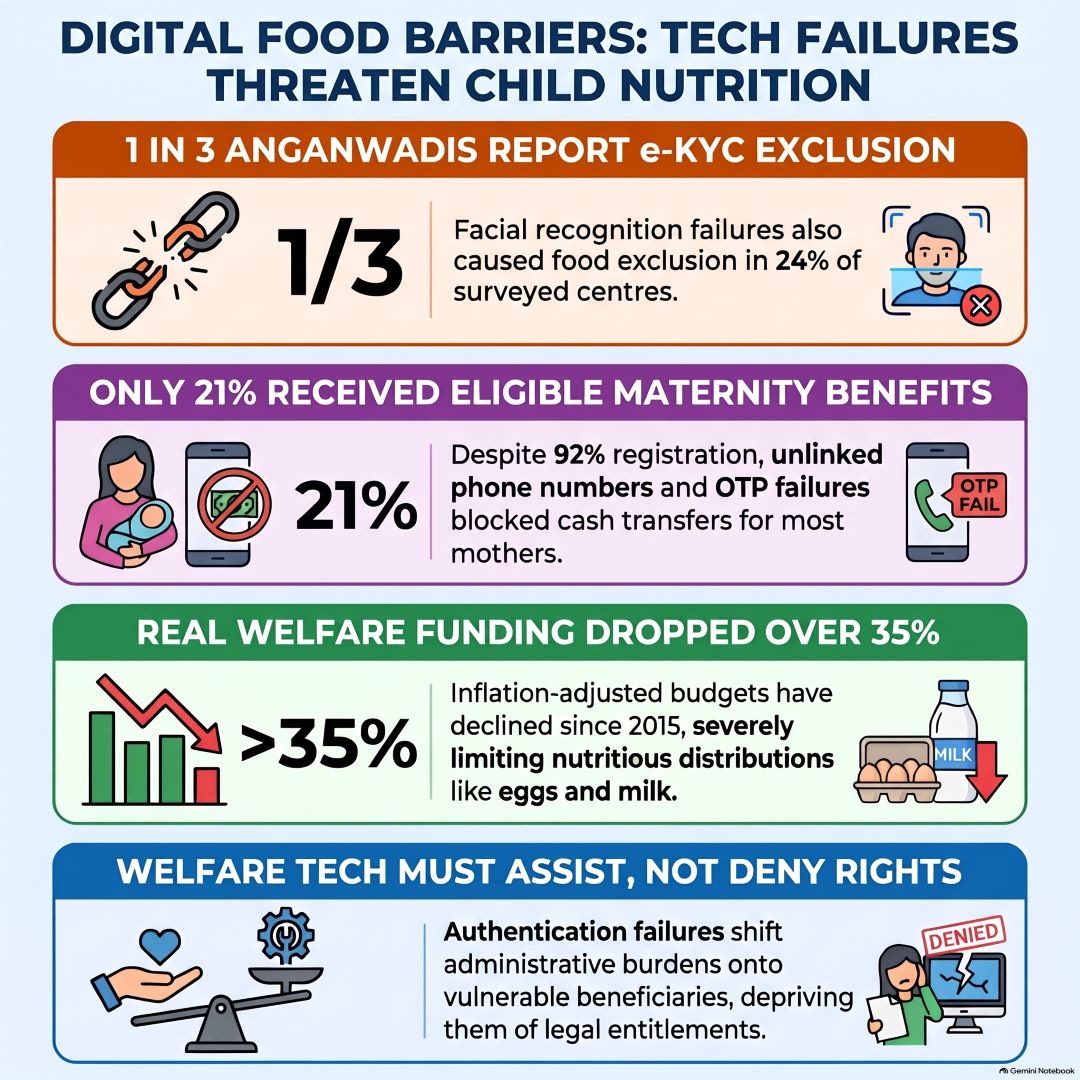
- Around one-third of Anganwadi workers reported children's exclusion due to e-KYC failures; 24% reported exclusion due to facial recognition failures.
- Authentication requirements are preventing beneficiaries from accessing legally recognised entitlements.
Digital exclusion: Denial or interruption of public services due to technological barriers such as biometric failure, OTP issues or poor connectivity.
B. Poor nutritional diversity
|
Food item |
Centres reporting distribution |
|
Eggs |
12% |
|
Fruits |
26% |
|
Milk/chikkis/laddus |
22% |
The campaign also cautioned against replacing freshly cooked, locally appropriate meals with ready-to-eat products.
C. Funding constraints
The campaign reported that ICDS allocations have remained stagnant in nominal terms for over a decade, representing a decline of over 35% in real terms compared with 2015 spending.
Real expenditure accounts for inflation and reflects the actual purchasing power of government allocations.
Maternity Benefits: Implementation Gap
A separate survey of 2,849 women across 12 states found:
- Of 2,580 eligible women, 92% had registered their pregnancies at Anganwadi centres.
- Only 21% had received even one instalment under the Pradhan Mantri Matru Vandana Yojana (PMMVY).
- For 56% of women, neither Aadhaar nor bank account details were linked to their own mobile phone, creating OTP-related difficulties.
PMMVY: A centrally sponsored maternity benefit scheme implemented by the Ministry of Women and Child Development. It provides financial assistance to eligible pregnant and lactating women to compensate partially for wage loss and support maternal health and nutrition.
Key Governance Concerns
- Denial of statutory rights: Technical authentication failures should not deprive children of their legal entitlement to nutrition.
- Technology-induced exclusion: Dependence on Aadhaar, facial recognition and OTPs creates barriers for beneficiaries with limited digital access.
- Accountability deficit: The burden of resolving authentication failures is shifted to beneficiaries instead of the administration.
- Weak service delivery: Poor dietary diversity and declining real funding weaken nutritional outcomes.
Conclusion
Digital technology should facilitate welfare delivery, not become a barrier to statutory entitlements. Effective implementation of the right to food requires accessible authentication, adequate funding, nutritional diversity and administrative accountability.