

EAM: India, Japan partnership has potential to de-risk global economy
Indian Express
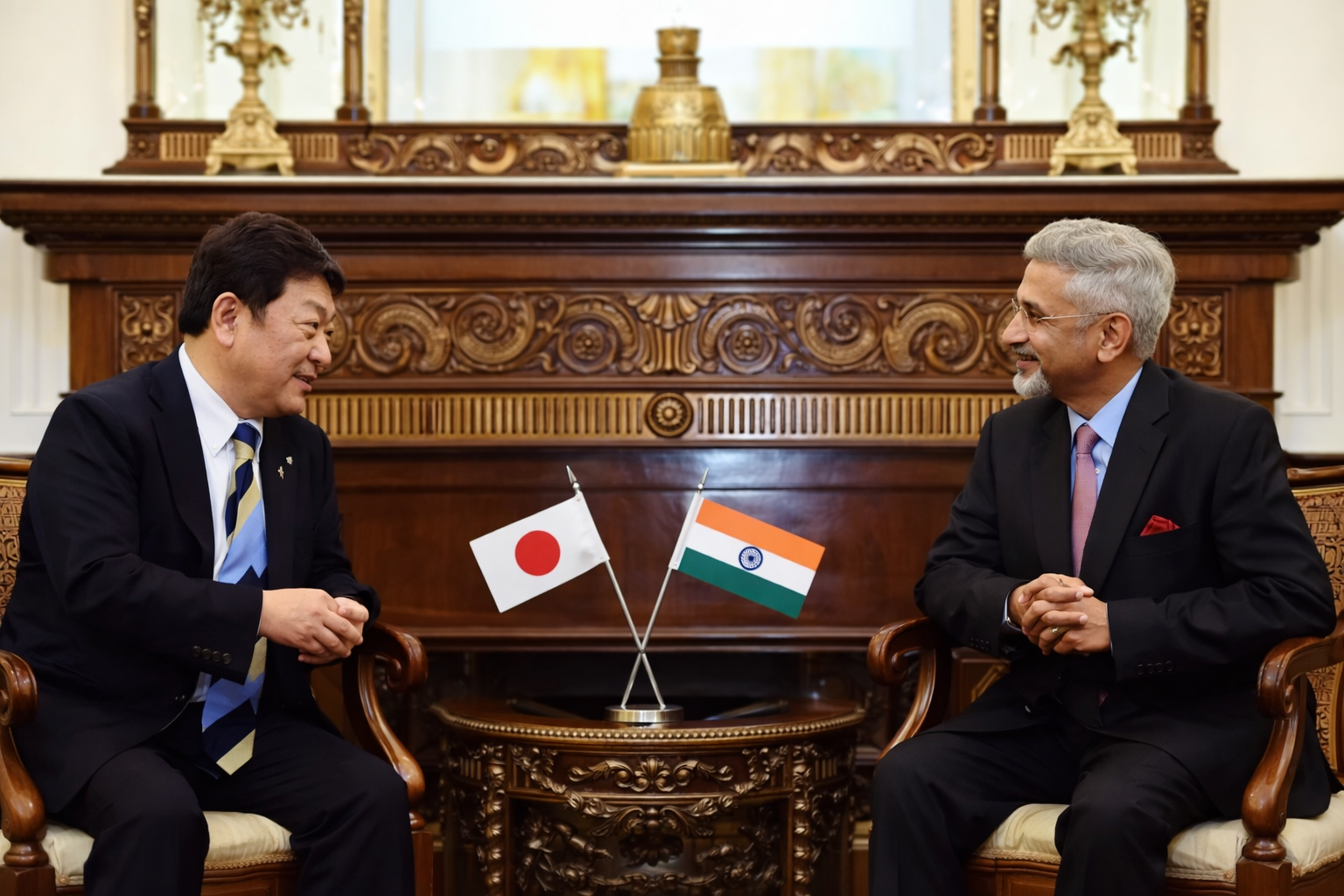
Context and Core Theme
This article reports on the 18th India–Japan Strategic Dialogue, highlighting External Affairs Minister S. Jaishankar’s assertion that the India–Japan partnership can contribute to de-risking the global economy. The piece is situated in the context of geopolitical uncertainty, supply-chain disruptions, technological competition, and economic security concerns, especially in the Indo-Pacific.
The article is both descriptive and agenda-setting, reflecting official diplomatic messaging rather than independent commentary.
Key Arguments
1. India–Japan as Anchors of Economic Security
The primary argument is that India and Japan, as major democracies and large economies, can jointly:
- Strengthen resilient supply chains
- Reduce over-dependence on concentrated production hubs
- Contribute to stability in global trade and technology flows
“De-risking” is framed not as decoupling, but as diversification and resilience.
2. Shift from Pure Trade to Economic Security
The article underscores a conceptual shift:
- Economic engagement is no longer limited to trade and investment
- It now includes critical minerals, AI, emerging technologies, and secure supply chains
- Economic policy is increasingly linked with national and international security
This reflects a broader global trend of securitisation of economic policy.
3. Institutionalisation of Cooperation
Concrete mechanisms are highlighted:
- Launch of an AI Dialogue
- A joint working group on critical minerals
- Expansion of economic security dialogue, including public-private collaboration
This suggests movement from symbolic partnership to institutional depth.
4. Indo-Pacific Convergence
The partnership is explicitly linked to a shared vision of a Free and Open Indo-Pacific, aligning economic cooperation with:
- Maritime security
- Rules-based order
- Strategic stability in Asia
India–Japan cooperation is thus positioned as a pillar of regional order.
Author’s / Institutional Stance
The stance is strongly affirmative and optimistic, reflecting the Indian government’s diplomatic narrative:
- India–Japan ties are portrayed as mutually reinforcing and globally beneficial
- The partnership is framed as normative, stabilising, and responsible
- There is emphasis on shared democratic values and strategic convergence
The article functions more as policy communication than analytical critique.
Biases and Silences
1. Official Narrative Bias
As a report centred on ministerial statements:
- Potential constraints and disagreements are not explored
- Implementation challenges are underplayed
- Outcomes are projected rather than evaluated
2. China as an Unspoken Reference
While not named explicitly:
- The language of “de-risking,” “critical minerals,” and “supply chains” implicitly reflects concerns about China-centric dependencies
- This indirect framing avoids overt confrontation but narrows interpretive neutrality
3. Limited Global South Perspective
The article does not sufficiently examine:
- How such partnerships affect developing economies
- Whether de-risking could unintentionally marginalise smaller states
Pros of the Argument
- Accurately captures the evolving nature of global economic diplomacy
- Highlights India–Japan convergence beyond traditional development assistance
- Reflects strategic maturity in linking economics, technology, and security
- Highly relevant for understanding contemporary foreign policy discourse
Cons and Limitations
- Lacks independent evaluation of feasibility and timelines
- Over-relies on intent rather than outcomes
- Does not engage with domestic economic constraints in either country
- Risks overstating bilateral capacity to influence a structurally complex global economy
Policy Implications
1. Economic Diplomacy
India must:
- Align domestic industrial policy with strategic partnerships
- Ensure that supply-chain resilience initiatives translate into manufacturing and technological gains
2. Technology and Critical Minerals
- Requires regulatory clarity, investment facilitation, and skill development
- Calls for coordination between ministries, industry, and foreign partners
3. Strategic Autonomy
While partnering closely with Japan:
- India must preserve decision-making autonomy
- Avoid bloc-based economic alignments that reduce flexibility
Real-World Impact
If effectively implemented, the partnership could:
- Enhance resilience against global shocks
- Strengthen India’s role in high-technology and critical-resource ecosystems
- Reinforce Indo-Pacific stability through economic means
If rhetoric outpaces delivery:
- The partnership risks being perceived as symbolic
- De-risking may remain confined to policy documents rather than production networks
UPSC GS Paper Alignment
GS Paper II – International Relations
- India–Japan relations
- Indo-Pacific strategy
- Economic diplomacy and strategic partnerships
GS Paper III – Economy
- Supply-chain resilience
- Critical minerals and technology policy
- Globalisation and economic security
GS Paper IV – Ethics
- Responsibility of major powers in maintaining global stability
Balanced Conclusion and Future Perspective
The article reflects a clear evolution in India–Japan relations, from development cooperation to strategic economic partnership. The emphasis on de-risking the global economy aligns with contemporary geopolitical realities, where economics, security, and technology intersect. However, the success of this vision will depend less on shared statements and more on domestic capacity building, execution, and sustained political commitment. For India, the challenge lies in converting strategic intent into tangible economic transformation while retaining strategic autonomy in an increasingly fragmented global order.
