

Ecocide’: Where International Law Stands in Tackling War Toll on Environment
Indian Express
1. Core Issue and Context
Environmental destruction as an international crime
The article examines the growing global debate around recognising “ecocide” as an international crime under international law, especially in the context of war-induced environmental destruction. It discusses whether large-scale ecological damage should be treated at par with crimes like genocide, war crimes, and crimes against humanity.
The discussion gains relevance amid recent conflicts such as Russia–Ukraine and Israel–Gaza, where allegations of severe environmental destruction have emerged.
2. What is ‘Ecocide’?
Meaning and scope
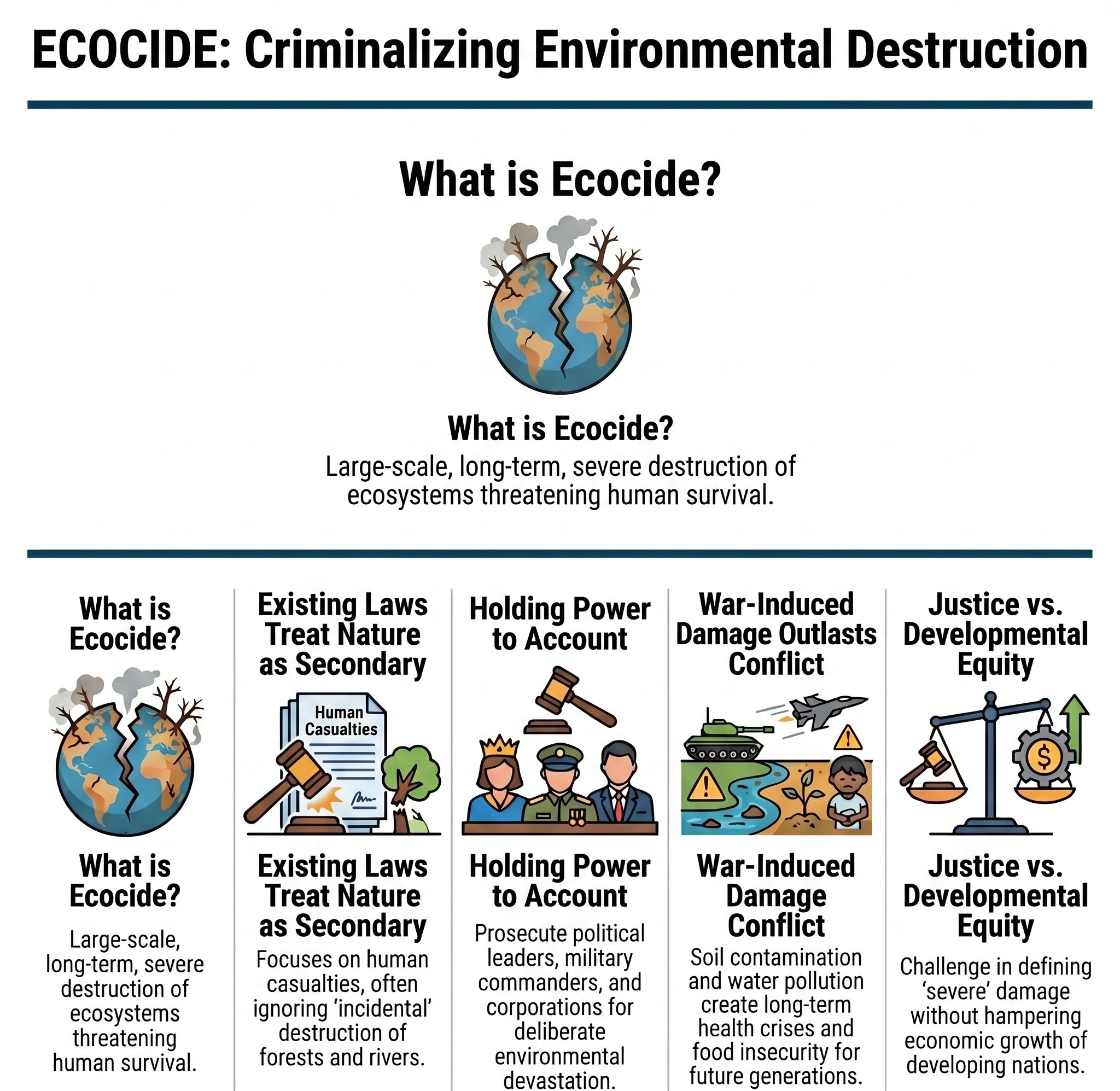
Ecocide refers to large-scale, long-term,
and severe destruction of ecosystems that threatens environmental stability and human survival.
The concept aims to:
Criminalise deliberate environmental devastation
Hold political leaders, military commanders, and corporations accountable
Recognise nature as a subject deserving legal protection
3. Key Arguments in the Article
Environmental destruction during war is inadequately addressed
Existing international humanitarian law mainly focuses on human casualties and property destruction
Environmental harm is treated as secondary or incidental
Current legal frameworks lack strong enforcement mechanisms
Need for ecocide as an international crime
Advocates argue that environmental destruction has long-term consequences beyond immediate war zones
Damage to forests, rivers, agricultural systems, and biodiversity affects future generations
Ecological destruction can worsen food insecurity, displacement, and climate vulnerability
Limitations of current international law
Rome Statute of the International Criminal Court (ICC) partially addresses environmental harm during warfare
However, thresholds for proving liability are extremely high
Most peacetime ecological destruction remains outside international criminal jurisdiction
Growing global momentum
Small island nations, environmental groups, and legal scholars increasingly support recognition of ecocide
Climate change and biodiversity loss have strengthened demands for stronger international environmental accountability
4. Author’s Stance
Supportive of stronger environmental accountability
The article broadly supports the idea that environmental destruction deserves greater legal recognition and accountability.
However, the tone remains analytical rather than activist:
It acknowledges legal complexities
It discusses institutional limitations
It avoids presenting ecocide recognition as an immediate or easy solution
5. Underlying Biases
Normative environmental bias
Assumes environmental protection should hold equal importance with traditional security concerns
Gives greater moral legitimacy to ecological justice frameworks
International law reform perspective
Implicitly favours expansion of international legal institutions and ICC jurisdiction
Less attention given to sovereignty concerns of powerful states
Anthropocentric vs ecocentric debate
The article subtly shifts toward an ecocentric worldview:
Nature viewed as possessing intrinsic value
Environment treated as more than a resource for human use
6. Pros of Recognising Ecocide
Strengthening global environmental governance
Creates legal deterrence against mass ecological destruction
Encourages sustainable military and industrial practices
Promotes accountability
Political leaders and corporations could face prosecution for severe ecological harm
Reduces impunity in conflict zones
Supports climate justice
Recognises environmental destruction as a human rights issue
Protects vulnerable communities disproportionately affected by ecological collapse
Long-term ecological protection
Encourages preservation of biodiversity and ecosystem stability
Aligns international law with contemporary climate realities
7. Cons and Challenges
Difficulty in legal definition
What constitutes “severe” or “widespread” environmental damage remains contested
Ambiguous definitions may lead to politicisation
Enforcement limitations
International law depends heavily on state cooperation
Powerful countries may refuse ICC jurisdiction
Risk of selective application
Smaller or weaker nations may face prosecution more often than major powers
Geopolitical bias in enforcement is a serious concern
Conflict with developmental priorities
Developing nations may fear restrictions on industrialisation and resource extraction
Balancing development and ecological liability remains difficult
8. Policy Implications
Expansion of international criminal law
Potential amendment of the Rome Statute to include ecocide
Greater role for international courts in environmental governance
Military doctrine reforms
Countries may need stricter environmental safeguards during warfare
Increased emphasis on ecological impact assessments
Corporate accountability frameworks
Stronger global ESG and environmental compliance standards
Greater scrutiny of extractive industries and multinational corporations
Climate diplomacy implications
Ecocide debate may influence future climate negotiations and treaties
9. Real-World Impact
War zones and ecological devastation
Environmental destruction during wars leads to:
Soil contamination
Water pollution
Food insecurity
Long-term public health crises
Impact on vulnerable populations
Indigenous and rural communities suffer disproportionately
Environmental collapse intensifies migration and humanitarian crises
Global climate consequences
Ecosystem destruction contributes to climate instability and biodiversity loss
Weakens planetary resilience against future ecological shocks
10. UPSC GS Paper Linkages
GS Paper III (Environment & Security)
Environmental governance
Climate change and biodiversity
Environmental consequences of warfare
GS Paper II (International Relations & Governance)
International institutions and ICC
Global environmental treaties
International humanitarian law
GS Paper I (Society)
Human displacement and ecological crises
Vulnerability of indigenous communities
Essay & Ethics Relevance
Important themes:
“Development vs sustainability”
“Intergenerational justice”
“Humanity’s responsibility toward nature”
11. Critical Examination from UPSC Perspective
Major conceptual debate
The ecocide debate reflects a transition:
From state-centric security
To human-centric security
And now toward planet-centric security
This marks an important evolution in global governance thinking.
Need for balance
While ecological accountability is essential, excessive criminalisation without clear standards may:
Create legal uncertainty
Politicise international law
Hamper developmental aspirations of poorer nations
12. Balanced Conclusion
Ecocide represents the evolving moral conscience of international law.
As environmental destruction increasingly threatens global stability, the demand for stronger ecological accountability is likely to grow.
However, recognition alone will not solve the problem. The effectiveness of ecocide laws will depend on:
Clear legal definitions
Fair and unbiased enforcement
Strong international cooperation
Balance between ecological protection and developmental equity
13. Future Perspective
Likely future trends
Greater integration of environmental concerns into international security frameworks
Expansion of climate justice jurisprudence
Stronger global pressure for corporate environmental accountability
Increasing recognition of ecological harm as a human rights issue
Ultimately, the ecocide debate reflects a deeper civilisational shift — from viewing nature merely as an economic resource to recognising it as a foundational condition for human survival and global peace.
