

Edible Oil Import Duty Reduction: Balancing Inflation and Farmer Interests

Edible Oil Import Duty Reduction: Balancing Inflation and Farmer Interests
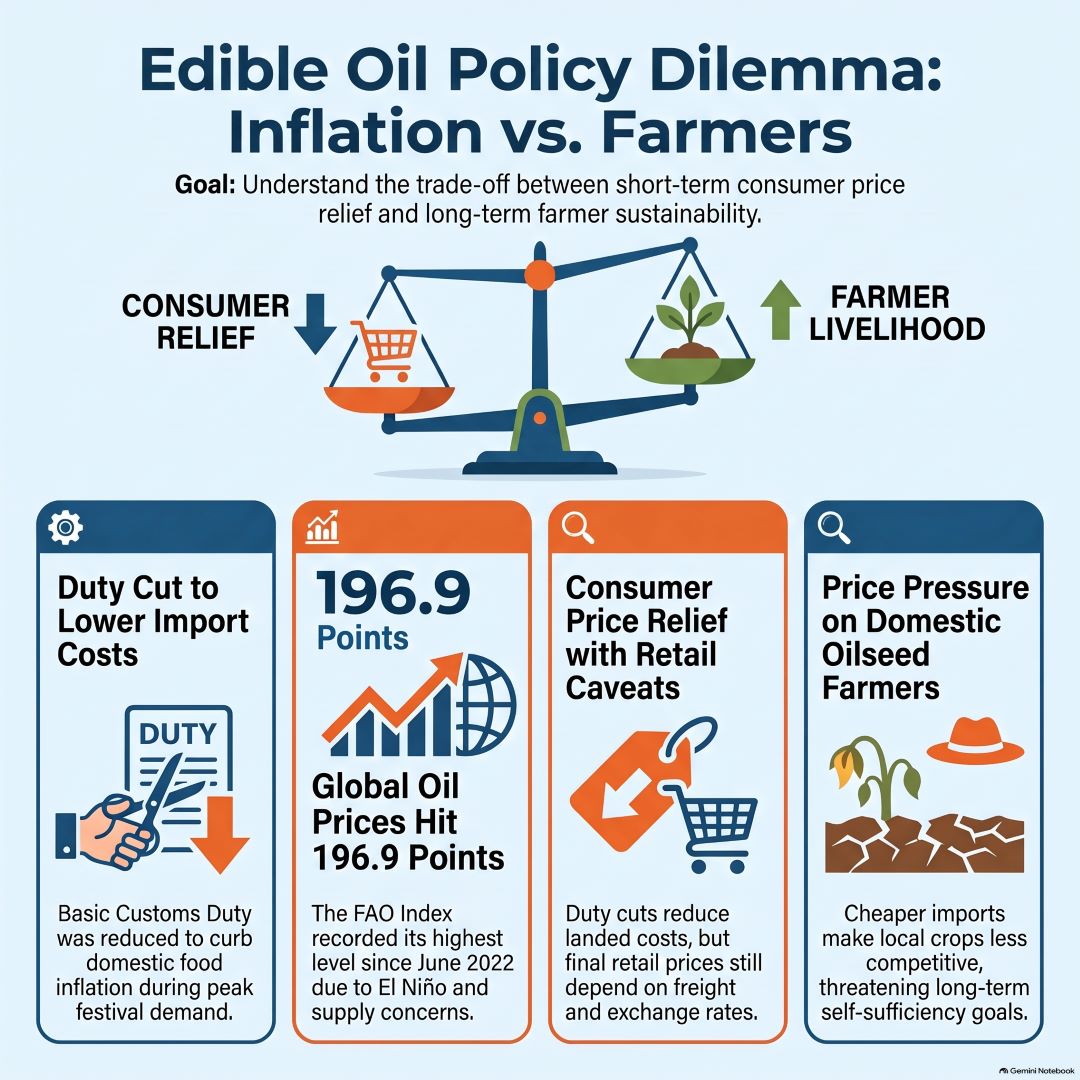
1. Why Did the Government Reduce BCD?
- The Union Government reduced Basic Customs Duty (BCD) on major imported edible oils from 24 September 2026.
- Main objectives:
- Reduce the landed cost of imported edible oils.
- Moderate domestic food inflation.
- Ensure adequate supply during the festival season, when demand rises.
- The FAO Food Price Index recorded a vegetable oil price index of 196.9 points in August 2026, the highest since June 2022.
- Rising global palm and soybean oil prices contributed to the increase.
- International palm oil prices have also been affected by strong import demand and concerns over El Niño-related weather conditions in Southeast Asia.
2. Impact on Consumers and Domestic Market
- Lower BCD can reduce the tax component of imported oil and therefore its landed price.
- Greater import availability of soybean and sunflower oil can provide alternatives to relatively expensive palm oil.
- This may help moderate edible-oil prices during periods of high festival demand.
- However, lower import duty does not automatically mean an equivalent fall in retail prices. Transmission depends on:
- International prices
- Exchange rates
- Freight and transportation costs
- Domestic margins
- Efficiency of the supply chain
- The government has retained a 19.25% duty differential between crude and refined edible oils, maintaining an incentive for domestic refining.
3. Concerns of Domestic Oilseed Farmers
- Cheaper imports can make domestically produced oilseeds relatively less competitive.
- Farmers producing soybean, sunflower, groundnut and oil palm may face greater price pressure.
- Increased import dependence could weaken incentives for domestic oilseed cultivation if domestic prices remain depressed.
- This creates a policy dilemma between short-term consumer relief and long-term farmer income and production incentives.
- Farmer organisations have therefore raised concerns that frequent duty reductions could conflict with India's objective of greater edible-oil self-sufficiency.
4. India's Edible-Oil Challenge
- India is a major consumer of edible oils but remains significantly dependent on imports, making domestic prices vulnerable to global commodity prices, exchange rates and geopolitical or climatic disruptions.
- The government has been promoting domestic production through initiatives such as the National Mission on Edible Oils – Oil Palm (NMEO-OP).
- Long-term self-sufficiency requires higher productivity, better oilseed varieties, irrigation, extension services, processing infrastructure and stable market incentives.
- Therefore, import-duty policy needs to be aligned with agricultural policies rather than operating as a stand-alone inflation-management measure.
5. Policy Trade-off and Way Forward
The edible-oil duty reduction highlights the classic conflict between consumer welfare and producer incentives. In the short term, lower duties can help contain food inflation and ensure adequate supplies. However, prolonged dependence on cheaper imports can weaken domestic oilseed production and India's self-sufficiency objectives. A balanced approach would combine temporary and calibrated tariff intervention during global price shocks with long-term support for domestic oilseed productivity, processing and farmer incomes. Better storage, efficient supply chains, diversification of oilseed production and predictable trade policy can help India achieve both affordable edible oil for consumers and sustainable incomes for farmers.
