

Elephant Corridors: Lifelines for a Mobile Species

Elephant Corridors: Lifelines for a Mobile Species
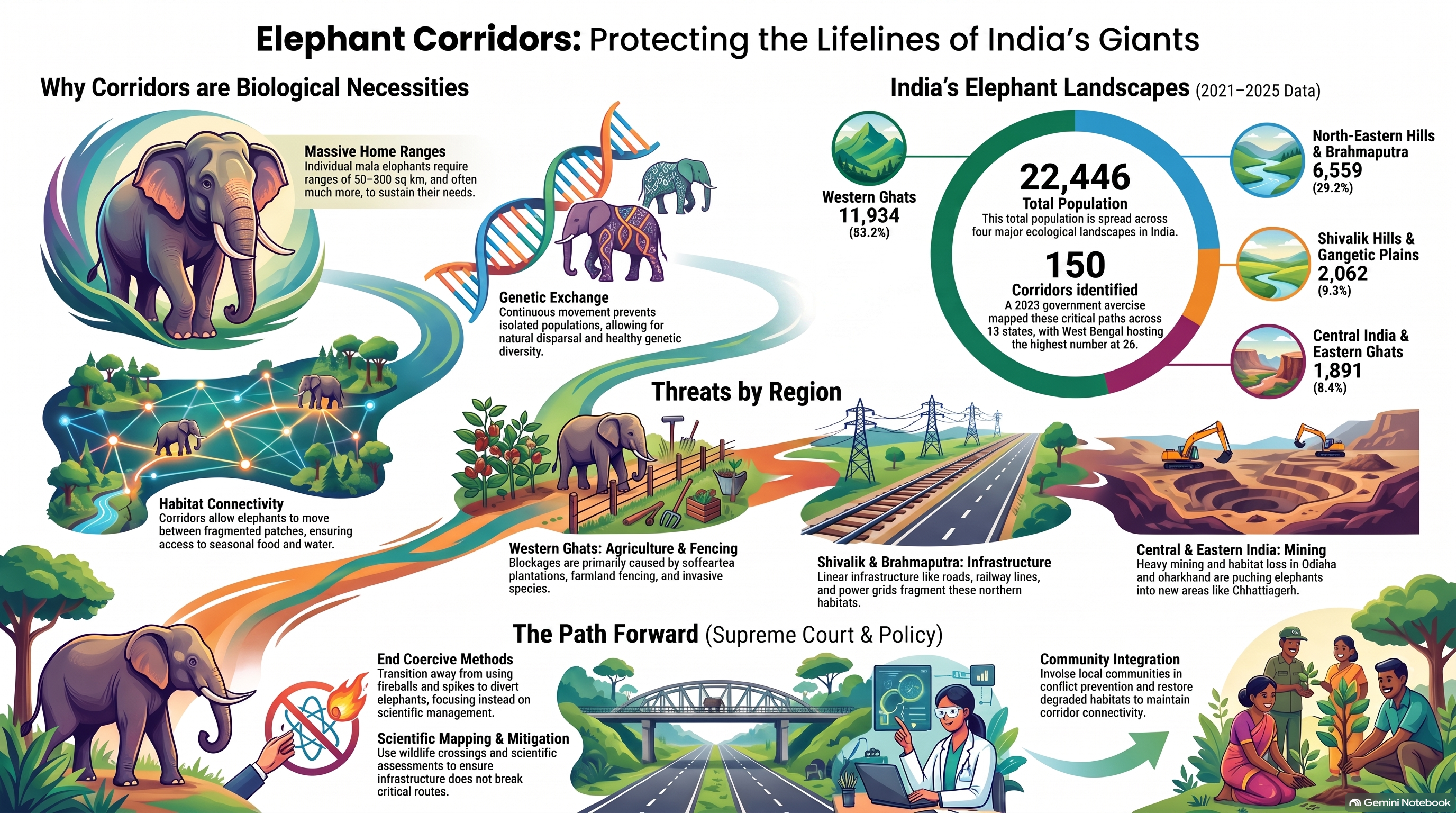
The Supreme Court has directed the Centre to conduct a fresh survey of elephant corridors and sought action against coercive methods such as fireballs and spikes used to divert elephants. The Court stressed that elephants naturally travel long distances and their movement routes cannot simply be blocked due to crop damage concerns.
Why Do Elephants Need Corridors?
Asian elephants are highly mobile and move according to seasonal availability of food and water. Male elephants may have home ranges of around 50–300 sq km, sometimes extending further.
Corridors help elephants:
- Move between fragmented habitats.
- Access seasonal food and water.
- Disperse naturally and maintain genetic exchange.
- Reduce pressure to enter farms and settlements.
India’s Elephant Landscapes
India has around 22,446 elephants (SAIEE 2021–25) across four major landscapes:
|
Landscape |
Elephant Population |
|
Western Ghats |
11,934 (53.2%) |
|
North-Eastern Hills & Brahmaputra |
6,559 (29.2%) |
|
Shivalik Hills & Gangetic Plains |
2,062 (9.2%) |
|
Central India & Eastern Ghats |
1,891 (8.4%) |
Major Threats to Corridors
- Western Ghats: Coffee and tea plantations, farmland fencing, invasive species and changing land use.
- Shivalik & Brahmaputra regions: Roads, railway lines, power infrastructure and land-use changes.
 Central & Eastern India: Mining, habitat loss and infrastructure have pushed elephant movements into new areas including Chhattisgarh, Madhya Pradesh and Maharashtra.
Corridor Mapping
· The 2023 government exercise identified 150 elephant corridors across 15 States.
· In South India, bottlenecks have been linked to highways, railways, hydel projects, power lines, electric fences, quarries, plantations and tourism infrastructure.
· West Bengal has the highest number of identified corridors, with 26 corridors.
Why Corridor Protection Matters?
Blocking traditional routes can increase human-elephant conflict by forcing elephants towards farms and settlements. Maintaining habitat connectivity is therefore both a conservation measure and a conflict-mitigation strategy.
The Charmar–Jingol corridor, largely in Chhattisgarh, is about 20 km long and 2.5 km wide and facilitates the movement of an estimated 80–100 elephants from Odisha into interior Chhattisgarh.
Way Forward
- Freshly map and scientifically assess elephant corridors.
- Prevent infrastructure and mining projects from fragmenting critical routes.
- Use wildlife crossings and other mitigation measures where infrastructure is unavoidable.
- Replace coercive methods with scientific conflict-management techniques.
- Restore degraded habitats and maintain corridor connectivity.
- Integrate local communities into conflict-prevention measures.
Conclusion
Elephant corridors are essential for seasonal movement, genetic connectivity and reducing human-elephant conflict. The Supreme Court’s intervention reinforces that conservation must protect natural elephant movement rather than simply diverting animals away from human settlements.
