

Emerging Science, Technology and Innovation Conclave (ESTIC) 2026

Emerging Science, Technology and Innovation Conclave (ESTIC) 2026
GS Paper: GS-III (Science and Technology, Indigenisation, Nuclear Energy, Economy) |
Source: The Hindu | The Indian Express
Why in News?
Prime Minister Narendra Modi inaugurated ESTIC 2026 at Bharat Mandapam, New Delhi. He stressed measurable research outcomes, indigenous technology and the role of science in development. Scientists, Nobel laureates, industry leaders and startups attended.
Key Themes
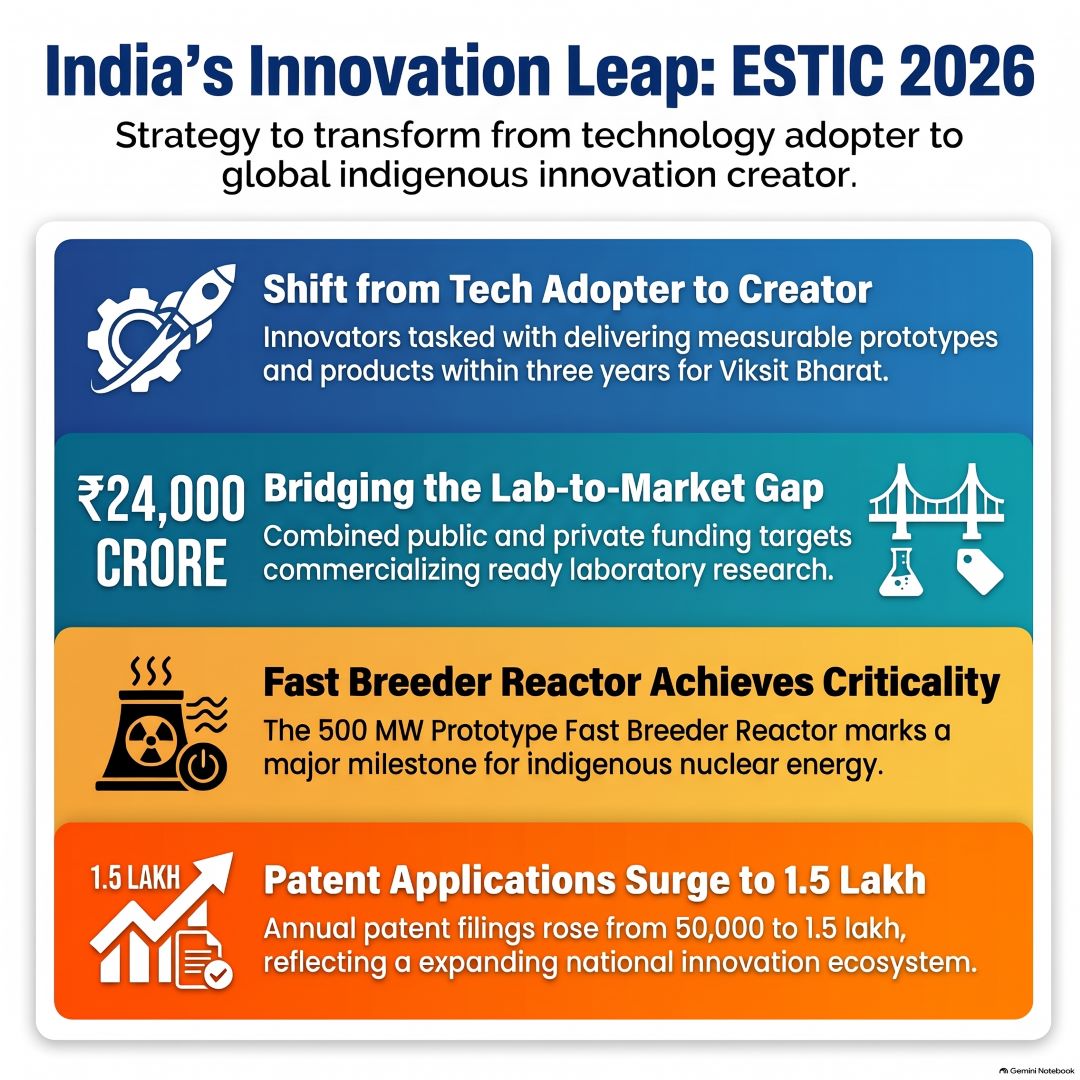
• Targets, not just talk: researchers and entrepreneurs were encouraged to name technologies, prototypes, pilots or products they can deliver in the next three years for Viksit Bharat.
• Shift from adopter to creator: examples cited were Chandrayaan's landing near the lunar south pole, Mangalyaan and satellite docking (space); COVID-19 vaccines (health); Indian AI models and chips reaching global markets (semiconductors and AI); fast breeder reactor technology (nuclear); and batteries using Indian raw materials.
• Sustaining progress needs research investment, skilled people, industrial capacity and commercialisation.
Research Funding and the Lab-to-Market Gap
• The Anusandhan National Research Foundation (ANRF) is meant to strengthen research and innovation, and the conclave stressed speeding up its work.
• A commitment of Rs 1 lakh crore under the Research Development and Innovation (RDI) Fund was highlighted.
• About Rs 12,000 crore is committed to technologies ready to move from labs to market, matched by private-sector commitment, for a total of about Rs 24,000 crore. This targets the "valley of death" between research and products.
• Patent applications were said to have risen from about 50,000 to 1.5 lakh, a sign of a growing innovation ecosystem.
AI and Scientific Judgement; Nuclear Energy
• AI: it speeds up routine tasks and helps analyse complex problems, but raises concerns about scientific independence and reliability of AI-generated results. It should support, not constrain, independent thinking. Verification, questioning assumptions and accuracy standards must stay.
• Nuclear: the 500 MW Prototype Fast Breeder Reactor (PFBR) has reached first criticality, a major step for indigenous nuclear technology and long-term energy strategy.
Science for Society and Analysis
• Progress should be judged by practical benefit, with priorities in health, agriculture, education and employment, and disaster mitigation. This needs collaboration among institutions, startups, industry and government.
• Challenges: India's R&D spending is still low as a share of GDP (about 0.6-0.7%), private R&D share is small, and translating research into products is slow. Claims of figures such as patent growth should be checked against official data.
|
PFBR and India's Three-Stage Nuclear Programme • Three stages (Homi Bhabha): Stage 1 pressurised heavy water reactors (natural uranium, produce plutonium); Stage 2 fast breeder reactors (use plutonium-uranium fuel and breed more fissile material, using a U-238 blanket); Stage 3 reactors based on thorium-233 to U-233 (India has large thorium reserves). • PFBR: at Kalpakkam, Tamil Nadu, built by BHAVINI (Bharatiya Nabhikiya Vidyut Nigam Ltd) under the Department of Atomic Energy. It is a sodium-cooled fast reactor using mixed oxide (MOX) fuel. Criticality means a self-sustaining chain reaction, but it comes before grid power generation. • ANRF: statutory body created by the ANRF Act, 2023 (replacing SERB), to seed and fund research, with private and philanthropic contributions. Related: National Quantum Mission, India Semiconductor Mission, IndiaAI Mission, SpaDeX (docking demonstrated in 2025), Chandrayaan-3 (August 2023, first landing near the lunar south pole region). • ESTIC is an annual conclave by the Office of the Principal Scientific Adviser and the Ministry of Science and Technology. Verify the latest nuclear-sector reforms (such as private participation) before quoting them.
|