

Employment Guarantee Under VB-G RAM G

Employment Guarantee Under VB-G RAM G
Why in News?
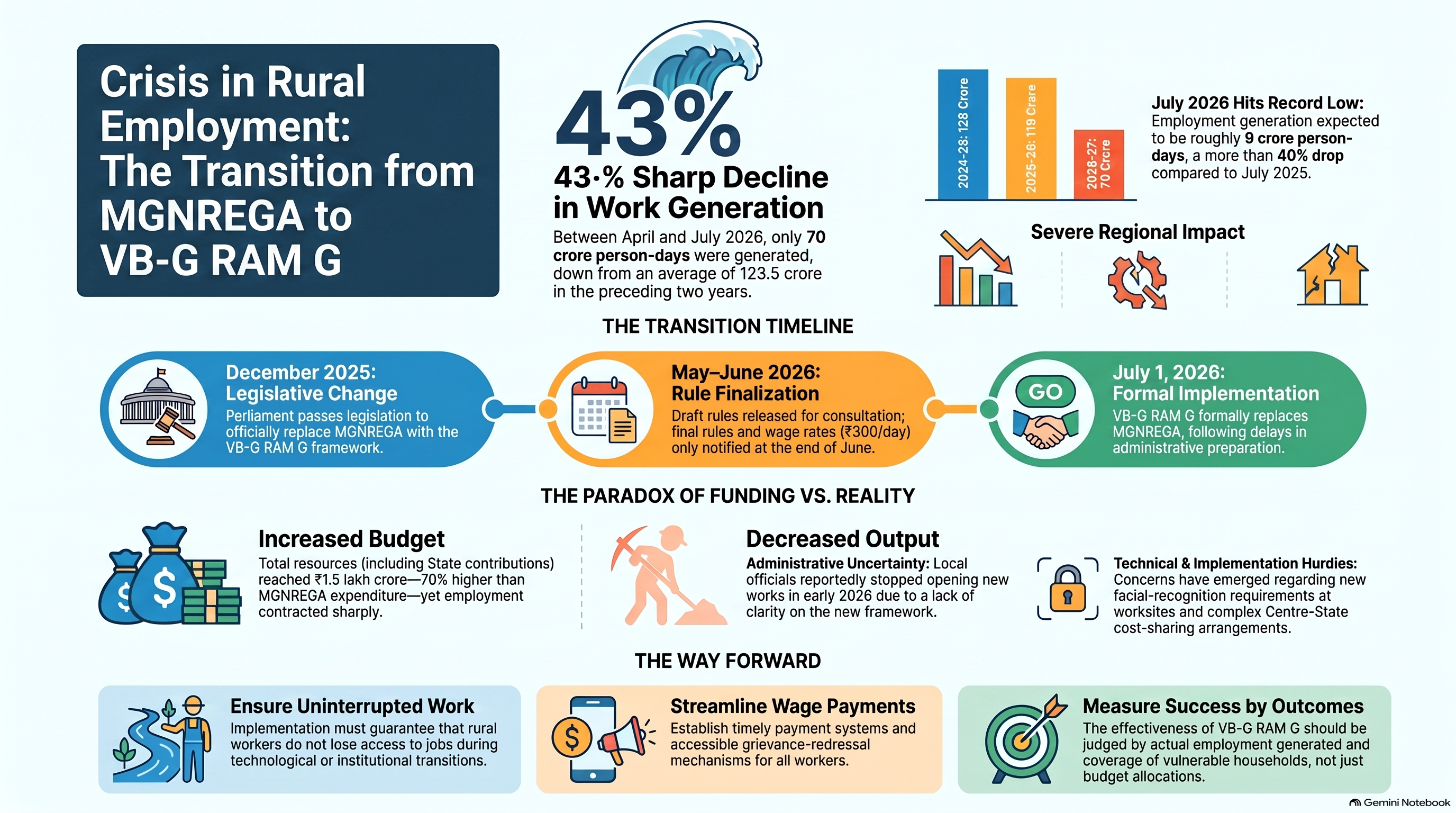
- Employment generation under the Viksit Bharat-Guarantee for Rozgar and Ajeevika Mission (Gramin) (VB-G RAM G) has witnessed a sharp decline during the transition from MGNREGA.
- During April–July 2026, MGNREGA and VB-G RAM G together generated around 70 crore person-days, about 43% lower than the average of the preceding two years for the same period.
- In July 2026 alone, employment generation is expected to be around 9 crore person-days, implying a decline of more than 40% compared with July 2025.
Transition from MGNREGA to VB-G RAM G
- Parliament passed legislation in December 2025 to replace MGNREGA with VB-G RAM G.
- The government initially announced that the transition would take place from 1 April 2026.
- However, the transition was delayed because the rules required for implementation had not been finalised.
- Draft VB-G RAM G Rules were released for public consultation on 22 May 2026.
- Final rules began to be released towards the end of June, allowing the formal replacement of MGNREGA from 1 July 2026.
- VB-G RAM G wage rates were notified on 30 June, with a minimum norm of ₹300 per day.
Employment Crisis
- April–July normally accounts for nearly half of annual MGNREGA employment because these months coincide with the agricultural slack season in many parts of rural India.
- Employment generation during April–July was:
- 2024-25: 128 crore person-days
- 2025-26: 119 crore person-days
- 2026-27: 70 crore person-days
- Employment declined across all major States, although the magnitude varied considerably.
- In 10 of 19 major States, the decline was between 60% and 85%.
- Madhya Pradesh, Uttar Pradesh and Jharkhand witnessed particularly severe declines, with employment generation approaching a virtual standstill in some areas.
Why is the Decline Significant?
- The decline is notable because VB-G RAM G was expected to increase employment generation.
- The Union Budget allocation for VB-G RAM G in 2026-27 is ₹95,692 crore, slightly higher than actual MGNREGA expenditure in 2025-26.
- Including State contributions, the total available resources were expected to reach around ₹1.5 lakh crore, about 70% higher than MGNREGA expenditure in 2025-26.
- With wage rates broadly maintained in real terms, the larger allocation was expected to generate more employment rather than a sharp contraction.
Reasons and Implementation Concerns
- The transition created administrative uncertainty during April–June 2026.
- In some districts, officials reportedly stopped opening new MGNREGA works in anticipation of the new framework.
- In several areas, workers had little or no access to employment during the transition period.
- The Ministry's explanation that the July decline was mainly due to some States suspending VB-G RAM G under Section 6 has been criticised as insufficient because those States account for only a small share of total employment.
- Concerns have also emerged regarding wage-payment systems, facial-recognition requirements at worksites and Centre-State cost-sharing arrangements.
Way Forward
- The transition needs clear administrative guidelines and uninterrupted availability of employment.
- Implementation should ensure that rural workers do not lose access to employment during institutional or technological changes.
- Timely wage payments and accessible grievance-redressal mechanisms are essential.
- States and local administrations need adequate capacity and clarity to implement the new employment guarantee framework.
- The effectiveness of VB-G RAM G should ultimately be assessed through actual employment generated, wage payments and coverage of vulnerable rural households rather than only through budgetary allocations.
