

Enrolment falls, 75 schools shut
Morning Standard
Key Arguments Presented in the Article
Declining Enrolment in Primary Schools
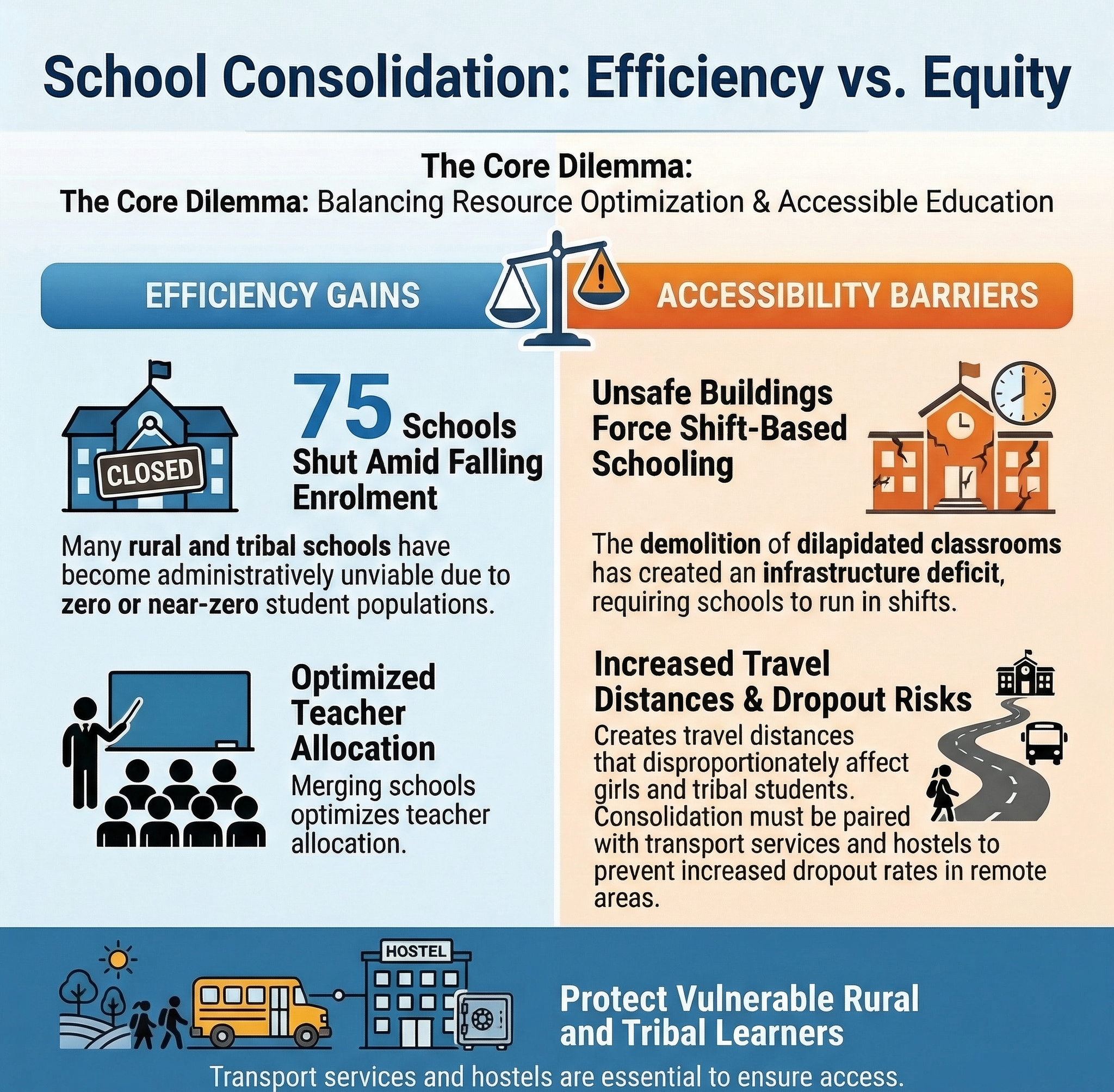
The central argument revolves around the sharp decline in enrolment at the primary level. Many rural and tribal schools have either zero enrolment or very small student populations, making them administratively unviable.
Several schools have therefore been shut or merged with nearby institutions.
Infrastructure Constraints
A significant number of schools are running in shifts because old classrooms were demolished due to safety concerns. The government cited demolition of dilapidated buildings and ongoing reconstruction as a key reason.
This reflects the infrastructure deficit in public schooling.
Rural and Tribal Vulnerability
The closures are concentrated in rural and tribal belts where population dispersal, migration, and socio-economic challenges affect enrolment levels.
Students in these regions face barriers such as distance to schools, linguistic challenges, and economic pressures.
Improvement at Upper Levels
The article highlights a contrasting trend: enrolment in higher secondary and higher education is rising. This suggests better retention or expansion of access beyond the primary stage in certain areas.
However, this trend may also reflect demographic shifts and urban concentration.
Teacher Numbers and Administrative Rationalisation
Teacher numbers have declined slightly alongside falling enrolment. This suggests an administrative rationalisation of resources.
The policy implication appears to be consolidation rather than expansion of small schools.
Author’s Stance
The article adopts a largely factual and data-driven tone but subtly highlights the social implications of school closures. The presentation suggests concern about access to education in vulnerable regions, particularly rural and tribal areas.
While it does not openly criticise the government, the narrative implicitly raises questions about educational equity and long-term policy planning.
Possible Biases
Institutional Perspective
The data and explanations rely heavily on government statements, which may frame closures as administrative rationalisation rather than policy failure.
Limited Community Voice
The article does not include perspectives from affected students, parents, or teachers.
Focus on Numbers Rather Than Outcomes
The analysis emphasises enrolment figures but does not explore learning outcomes or quality of education.
Positive Aspects of the Policy Response
Resource Optimisation
Closing schools with extremely low enrolment may allow better allocation of teachers, infrastructure, and funds.
Infrastructure Renewal
Demolition of unsafe buildings and reconstruction indicates attention to safety standards.
Strengthening Upper Education
Improvement in higher secondary and higher education enrolment suggests expansion of educational opportunities at advanced levels.
Concerns and Limitations
Access Barriers for Rural Students
Closing neighbourhood schools may increase travel distance, potentially discouraging attendance.
Impact on Tribal Areas
Tribal and remote regions depend heavily on local schools. Closure may exacerbate educational inequality.
Gender Implications
Longer travel distances can disproportionately affect girls’ education due to safety and social norms.
Early Education Disruption
Weak primary schooling can undermine the entire educational pipeline, affecting literacy and foundational learning.
Policy Implications
Strengthening Foundational Education
Focus on early childhood and primary schooling through programmes aligned with the National Education Policy and foundational literacy missions.
Transport and Residential Facilities
School consolidation should be accompanied by transport services, hostels, or cluster schooling models.
Targeted Tribal Education Policies
Special measures such as mother-tongue education, local teacher recruitment, and residential schools may be required.
Digital and Hybrid Learning
Technology-enabled education could complement physical infrastructure in sparsely populated regions.
Teacher Deployment Reform
Better teacher allocation and training can address disparities across rural and urban areas.
Real-World Impact
If properly managed:
• Efficient use of educational resources
• Improved infrastructure quality
• Stronger higher education participation
If poorly managed:
• Increased dropout rates in rural areas
• Reduced accessibility of primary education
• Widening educational inequality
• Long-term learning deficits
UPSC GS Paper Alignment
GS Paper II
Issues relating to education policy, government interventions in social sectors, role of states in educational administration.
GS Paper I
Rural development, tribal issues, demographic changes affecting social institutions.
GS Paper III
Human capital development, inclusive growth, and social sector investments.
GS Paper IV
Ethical governance in ensuring equitable access to public services such as education.
Balanced Assessment
The closure of under-enrolled schools reflects a governance dilemma between efficiency and equity. Administrative consolidation may appear rational from a resource management perspective, but education—particularly primary education—requires accessibility and community presence.
Policies must therefore balance efficiency with inclusivity.
Future Perspective
India’s long-term development depends on strengthening foundational education. As demographic patterns shift and migration increases, education systems must adapt through flexible models such as cluster schools, transport facilities, and community learning centres.
For policymakers and UPSC aspirants, the key lesson lies in recognising that educational reform must simultaneously address infrastructure, accessibility, quality, and equity. Only a balanced approach can ensure that rationalisation of schools does not translate into exclusion of vulnerable learners.
