

Ethnopharmacology Beyond Times’ marks the beginning of a new chapter in global healthcare
The Statesman
I. Core Context
The article reports on an international conference on ethnopharmacology organised under the aegis of Patanjali Research Foundation and Patanjali University. It positions traditional medical systems—particularly Ayurveda—as foundational to the future of global healthcare, provided they are supported by scientific validation and evidence-based research.
The event is portrayed as:
- A convergence of traditional wisdom and modern science
- A step toward global acceptance of indigenous medical systems
- A platform for interdisciplinary dialogue
II. Key Arguments Presented
1. Traditional Knowledge as Scientific Resource
The article asserts that:
- Traditional systems such as Ayurveda, Siddha, Unani, and other global traditions contain valuable medical knowledge
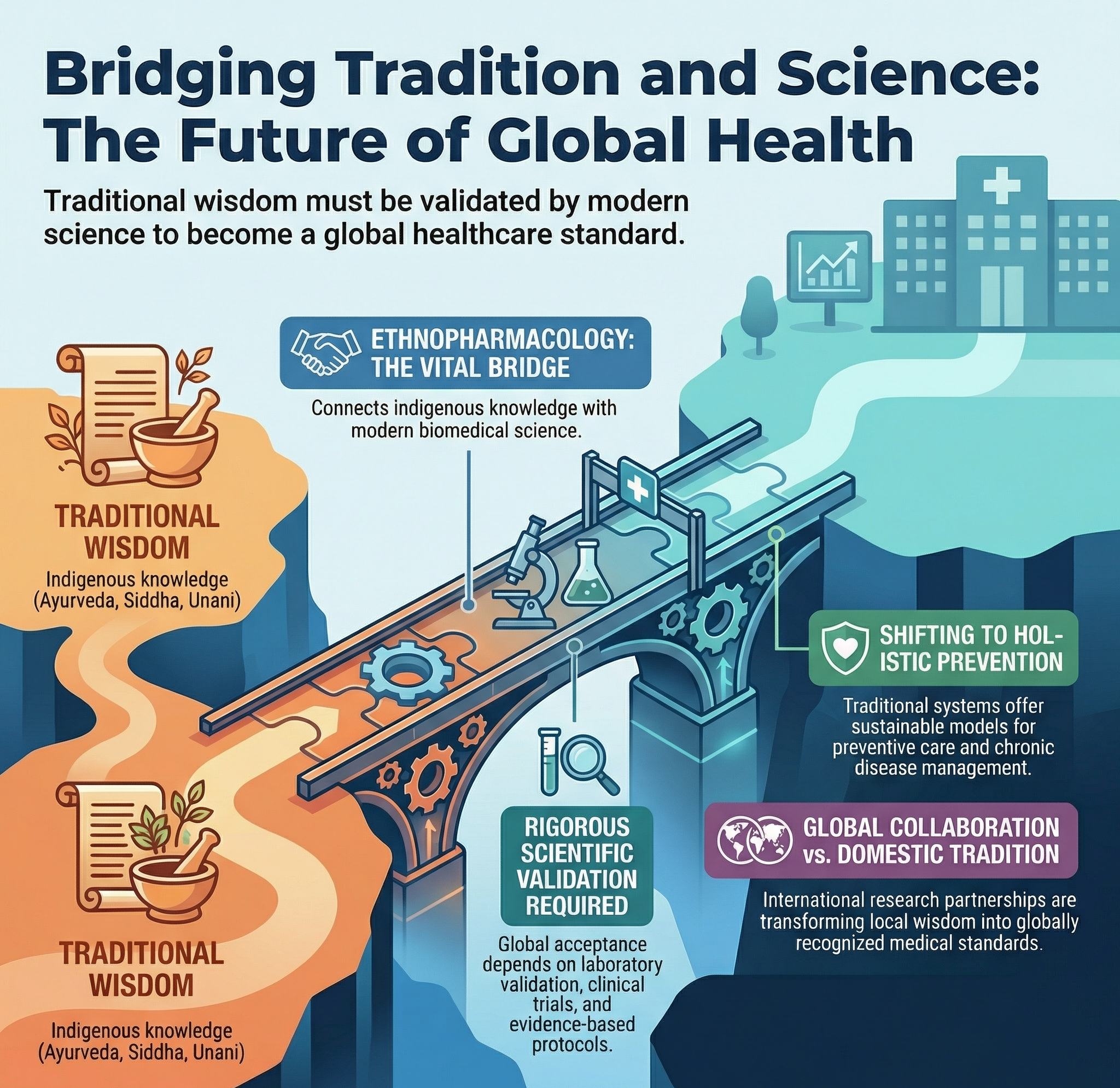
- Ethnopharmacology can bridge indigenous knowledge and modern biomedical science
- Preventive and holistic healthcare models may offer sustainable global solutions
The narrative highlights convergence rather than conflict between traditions and contemporary medicine.
2. Scientific Validation is Essential
Speakers emphasised:
- Need for laboratory validation
- Clinical trials
- Evidence-based protocols
The article suggests that credibility and global acceptance depend on rigorous scientific evaluation.
3. Global Collaboration
Participation from international scholars indicates:
- Growing worldwide interest
- Potential cross-border research collaboration
- Recognition of integrative medicine
The event is framed as globally relevant, not merely domestic.
4. Institutional Commitment
Patanjali Research Foundation is presented as:
- Investing in validation efforts
- Establishing global research centres
- Integrating ancient knowledge with contemporary methodologies
The article suggests institutional seriousness.
III. Author’s Stance
The tone is affirmative and promotional.
The article clearly supports:
- Integration of traditional medicine into mainstream healthcare
- Expansion of evidence-based Ayurveda
- Institutional recognition
There is minimal scepticism; the framing is largely celebratory.
IV. Possible Biases and Limitations
1. Promotional Undertone
The article heavily features:
- Organising institutions
- Leadership endorsements
- Institutional commitments
It reads partially like an institutional showcase rather than a critical evaluation.
2. Limited Critical Scrutiny
The article does not deeply address:
- Past controversies around validation standards
- Regulatory gaps in alternative medicine
- Safety concerns in herbal pharmacology
- Standardisation challenges
3. Evidence Claims Not Substantiated
While “scientific validation” is repeatedly mentioned, the article does not:
- Cite peer-reviewed studies
- Reference clinical outcomes
- Provide measurable benchmarks
The argument remains aspirational.
V. Pros and Cons of the Approach
Pros
• Promotes preventive healthcare
• Encourages integration of traditional and modern systems
• Expands research diversity
• Strengthens indigenous knowledge systems
• Supports medical pluralism
Cons
• Risk of inadequate clinical validation
• Regulatory oversight challenges
• Standardisation and dosage issues
• Potential public misinterpretation as substitute for modern medicine
VI. Policy Implications
1. Strengthening Evidence-Based AYUSH
India must:
- Expand high-quality clinical trials
- Develop pharmacological standardisation frameworks
- Ensure toxicology testing
Scientific rigour is non-negotiable.
2. Regulatory Harmonisation
Need for:
- Uniform quality control
- Transparent safety certification
- International regulatory recognition
3. Research Ecosystem Development
Encourage:
- Interdisciplinary research between biomedical and traditional experts
- Funding for translational research
- Global research partnerships
4. Public Health Integration
Traditional medicine can contribute to:
- Preventive care
- Chronic disease management
- Community-based health awareness
But integration must avoid therapeutic substitution without evidence.
VII. Real-World Impact
Short-term:
- Increased global interest in Ayurveda
- Expanded research collaborations
Medium-term:
- Development of validated herbal formulations
- Growth in integrative healthcare models
Long-term:
- Potential expansion of India’s soft power
- Contribution to affordable global healthcare
Failure to ensure scientific rigour may:
- Damage credibility
- Create public health risks
- Invite international regulatory scrutiny
VIII. UPSC Relevance
GS Paper II
• Health policy and governance
• Promotion of traditional knowledge systems
• Soft power diplomacy
GS Paper III
• Biotechnology and pharmacology
• Research and development
• Intellectual property rights
GS Paper IV
• Ethical marketing of medical claims
• Evidence vs belief in public policy
Essay Themes
• Tradition and modernity in science
• Integrative healthcare models
• Indigenous knowledge and globalisation
IX. Balanced Conclusion and Future Perspective
The conference signals growing institutional ambition to position ethnopharmacology and traditional systems within mainstream global healthcare discourse.
The key test lies in:
- Rigorous scientific validation
- Transparent regulatory oversight
- Clear distinction between complementary and alternative claims
Traditional knowledge can enrich modern medicine—but only when subjected to empirical scrutiny and ethical standards.
A new chapter in global healthcare will not be written by rhetoric alone; it will be defined by reproducible evidence, patient safety, and international credibility.
