

Excavators at Sheshnag Lake: Environmental Concerns

Excavators at Sheshnag Lake: Environmental Concerns
Why in News?
The use of excavators for widening and levelling trekking routes near Sheshnag Lake in Jammu and Kashmir has triggered controversy over the potential environmental impact on the ecologically fragile Himalayan region.
Key Highlights
- Sheshnag Lake is situated at an elevation of approximately 3,950 metres in the Pahalgam-Amarnath cave trekking route.
- Excavators were reportedly being used to widen trekking paths and remove debris along the route.
- The activity raised concerns about damage to fragile mountain ecosystems and the ecological sensitivity of the region.
- The work is associated with improving accessibility and facilitating the movement of Amarnath pilgrims.
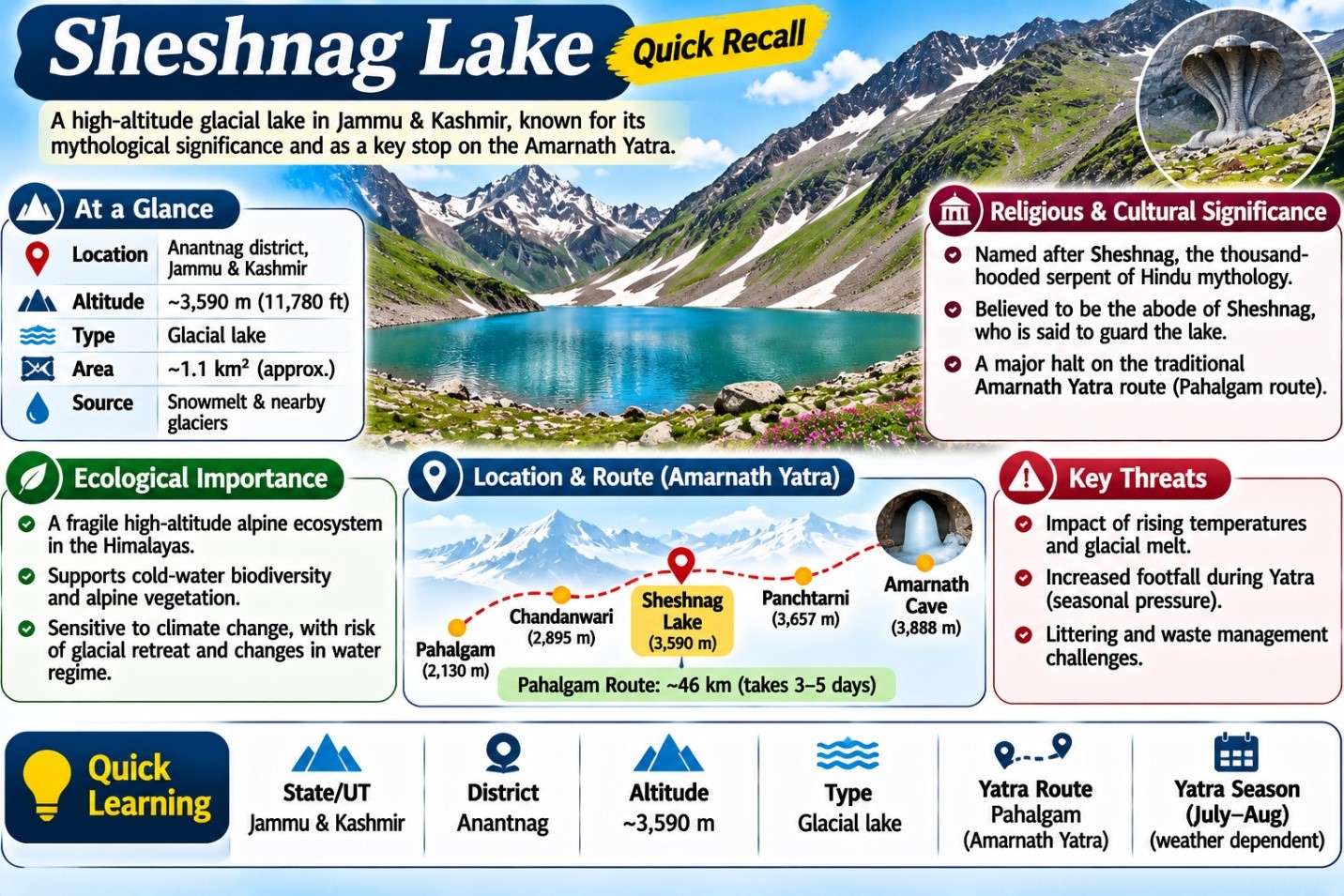
Geographical and Cultural Significance
· It is located near Pahalgam in Anantnag district, Jammu and Kashmir.
· It lies on the Pahalgam to Amarnath pilgrimage route.
· It is an oligotrophic alpine lake – a high-altitude lake that is naturally low in nutrients. The water of the lake is clean and clear due to its low algae production.
· It lies at an altitude about 3,590 metres above sea level.
· It is spread over an area of 1.1 kilometers in length and 0.1 kilometers in width.
· The lake is fed by glaciers and surrounded by steep slopes and loose moraine deposits, which are a mix of rocks, stones, gravel, sand and fine soil.
· Kunyirhayan, a group of three mountain peaks standing tall at 16,850 ft, 16,570 ft, and 16,310 ft surrounds Sheshnag Lake.
· It completely freezes over during the winter months.
· It drains into a tributary of the Lidder River.
· It is among the 14 high-risk glacial lakes identified across Jammu and Kashmir that are closely monitored for environmental vulnerabilities.
Environmental Concerns
- Ecological degradation: Excavation and widening of mountain tracks can disturb fragile Himalayan ecosystems.
- Soil erosion: Removal of vegetation and earthwork can increase soil instability and landslide risks.
- Biodiversity loss: Construction activities may disturb local wildlife and natural habitats.
- Glacial lake ecosystem: Unregulated activities may affect the surrounding high-altitude environment.
- Carrying capacity: Increased infrastructure and tourist movement may put additional pressure on the fragile mountain landscape.
Supreme Court's Intervention
- Following the deaths of pilgrims in 2012, the Supreme Court examined facilities and safety arrangements along the Amarnath Yatra route.
- It directed measures to improve the safety and accessibility of pilgrimage tracks.
- The court emphasised that development activities should not damage the ecological character of the region.
- It clarified that infrastructure development must be undertaken within environmental safeguards.