

Experts back warnings for high level of each nutrient — not just fats, sugar, or salt content

Context:
This push for comprehensive labeling marks a critical shift in India’s public health policy, moving from simple nutritional tables to aggressive Front-of-Pack Labeling (FoPL). As of September 2026, the debate has moved beyond the mere presence of labels to the stringency of their "trigger" mechanisms.
The Warning Label Controversy
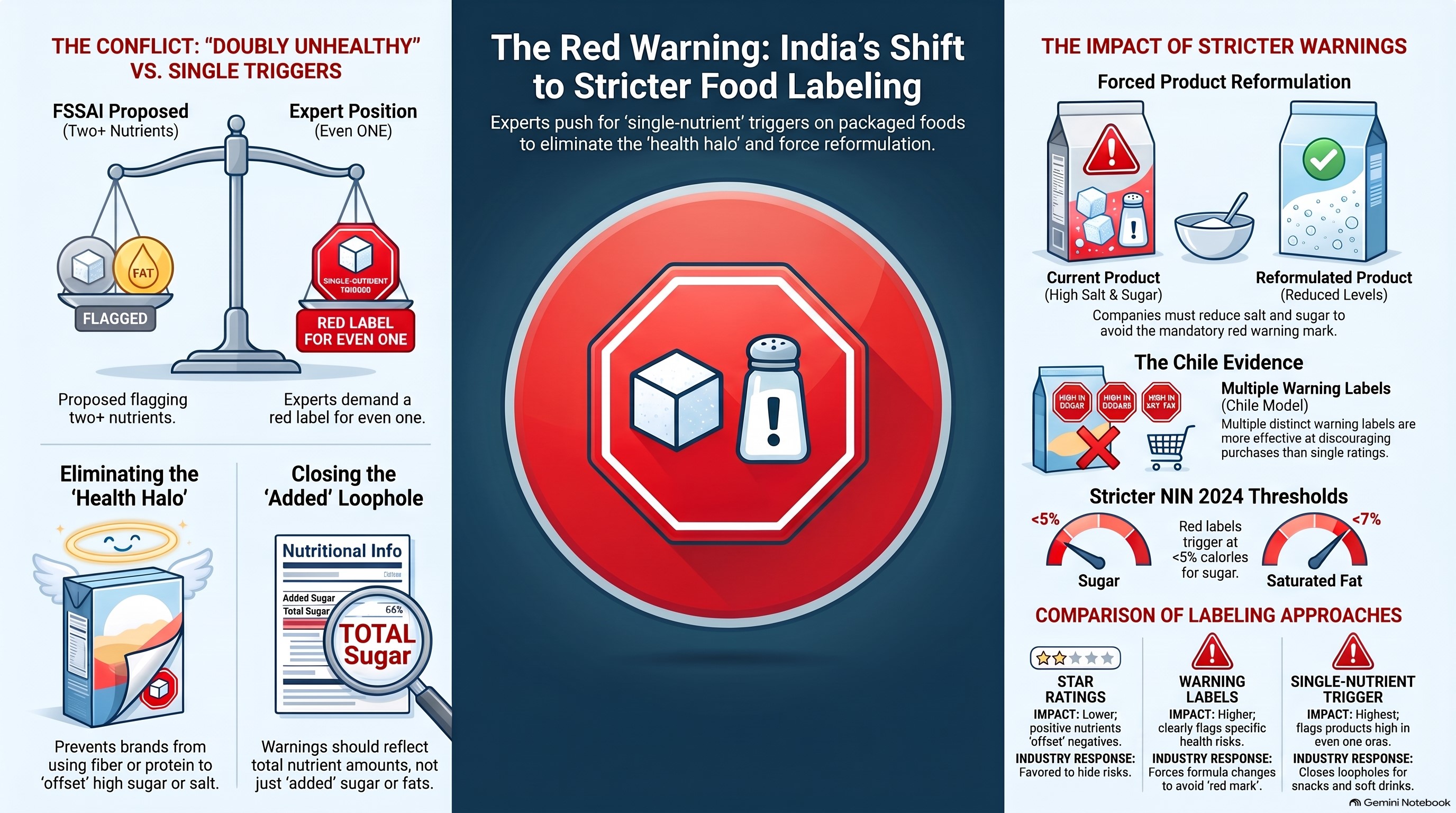
The Food Safety and Standards Authority of India (FSSAI) recently proposed a red hexagonal warning label for packaged foods. However, the core of the expert warning is that a product should carry a red label if it is high in even one nutrient of concern, rather than waiting for it to cross thresholds for two or more.
- The FSSAI Proposal (Initial): A two-phase rollout where Phase I only flags products high in two or more specified nutrients (added sugar, salt, or saturated fat).
- The Expert/NIN Position: Supported by the ICMR-National Institute of Nutrition (NIN) and global health experts, they argue that a single-nutrient trigger is essential. For instance, a soft drink high only in sugar, or a snack high only in salt, would escape a warning under a multi-nutrient rule.
- Judicial Intervention: In September 2026, the Supreme Court questioned why consumers should wait for a product to be "doubly unhealthy" before being warned, prompting FSSAI to consider a single-phase rollout for all high-nutrient products.
Key Fact
The thresholds for these warnings are based on the ICMR-NIN Dietary Guidelines for Indians (2024), which set stricter limits on added sugar (<5% of total calories) and saturated fat (<7%).
Why Experts Want "Each Nutrient" Warnings?
The primary goal is to eliminate the "health halo" that manufacturers use to market products as healthy despite high levels of specific harmful ingredients.
- Consumer Psychology: Evidence from countries like Chile shows that multiple distinct warning labels (e.g., "High in Salt" AND "High in Fat") are more effective at discouraging purchases than a single combined rating.
- Addressing Ultra-Processed Foods (UPF): Experts point out that UPFs often use high levels of one nutrient to compensate for the reduction of another. A single-nutrient warning closes this loophole.
- Total vs. Added Nutrients: A major point of expert backing is that warnings should be based on total amounts of sugar and fat (as per NIN guidelines) rather than just added amounts, preventing naturally high but processed products from escaping scrutiny.
Real Example
A packet of salted fried chips may be low in added sugar but extremely calorie-dense and high in total fat. A system focused only on "added" components might miss the overall health risk.
Impact on the Food Industry
The industry has historically favored "Rating Systems" (like Star Ratings) which allow positive nutrients (fiber, protein) to "offset" the negative ones. The move toward Warning Labels is significantly tougher because:
- Reformulation: It forces companies to reduce salt, sugar, and fat to avoid the "red mark" entirely.
- Advertising Restrictions: Products carrying these warnings are likely to face bans on marketing directed at children.
