

Fertiliser Security Challenge
Fertiliser Security Challenge
Source: The Statesman (23-06-2026)
1. Core Thesis
India's heavy dependence on imported fertilisers and fertiliser feedstocks exposes its agricultural sector to geopolitical disruptions. Strengthening fertiliser self-reliance and promoting balanced nutrient management are essential for ensuring long-term food security.
2. Background
• The Green Revolution increased India's dependence on chemical fertilisers to sustain high crop productivity.
• Despite expanding domestic production, India continues to rely heavily on imports to meet fertiliser demand.
• Geopolitical tensions and supply disruptions have highlighted the vulnerability of India's fertiliser sector.
3. Fertiliser Import Dependence
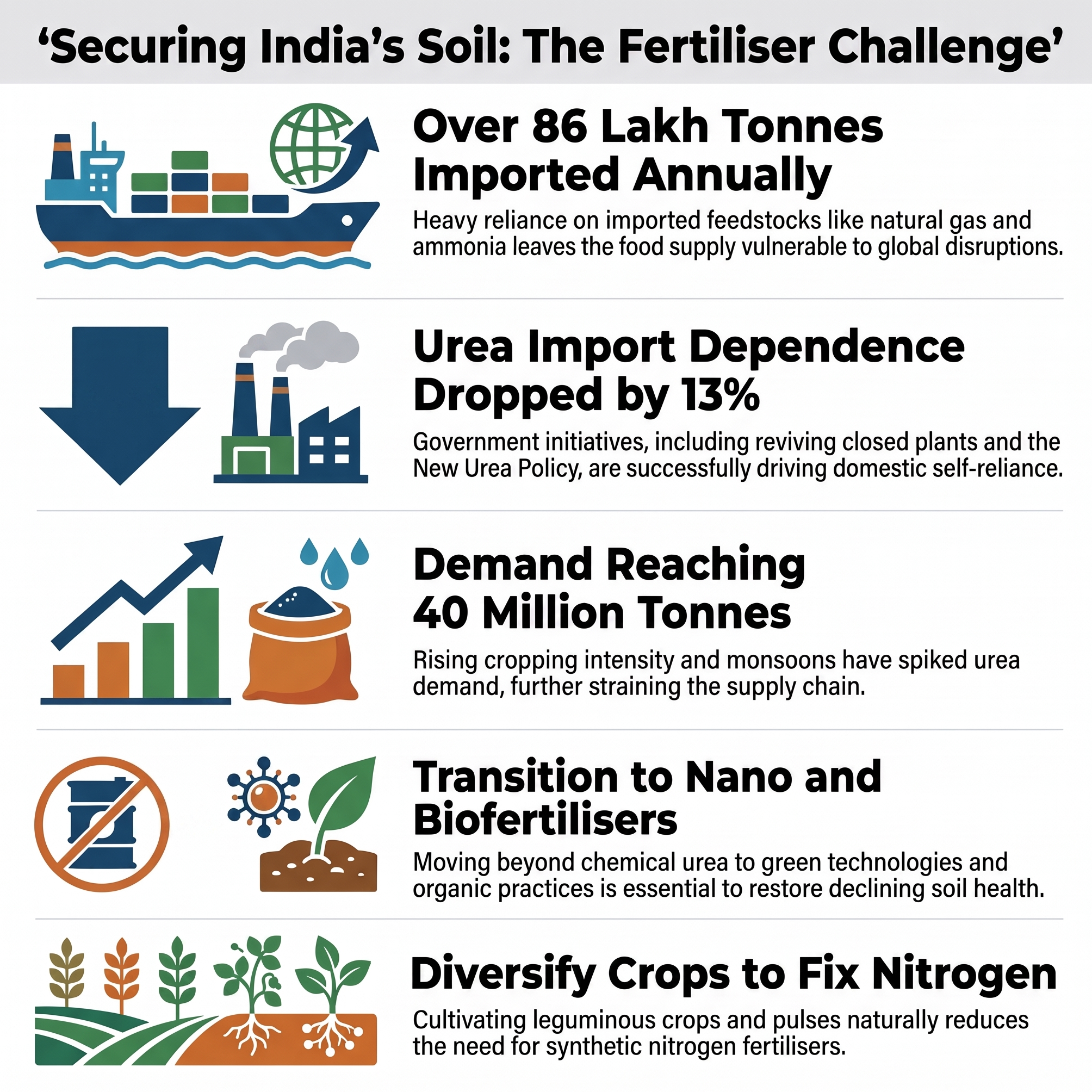
• More than 86 lakh tonnes of fertiliser requirements are met through imports and international agreements.
• India imports critical feedstocks such as natural gas, ammonia and sulphur required for domestic fertiliser production.
• Fertiliser subsidies are provided to maintain affordability for farmers and ensure food security.
4. Government Measures for Self-Reliance
• Revival of closed urea plants to increase domestic production.
• Introduction of the New Urea Policy.
• Implementation of the Nutrient-Based Subsidy (NBS) Scheme.
• Notification of the Natural Gas (Supply Regulations) Order to ensure feedstock availability.
• Promotion of green ammonia and other green technologies.
• As a result, urea import dependence declined by nearly 13% by 2024-25.
5. Emerging Challenges
Rising Demand
• Higher cropping intensity and favourable monsoons increased urea demand from 31 million tonnes to nearly 40 million tonnes in 2025-26.
Geopolitical Risks
• Dependence on imported fertilisers and raw materials exposes India to supply disruptions and price volatility.
Imbalanced Fertiliser Use
• Excessive dependence on urea has distorted the N:P ratio and adversely affected soil health.
Declining Soil Organic Matter
• Soil organic carbon in many parts of India remains below desirable levels, reducing nutrient-use efficiency and long-term productivity.
6. Significance
• Fertiliser availability is critical for sustaining foodgrain production.
• Fertiliser security is closely linked to national food security.
• Import dependence exposes agriculture to external shocks.
• Balanced nutrient management is essential for sustainable agriculture and environmental protection.
7. Way Forward
Strengthen Domestic Production
• Fully operationalise existing fertiliser plants.
• Secure long-term access to natural gas, ammonia and sulphur.
• Diversify sources of fertiliser imports and feedstocks.
Promote Sustainable Agriculture
• Encourage balanced nutrient use based on soil health.
• Expand the use of nano fertilisers and biofertilisers.
• Promote natural farming and organic farming practices.
• Strengthen Direct Benefit Transfer (DBT) in fertiliser subsidies.
Improve Soil Health
• Promote crop residue retention and discourage stubble burning.
• Encourage green manuring and integrated nutrient management.
• Increase the use of microbial inoculants such as Azotobacter, phosphate-solubilising bacteria and mycorrhizae.
Encourage Crop Diversification
• Expand cultivation of nitrogen-fixing leguminous crops and pulses to reduce dependence on synthetic nitrogen fertilisers.
8. Conclusion
Achieving food security requires not only adequate fertiliser availability but also sustainable nutrient management. Reducing import dependence and improving soil health are essential for building a resilient agricultural system.
9. Final Takeaway
Fertiliser security has emerged as an important dimension of national food security. India must simultaneously pursue self-reliance in fertiliser production and promote sustainable nutrient management to reduce vulnerability to global disruptions.

