

Food Security Act Amendment will hurt the poorest

Food Security Act Amendment will hurt the poorest
Context:
The proposed changes to the National Food Security Act (NFSA), 2013, via the Draft Amendment Bill, 2026, have triggered a sharp debate on whether "rationalising" food grains might end up penalising the country’s most vulnerable families.
The Core Shift: From Family to Individual
The amendment proposes a fundamental change in how the Antyodaya Anna Yojana (AAY)—the category for the "poorest of the poor"—receives its food grains.
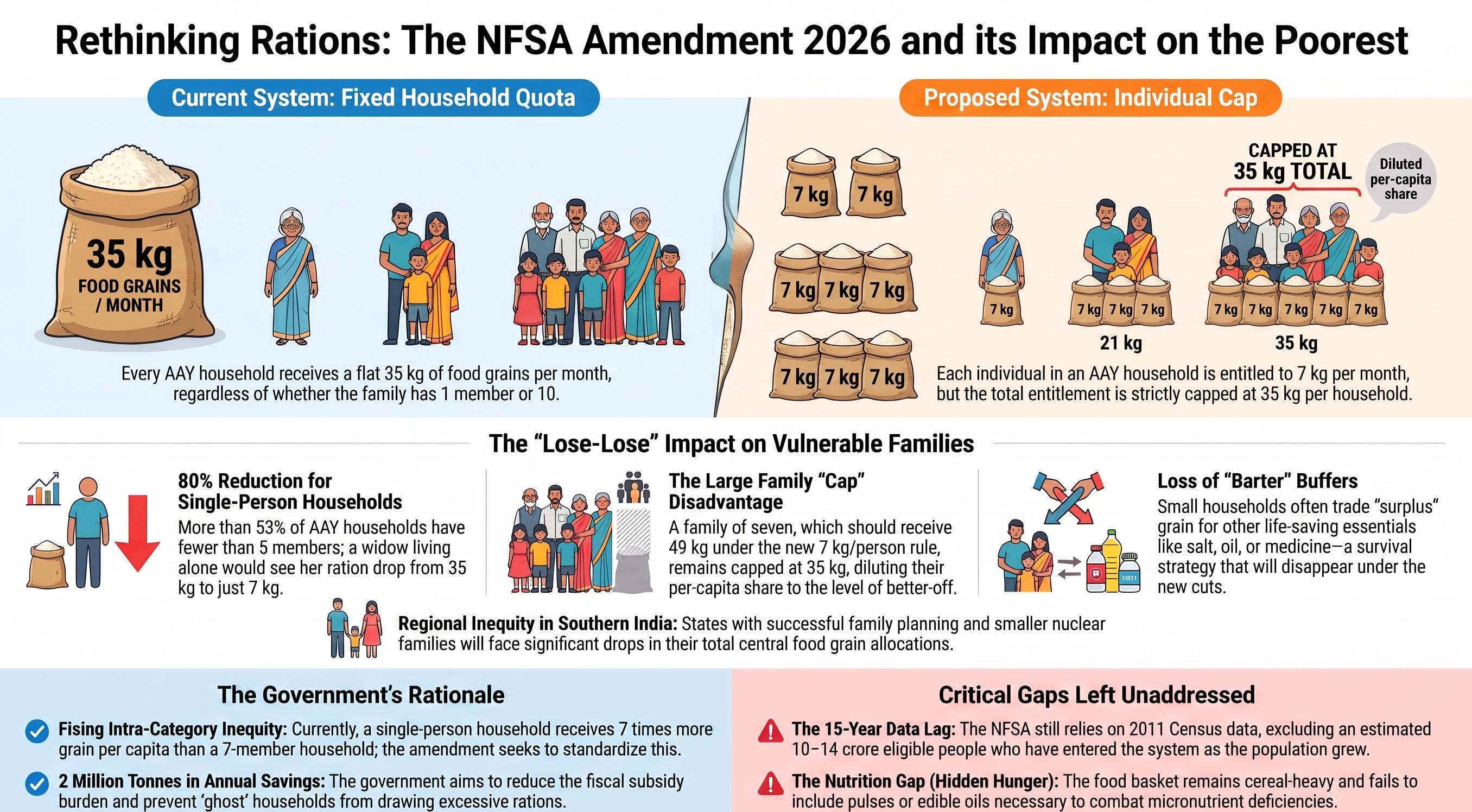
- Current System: Every AAY household receives a flat 35 kg of food grains per month, regardless of whether there is 1 person or 10 people in the family.
- Proposed System: Each individual in an AAY household gets 7 kg per month, but the total entitlement is capped at 35 kg per household.
Why it Might "Hurt the Poorest"?
Critics and food-rights experts argue that the amendment creates a "lose-lose" situation for a significant portion of the AAY category.
- Drastic Cuts for Small Households: More than 53% of AAY households have fewer than five members. For a widow living alone or an elderly couple, the ration would drop from 35 kg to 7 kg or 14 kg, respectively—a reduction of up to 80%.
- The "Cap" Disadvantage for Large Families: The 35 kg cap means that a family of seven, which should logically receive 49 kg under the new "7 kg per person" rule, will still only get 35 kg. This effectively lowers their per-capita share to 5 kg, the same as the "Priority Household" (PHH) category, who are relatively better off.
- Regional Inequity: States in Southern India that have successfully stabilised their population through family planning tend to have smaller nuclear families. These states would see a significant drop in their total central food grain allocation.
- Invisible Vulnerabilities: The poorest households often include the elderly, persons with disabilities, and single women living in small units. For them, the "surplus" grain from the current 35 kg quota is often bartered for other essentials like salt, oil, or medicine.

The Government's Perspective: The "Equity" Argument
The Ministry of Food and Public Distribution justifies the move by citing intra-category inequity. Currently, a single-person AAY household gets 7 times more grain per capita than a 7-member AAY household. The amendment aims to:
- Standardize the individual entitlement.
- Prevent "ghost" households from drawing excessive rations.
- Reduce the fiscal subsidy burden (estimated savings of ~2 million tonnes of grain annually).
Structural Issues Unaddressed
Even with the amendment, experts point out that two major "pain points" for the poorest remain:
- Outdated Coverage: The NFSA is still using 2011 Census data, excluding an estimated 10–14 crore people who have become eligible as the population grew over the last 15 years.
- Nutrition Gap: The basket remains cereal-heavy. The amendment does not introduce pulses or edible oils, which are essential for tackling "hidden hunger" (micronutrient deficiency).

