

Forty years since the disaster, Chernobyl is a story that keeps finding new retellings
The Hindu
1. Core Thesis of the Article
The article argues that the Chernobyl disaster is not merely a historical nuclear accident but an evolving narrative shaped by archival research, survivor testimonies, and cultural reinterpretations, revealing systemic failures of governance, technology, and ideology.
2. Detailed Breakdown of Key Arguments
(1) Chernobyl as a Continuing Historical Narrative
- Disaster (1986) continues to generate:
- New scholarship
- Literary accounts
- Survivor testimonies
Implication:
History is not static; reinterpretation deepens understanding.
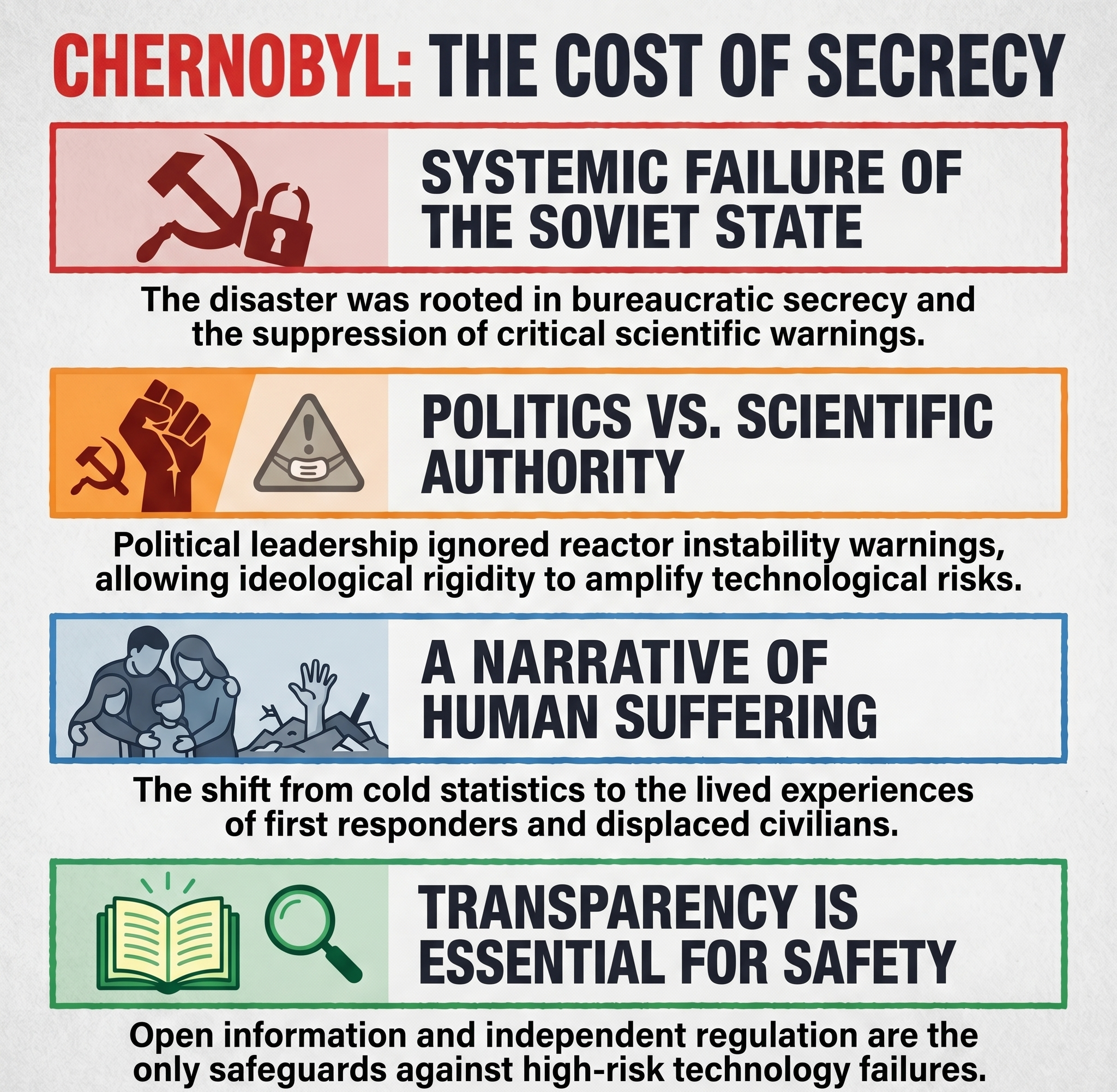
(2) Systemic Failure of the Soviet State
- Root causes identified:
- Bureaucratic secrecy
- Ideological rigidity
- Suppression of scientific warnings
- “Atomic prestige” over safety
Key Insight:
Disaster was institutional, not accidental
(3) Science vs Political Authority
- Scientists warned about:
- Reactor instability
- Political leadership:
- Ignored warnings
Outcome:
Technological failure amplified by political negligence
(4) Human Cost and Lived Experiences
- Firefighters and workers:
- Immediate exposure
- Death within weeks
- Civilians:
- Long-term health consequences
Narrative Shift:
From statistics → human suffering
(5) Delay and Denial in Crisis Response
- Delayed evacuation of Pripyat
- Lack of transparency
Impact:
Increased casualties and long-term damage
(6) Role of Archival Research
- Use of:
- Soviet archives
- KGB documents
Value:
Reveals:
- Hidden truths
- Institutional cover-ups
(7) Competing Interpretations
Three major intellectual approaches:
Historical reconstruction
- Focus on facts and sequence
Political critique
- Focus on state failure
Humanistic narrative
- Focus on lived experiences
(8) Limits of “Objective History”
- Conflicting accounts exist
- Complexity cannot be fully captured
Conclusion:
No single “complete” narrative
(9) Cultural Memory and Myth Formation
- Chernobyl represented through:
- Literature
- Media
- Tourism
Risk:
Mythologisation may:
- Distort reality
- Oversimplify causes
(10) Comparison with Other Disasters
- Reference to:
- Fukushima
Inference:
- Modern systems still vulnerable
- Lessons partially learned
(11) Environmental and Long-Term Impact
- Radiation:
- Affected ecosystems
- Created exclusion zones
Key Idea:
Disaster is intergenerational
(12) Knowledge, Power, and Accountability
- State monopoly over knowledge
- Lack of public accountability
Lesson:
Transparency is essential in high-risk technologies
3. Author’s Stance
- Critical and reflective
- Strong emphasis on:
- systemic failure
- importance of memory
- Appreciates:
- scholarly rigor
- survivor narratives
Tone:
- Analytical, historically grounded
4. Biases in the Article
(1) Anti-authoritarian Bias
- Strong critique of:
- Soviet governance
(2) Humanitarian Bias
- Emphasis on:
- suffering over technical analysis
(3) Western Academic Lens
- Heavy reliance on:
- post-Cold War archival interpretation
5. Pros and Cons of the Argument
Pros
Multidimensional analysis
- Combines:
- history
- politics
- human experience
Use of diverse sources
- Archives + testimonies
Relevance
- Lessons for modern governance
Cons
Limited technical depth
- Nuclear engineering aspects underexplored
Potential over-politicisation
- Focus on ideology may overshadow technical causes
6. Policy Implications
(1) Need for Transparency in Governance
- Open information systems
- Independent regulatory bodies
(2) Strengthening Disaster Preparedness
- Early warning systems
- Evacuation protocols
(3) Scientific Autonomy
- Protect scientists from:
- political pressure
(4) Nuclear Safety Regulations
- Global standards
- Regular audits
(5) Public Communication Systems
- Crisis communication:
- timely
- accurate
7. Real-World Impact
Short-Term
- Raised awareness about:
- nuclear risks
Medium-Term
- Reforms in:
- nuclear safety protocols
Long-Term
- Persistent:
- health issues
- ecological damage
- displacement
8. UPSC GS Linkages
GS Paper I
- Modern world history
- Industrial disasters
GS Paper II
- Governance
- Accountability
- Transparency
GS Paper III
- Disaster management
- Environmental issues
- Nuclear energy
GS Paper IV (Ethics)
- Responsibility of state
- Ethics in technology
Essay Topics
- “Science without ethics is dangerous”
- “Memory and history shape public policy”
9. Critical Analytical Insight
Chernobyl illustrates that technological disasters are rarely isolated events; they are the culmination of failures in governance, institutional culture, and ethical responsibility.
10. Balanced Conclusion
The article successfully demonstrates that:
- Chernobyl is:
- a historical event
- a political lesson
- a human tragedy
- Its reinterpretation:
- enriches understanding
- prevents complacency
11. Way Forward
- Institutionalise:
- transparency
- accountability
- Promote:
- interdisciplinary disaster studies
- Ensure:
- public participation in risk governance
Final Editorial Takeaway
Chernobyl is not just a past catastrophe; it is a continuing warning. Its evolving narratives remind us that the true danger lies not only in technology, but in the systems that govern it.
