

Fragile ecology, competing interests: The red flags in building Himalayan dams

Fragile ecology, competing interests: The red flags in building Himalayan dams
Context:
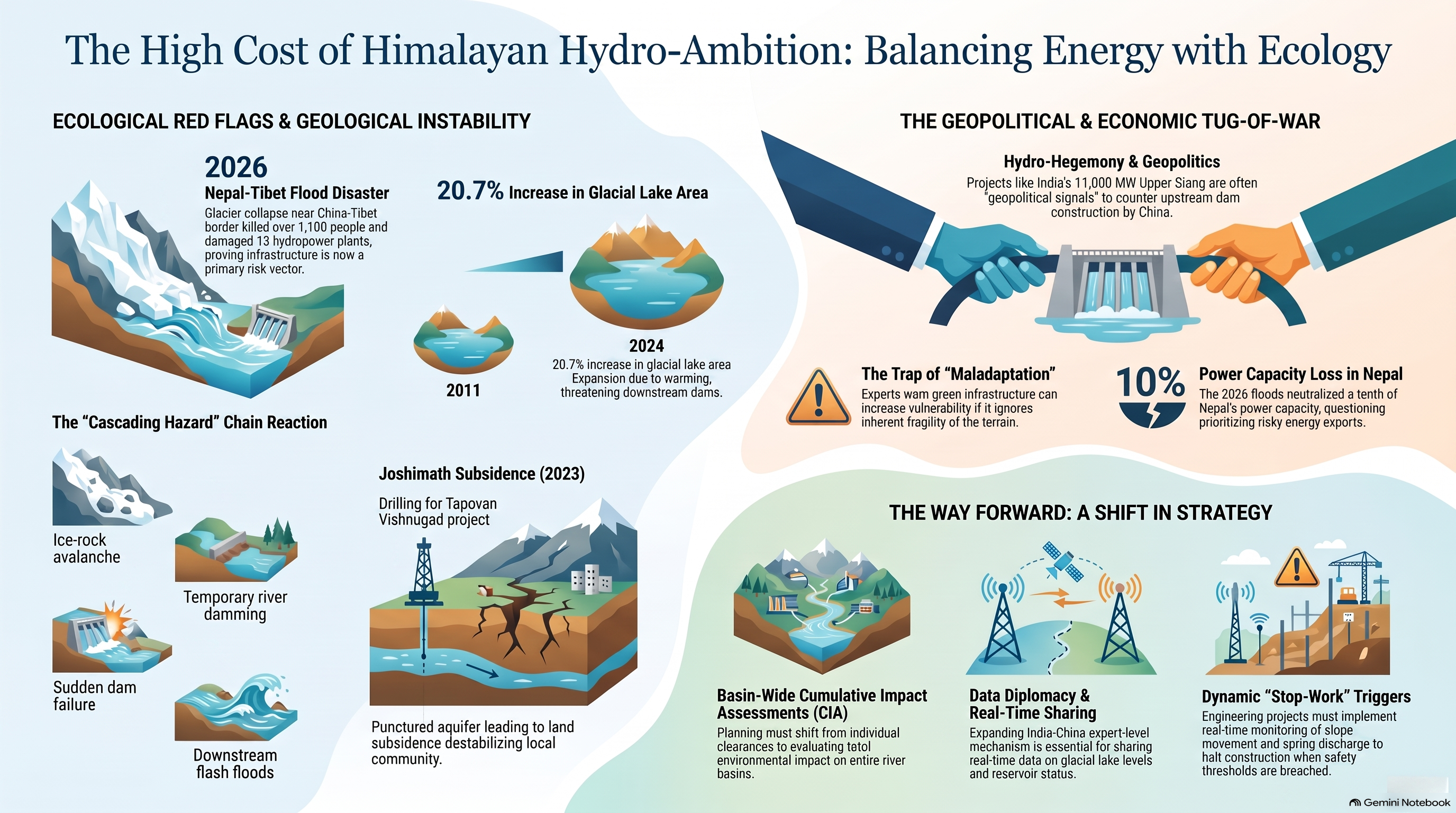
Building dams in the Himalayas is a high-stakes balancing act between India’s renewable energy goals and the inherent instability of the world's youngest mountain range. The recent August 2026 Nepal-Tibet floods, which affected 13 hydropower plants and killed over 1,100 people, have again highlighted that Himalayan risk now runs through infrastructure as much as geology.
The Ecological Red Flags
The Himalayas are geologically "restless," characterized by fragile lithology and high tectonic activity.
- Cascading Hazards: Disasters in this region are rarely isolated. A single trigger, like the glacier collapse near the China-Tibet border in August 2026, can initiate a chain reaction: ice-rock avalanches
 temporary river damming sudden dam failure downstream flash floods.
 - Glacial Lake Outburst Floods (GLOFs): Warming temperatures have led to a 20.7% increase in glacial lake area across India (2011–2024). These lakes, often held by unstable debris (moraines), pose a constant threat to downstream dams.

- Tunnelling & Subsidence: Extensive drilling for "run-of-river" projects disturbs subsurface aquifers. In Joshimath (2023), land subsidence was linked by locals and some experts to the puncturing of an aquifer during the construction of the Tapovan Vishnugad hydropower project.
Competing Interests: The Tug-of-War
The push for Himalayan dams is driven by a complex mix of energy, economics, and geopolitics.
- The "Green" Energy Mandate: Hydropower is central to India's Net-Zero targets. However, experts now warn of "Maladaptation"—where infrastructure intended to provide clean energy actually increases social and ecological vulnerability.
- Hydro-Hegemony & Geopolitics: Dam building is often a "geopolitical signal." For instance, India’s Upper Siang Multipurpose Project (11,000 MW) in Arunachal Pradesh is strategically positioned to counter China’s massive dam projects on the Yarlung Tsangpo (Brahmaputra) upstream.
- Economic Export vs. Local Risk: Countries like Nepal prioritize hydropower for export revenue, yet the 2026 floods knocked out 10% of Nepal's power capacity, sparking debates on whether domestic consumption should take precedence over risky export-oriented strategies.
The Way Forward: A Shift in Strategy
The "evidence written in rubble" from 2023 to 2026 suggests that engineering standards alone are insufficient.
- Basin-Wide Planning: Moving away from project-specific clearances to Cumulative Impact Assessments (CIA) for entire river basins.
- Early Warning & Data Diplomacy: Data sharing, not just engineering, is the binding constraint. There is an urgent need to widen the India-China expert-level mechanism to include real-time glacial lake and reservoir status.
- Dynamic Monitoring: Implementing "Stop-Work" triggers based on real-time slope movement and spring discharge monitoring during tunnelling.
Building in the Himalayas requires moving from a mindset of "conquering the mountains" to one of "informed coexistence," where ecological limits define the boundaries of engineering ambition
