

Free Trading With Europe Won’t Be Easy
Times Of India
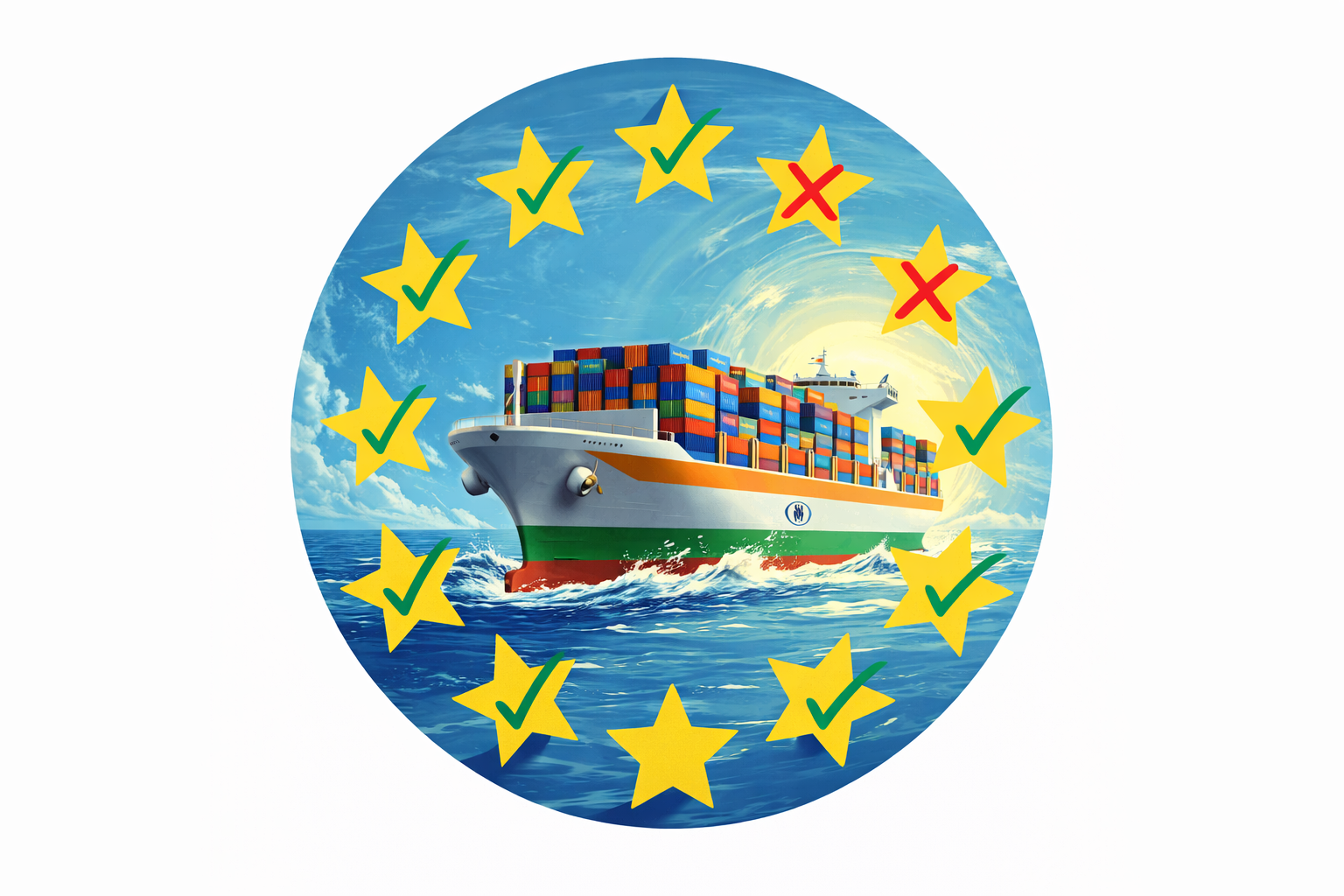
Key Arguments
Complexity of EU decision-making
The EU’s internal structure, requiring ratification by all member states, makes trade negotiations slow and vulnerable to vetoes driven by domestic politics rather than collective economic logic.
Regulatory barriers beyond tariffs
The article stresses that non-tariff barriers—environmental norms, labour standards, data rules and product regulations—are the real obstacles, not customs duties.
Carbon Border Adjustment Mechanism (CBAM)
Green regulations, particularly CBAM, are presented as a major challenge for Indian exports in steel, cement, aluminium and other carbon-intensive sectors.
Agriculture and services sensitivities
European concerns over agriculture, dairy and labour mobility contrast with India’s expectations of greater access for services and skilled professionals.
Geopolitics versus economics
Despite shared concerns over China and supply-chain resilience, strategic convergence does not automatically translate into trade concessions.
Author’s Stance and Underlying Bias
Stance
The author is cautiously sceptical. While acknowledging the strategic logic of an India-EU trade pact, the article repeatedly underlines structural constraints that make optimism premature.
Biases
There is a subtle tilt towards viewing EU regulations as protectionist rather than purely normative. Indian concerns—especially on employment, exports and policy autonomy—receive more empathetic treatment than European domestic anxieties.
Pros Highlighted
Long-term strategic value
An India-EU FTA could diversify trade partnerships and reduce over-dependence on a few major markets.
Market access and technology spillovers
If concluded, the deal could open high-value European markets and facilitate technology and investment flows into India.
Geopolitical alignment
Economic engagement could reinforce broader cooperation in a multipolar global order.
Cons and Risks
Regulatory asymmetry
EU’s stringent standards may disproportionately burden Indian exporters, especially MSMEs.
Limited policy space
Acceptance of EU norms on environment, labour and data could constrain India’s domestic developmental choices.
Implementation uncertainty
Even after negotiations, ratification delays and political resistance within EU states could dilute or derail outcomes.
Unequal adjustment costs
Short-term costs for Indian industry and agriculture may outweigh immediate gains.
Policy Implications
Trade policy recalibration
India must balance openness with strategic autonomy, particularly in climate-linked trade rules.
Domestic capacity building
Competitiveness, standards compliance and green transition in Indian industry become policy imperatives.
Negotiation strategy
India may need issue-based, phased agreements rather than an all-encompassing FTA.
Real-World Impact
For Indian exporters, especially in carbon-intensive sectors, the article signals rising compliance costs and uncertainty. For policymakers, it underscores that trade agreements are now deeply intertwined with climate policy, labour norms and domestic politics, not just tariffs and quotas.
UPSC GS Paper Linkages
GS Paper II – International Relations
India-EU relations, trade diplomacy, impact of global institutions and multilateral negotiations.
GS Paper III – Economy & Environment
Foreign trade policy, industrial competitiveness, climate change, carbon markets and sustainable development.
GS Paper II – Governance
Policy coordination, regulatory standards and federal-like decision-making within supranational bodies.
Conclusion and Future Perspective
The article makes a persuasive case that while an India-EU FTA is desirable, it will be neither quick nor easy. Structural rigidities within the EU, combined with evolving green and regulatory protectionism, pose serious challenges for India. Going forward, success will depend less on headline diplomacy and more on India’s ability to upgrade domestic competitiveness, negotiate transitional safeguards, and shape global trade norms rather than merely adapt to them. A pragmatic, phased and interest-based approach appears more realistic than a sweeping free-trade breakthrough.
