

From rhinos in Harappa to ancient war elephants, forests and their beings shaped India’s historical identity
Times Of India
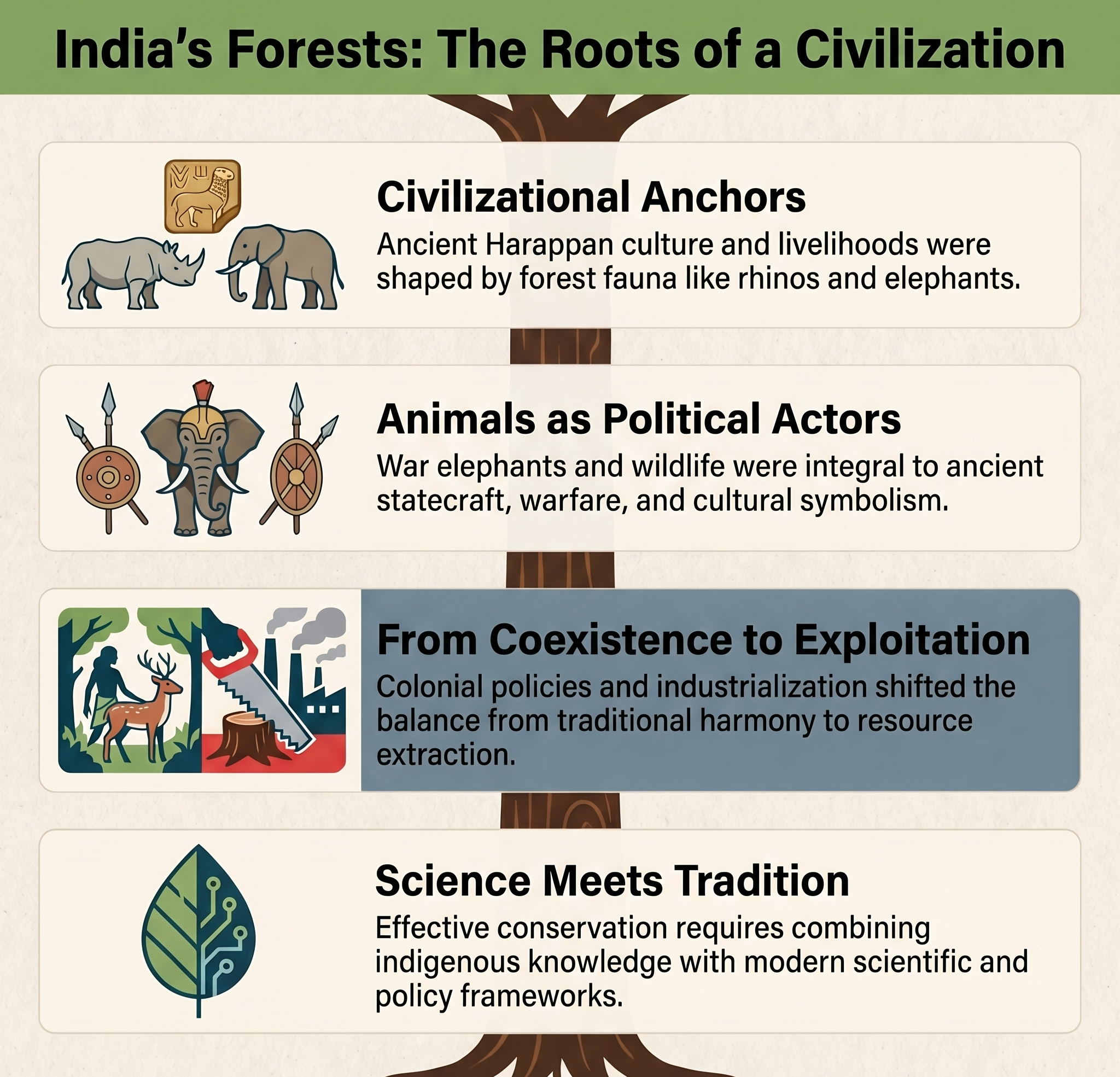
1. Key Arguments
A. Forests as Civilisational Anchors
Forests shaped early Indian settlements and culture.
From Harappan fauna (rhinos, elephants) to later agrarian and pastoral systems, forests influenced livelihood patterns and belief systems.
B. Human–Animal Interactions in History
Animals as economic, symbolic, and political actors.
War elephants, pastoral species, and wildlife were integral to statecraft, warfare, and cultural symbolism.
C. Gradual Transformation of Forest Landscapes
Shift from coexistence to exploitation.
Colonial forest policies, agrarian expansion, and industrialisation altered traditional ecological balances.
D. Biodiversity Decline and Fragmentation
Loss of species and habitats over time.
Modern deforestation, urbanisation, and infrastructure projects have reduced biodiversity and disrupted ecosystems.
E. Cultural Memory vs Ecological Reality
Disconnect between historical reverence and present neglect.
While forests remain embedded in mythology and identity, actual conservation practices are inadequate.
2. Author’s Stance
Reflective, conservation-oriented, and historically grounded
Normative tilt towards ecological preservation
The author advocates reconnecting with India’s ecological past to inform present conservation efforts.
3. Biases and Limitations
Romanticisation of the past
Overemphasis on harmonious human–nature relations historically
Ignores conflicts, overuse, and ecological pressures even in pre-modern periods.
Limited economic perspective
Insufficient engagement with development needs
Modern pressures like population growth and industrialisation are not fully contextualised.
Selective historical narrative
Focus on symbolic animals and forests
Less attention to regional diversity and variations in ecological history.
4. Strengths (Pros)
Interdisciplinary richness
Combines history, ecology, and anthropology
Highly valuable for holistic UPSC preparation.
Strong cultural linkage
Connects biodiversity with identity formation
Enhances understanding of environmental ethics.
Relevance to contemporary crises
Links past with present environmental degradation
Use of illustrative examples
Harappan fauna, war elephants, and forest economies
Improves conceptual clarity.
5. Weaknesses (Cons)
Normative over analytical
More descriptive than policy-driven
Insufficient data support
Lacks quantitative evidence on biodiversity loss
Limited policy direction
Does not clearly outline actionable solutions
6. Policy Implications
A. Integrating Cultural Ecology in Policy
Use traditional ecological knowledge in conservation planning
B. Strengthening Biodiversity Conservation
Focus on habitat restoration and wildlife corridors
C. Revisiting Forest Governance
Balance between conservation and livelihood needs (Forest Rights Act)
D. Sustainable Development
Promote eco-sensitive development models in forest regions
E. Environmental Education
Embed ecological history in curricula to build awareness
7. Real-World Impact
Ecological
Continued biodiversity loss threatens ecosystem services
Economic
Forests remain crucial for tribal livelihoods and climate resilience
Cultural
Erosion of traditional ecological knowledge systems
Climate Dimension
Deforestation contributes to climate change and disaster vulnerability
8. UPSC GS Paper Linkages
GS Paper I (History & Culture)
- Human–environment interaction in ancient India
- Cultural symbolism of animals
GS Paper III (Environment & Ecology)
- Biodiversity conservation
- Forest management
GS Paper II (Governance)
- Forest Rights Act, environmental policies
Anthropology Optional
- Cultural ecology
- Human adaptation and environment
9. Balanced Conclusion
The article successfully foregrounds the deep historical roots of India’s ecological consciousness and highlights the erosion of this relationship in modern times. However, it leans towards a nostalgic narrative without adequately addressing contemporary economic compulsions. A balanced approach must integrate historical wisdom with modern scientific and policy frameworks.
10. Future Perspective
Revival of ecological consciousness
Rebuild cultural respect for forests through education and policy
Science + Tradition synergy
Combine indigenous knowledge with modern conservation science
Community-led conservation
Empower forest-dwelling communities as custodians
Climate-integrated forest policy
Align forest conservation with India’s climate commitments
Final Insight
India’s forests are not merely ecological assets but civilisational foundations; their preservation is essential not just for sustainability, but for safeguarding the very identity they helped create.
