

From Water Infrastructure to Water Security: Lessons for Climate-Resilient Governance

From Water Infrastructure to Water Security: Lessons for Climate-Resilient Governance
Source: The hindu
Why in News?
The 9th India International Water Week, held in New Delhi, highlighted India's changing approach to water management — from merely expanding water infrastructure and access towards water security, climate resilience, efficient water use, wastewater reuse and sustainable service delivery.
India's experience, particularly the governance reforms undertaken in Gujarat between 2001 and 2014 and subsequently reflected in national programmes, provides lessons for other countries of the Global South.
India's Water Governance Journey
Over the past two decades, India has implemented several major programmes covering water conservation, sanitation, groundwater management, river rejuvenation and household water supply.
Important initiatives include:
- Jal Jeevan Mission (JJM) — household tap-water connections.
- Swachh Bharat Mission — sanitation and elimination of open defecation.
- Jal Shakti Abhiyan — water conservation and management.
- Namami Gange — rejuvenation of the Ganga and its tributaries.
- Atal Bhujal Yojana (ABY) — community-led groundwater management.
- Per Drop More Crop (PDMC) — improving water-use efficiency in agriculture through micro-irrigation.
The experience demonstrates that water security requires not only physical infrastructure but also governance, institutions, financing and community participation.
Four Lessons for Future Water Governance
|
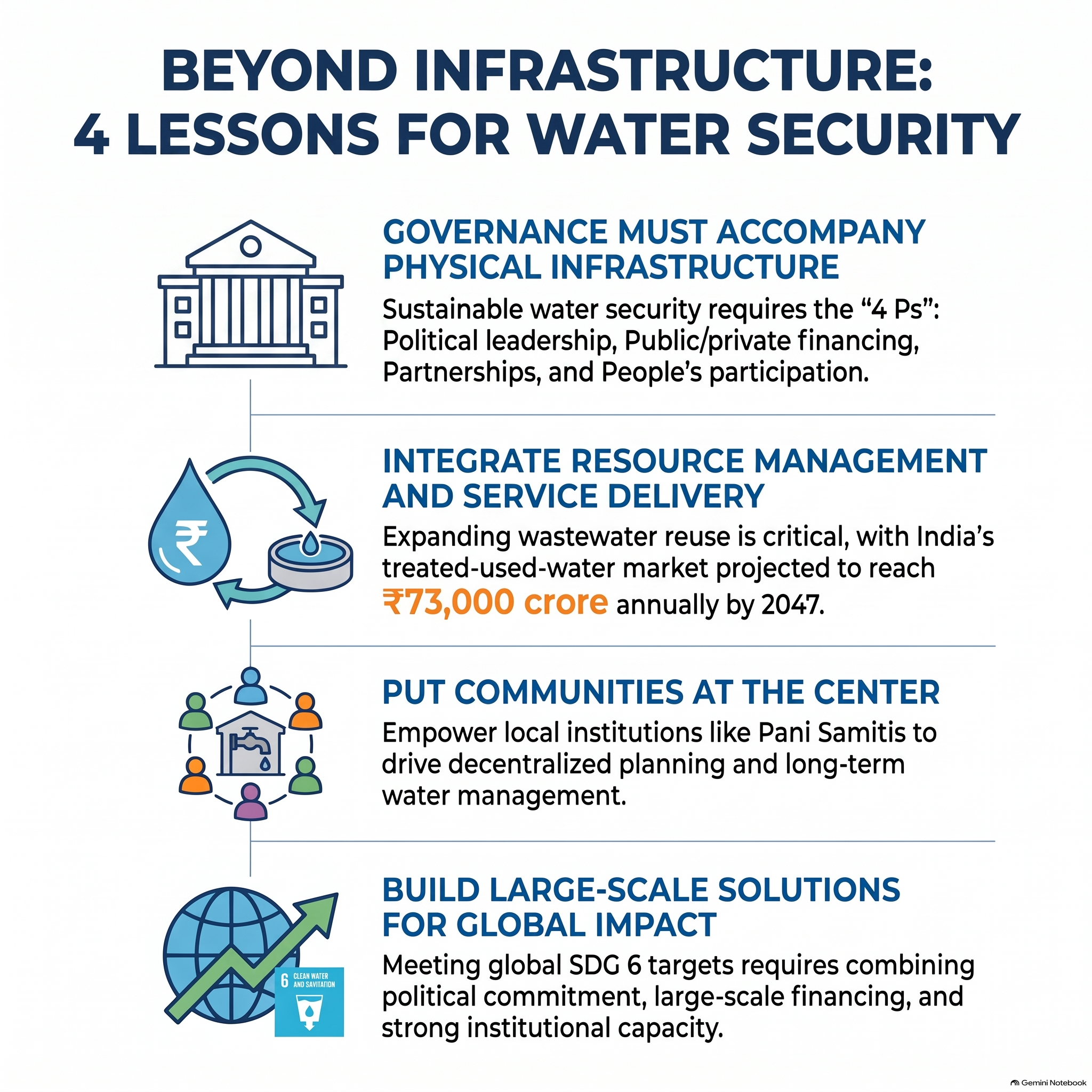
1. Governance Must Accompany Infrastructure Taps, canals and dams alone cannot ensure water security. Effective water governance requires the 4 Ps:
Initiatives such as Catch the Rain, village water-security plans and community-led sanitation reflect this approach. 2. Manage Water Resources and Services Together Water infrastructure is sustainable only when the underlying water resource is also secure. Rapid urbanisation, industrialisation and growing irrigation demand require integrated planning of: Water resources + water supply + wastewater + demand management An important emerging opportunity is reuse of treated wastewater, particularly for non-potable purposes. Industries such as data centres and semiconductor manufacturing can use treated wastewater, thereby reducing pressure on freshwater resources. India's treated-used-water market is projected to reach around ₹73,000 crore annually by 2047, at current prices. 3. Put Communities at the Centre Long-term water security requires local ownership and decentralised institutions. Institutions such as Pani Samitis can improve local participation in water planning and management when supported by adequate infrastructure, finance and technical assistance. Gujarat's Chintan Shivirs provided a platform for stakeholders to identify challenges and develop solutions according to local requirements. Similar approaches have subsequently been incorporated into national-level governance. Thus, effective water governance requires a connection between: Community → Local government → State government → Union government 4. Think Big and Build for Scale The world remains off track towards SDG 6, which seeks universal access to safe water and sanitation and sustainable management of water resources by 2030. Achieving this objective is estimated to require an additional $500 billion annually. India's Jal Jeevan Mission demonstrates how political commitment, large-scale financing, institutional capacity and implementation mechanisms can be combined to address water challenges at scale.
|
Climate-Resilient Water Governance
India's next phase must shift from an access-oriented approach to a sustainability-oriented approach by integrating:
- Climate resilience
- Groundwater management
- Wastewater reuse
- Demand management
- Data-driven planning
- Community ownership
Climate change makes this transition particularly important because changing rainfall patterns, droughts, floods and rising temperatures can affect both water availability and demand.
Way Forward
India needs to move from a predominantly supply-side, infrastructure-centric model towards an integrated water-governance framework based on:
Resource sustainability + Service delivery + Demand management + Behavioural change + Decentralised participation
Water security should therefore be treated not merely as an engineering problem but as a governance and institutional challenge.
Conclusion
India's water governance experience demonstrates that infrastructure becomes sustainable when supported by political leadership, institutional capacity, adequate financing and community participation. The broader lesson for the Global South is that climate-resilient water security requires an integrated approach combining water-resource management, efficient services, wastewater reuse and participatory governance.
Source: India International Water Week; Vajiram & Ravi, Daily Editorial Analysis, 6 October 2026.
