

Future of sovereignty at stake
The Statesman
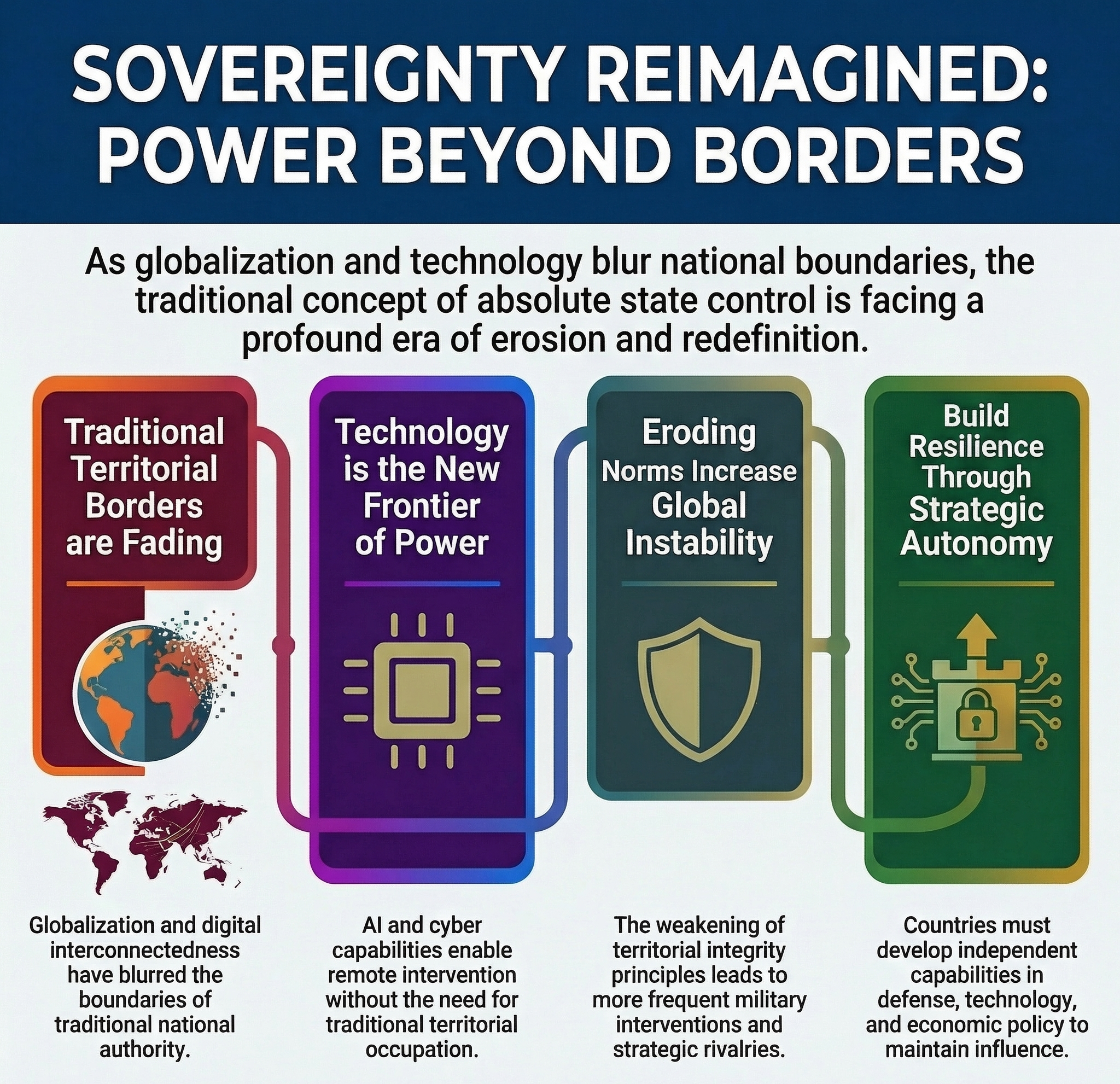
Key Arguments of the Article
Erosion of Traditional Sovereignty
The article argues that the classical concept of sovereignty—where states exercised complete control over their territories and internal affairs—is increasingly under pressure.
Globalisation, technological interconnectedness, and transnational threats have blurred the boundaries of national authority.
Impact of Geopolitical Conflicts
Military confrontations and strategic rivalries between major powers raise questions about respect for sovereignty. The article suggests that interventions and military strikes justified under various doctrines challenge established norms of international law.
Such actions may weaken the principle of territorial integrity.
Emerging Role of Advanced Technologies
Technologies such as artificial intelligence, cyber capabilities, and advanced weapons systems are transforming the nature of warfare and strategic competition.
These technologies can enable remote intervention and influence operations without traditional territorial occupation.
Economic and Strategic Power Dynamics
The article highlights that sovereignty today is closely linked with economic strength and technological capability. Countries with stronger economic and technological capacities exercise greater influence in global affairs.
Economic interdependence also complicates the idea of absolute national autonomy.
Challenges for Middle Powers
For countries like India, navigating the evolving global order requires balancing relations with competing global powers. Maintaining strategic autonomy while engaging in global partnerships is a key challenge.
Author’s Stance
The article reflects a realist interpretation of international relations. The discussion emphasises power politics, strategic competition, and technological transformation as central drivers of global change.
The tone suggests concern that weakening respect for sovereignty could destabilise the international system.
Possible Biases
Realist Perspective
The analysis strongly reflects a geopolitical and power-centric framework, emphasising state interests and strategic competition.
Limited Multilateral Perspective
While acknowledging international institutions, the discussion does not extensively explore the potential of cooperative global governance mechanisms.
Security Emphasis
The article focuses more on security and geopolitical aspects than on social or humanitarian dimensions.
Advantages of the Analysis
Insight into Changing Global Order
The article highlights how technological and geopolitical shifts are redefining international relations.
Strategic Awareness
Understanding these trends helps policymakers anticipate emerging global security challenges.
Relevance for Middle Powers
The discussion provides useful insights for countries navigating complex geopolitical environments.
Concerns and Challenges
Weakening International Norms
If sovereignty norms erode, international conflicts may become more frequent.
Technological Militarisation
Rapid advancement of military technologies increases the risk of escalation.
Power Imbalances
Smaller states may struggle to maintain autonomy in a system dominated by major powers.
Diplomatic Complexity
Balancing relations with multiple global actors requires careful strategic planning.
Policy Implications
Strengthening Strategic Autonomy
Countries must develop independent capabilities in defence, technology, and economic policy.
Investment in Emerging Technologies
Technological capability increasingly determines geopolitical influence.
Multilateral Engagement
Active participation in international institutions can help protect national interests.
Economic Resilience
Reducing dependence on external actors strengthens sovereignty in the economic domain.
Real-World Impact
If sovereignty norms weaken:
• Increased geopolitical instability
• More frequent military interventions
• Intensified great power competition
If managed effectively:
• Balanced international cooperation
• Strengthened global governance mechanisms
• Greater strategic stability
Alignment with UPSC GS Papers
GS Paper II
International relations, global governance, role of international organisations, and India’s foreign policy.
GS Paper III
Security challenges, emerging technologies in defence, geopolitical developments.
GS Paper IV
Ethical considerations in international relations and responsible use of power.
Balanced Assessment
The article raises important concerns about the changing nature of sovereignty in the modern world. While technological advances and geopolitical rivalries challenge traditional norms, sovereignty remains a central principle of international relations.
The challenge lies in adapting governance structures and international law to new realities without undermining the stability of the global system.
Future Perspective
The concept of sovereignty will likely evolve rather than disappear. As technology, economic interdependence, and global governance mechanisms expand, states will need to redefine sovereignty in terms of resilience, strategic autonomy, and cooperative engagement.
For civil services aspirants, the debate illustrates how international law, geopolitics, and technological change interact to reshape the foundations of global order.
