

FY26 growth outlook raised to 7.6% after GDP series reset
Business Standard
Core Theme of the Article
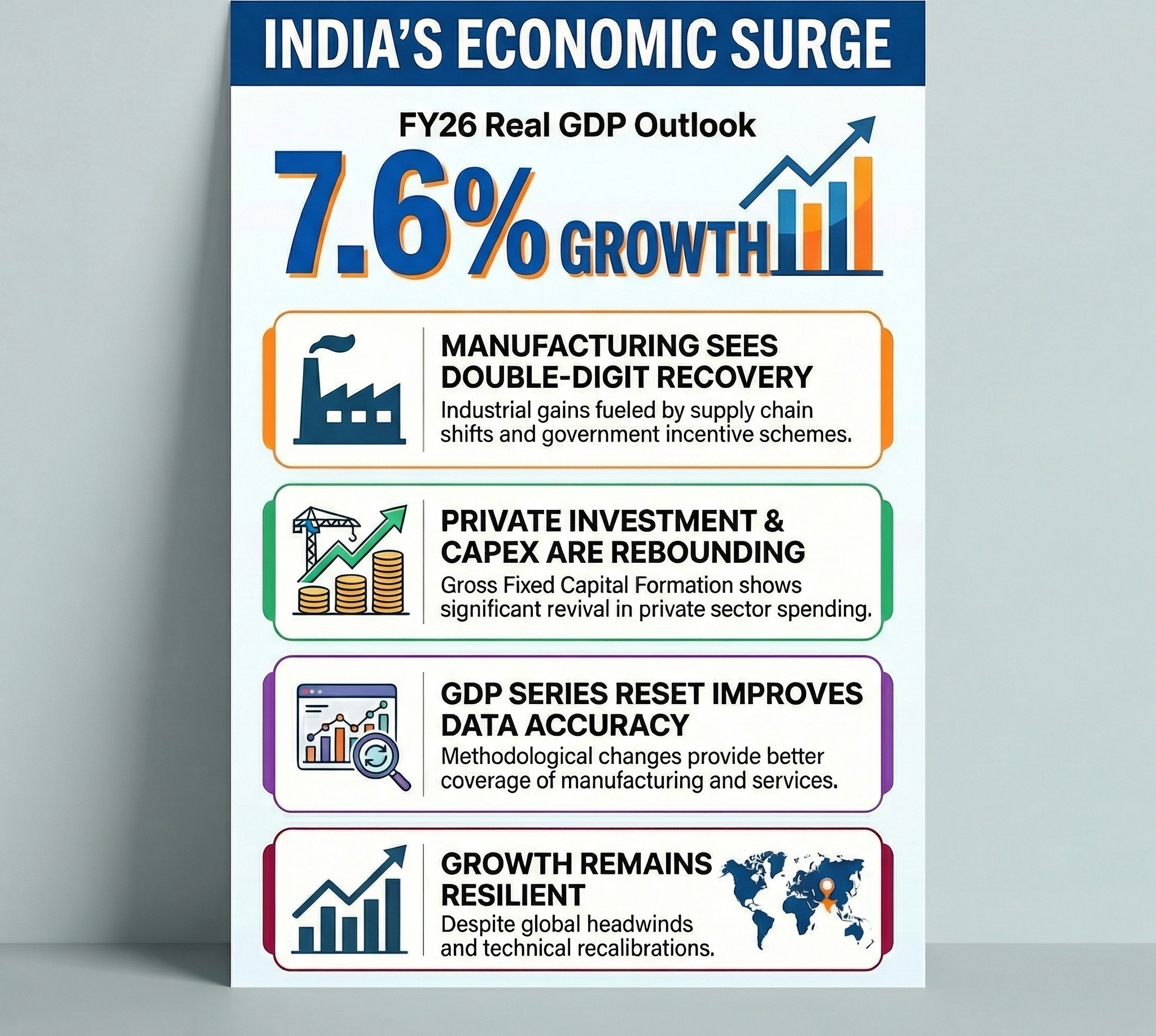
The article reports upward revision in India’s FY26 growth outlook to 7.6% following a reset of the GDP series and methodological changes in national accounts. It highlights strong real growth, especially in manufacturing and services, while noting a decline in nominal GDP estimates.
The overarching narrative: real growth remains robust despite technical recalibrations and global headwinds.
Key Arguments Presented
1. GDP Series Reset Enhances Data Accuracy
The change in base year and methodology provides improved coverage, especially of manufacturing and services.
2. Real Growth Remains Strong
Real GDP growth is projected at 7.6%, supported by Q3 expansion of 7.8%.
3. Manufacturing Emerges as Growth Driver
Double-digit manufacturing growth reflects industrial recovery and possible benefits of PLI schemes and supply chain shifts.
4. Services Continue to Dominate
Services remain the largest contributor to GDP, with healthy expansion in trade, transport, financial and professional services.
5. Private Investment Picks Up
Gross Fixed Capital Formation shows improvement, suggesting revival of private capex alongside public capex push.
6. Nominal GDP Estimate Falls
Despite stronger real growth, nominal GDP projection has been revised downward, reflecting moderating inflation.
Author’s Stance
The tone is broadly positive and data-driven.
• Emphasises resilience of India’s growth trajectory
• Frames reset as technical correction rather than manipulation
• Suggests macro stability is intact
It is analytical but subtly supportive of the growth narrative.
Possible Biases and Framing
Growth Narrative Bias
The article presents upward revision prominently, possibly underemphasising structural vulnerabilities.
Methodological Neutrality Bias
Assumes the GDP reset enhances accuracy without exploring potential controversies around data credibility.
Manufacturing Optimism Bias
Highlights manufacturing surge but does not deeply question sustainability or employment elasticity.
Strengths of the Article
• Provides sectoral disaggregation
• Differentiates between real and nominal growth
• Links investment revival with future growth prospects
• Acknowledges inflation moderation
Limitations
• Limited engagement with labour market outcomes
• Does not explore income inequality implications
• Insufficient discussion on rural demand trends
• External risks (geopolitics, crude oil) only lightly touched
Policy Implications
1. Strengthen Manufacturing Ecosystem
Sustain industrial momentum through logistics reform, credit support, and export facilitation.
2. Balance Real vs Nominal Growth
Moderating inflation is positive, but fiscal planning must account for lower nominal GDP base.
3. Investment-Led Growth Strategy
Encourage crowding-in of private investment via policy stability.
4. Export Diversification
Manufacturing gains must translate into global competitiveness.
5. Employment Generation
Translate sectoral growth into job-intensive outcomes.
Real-World Impact
Short Term
• Boost to investor confidence
• Strengthened fiscal narrative
• Improved global perception of economic resilience
Medium Term
• Capex-driven industrial expansion
• Manufacturing supply chain consolidation
Long Term
• Structural shift toward higher industrial share in GDP
• Potential demographic dividend realisation if employment aligns
UPSC GS Alignment
GS Paper III – Indian Economy
• GDP calculation and base year revision
• Real vs nominal growth
• Sectoral contribution to GDP
• Investment cycle
• Manufacturing and PLI schemes
GS Paper II
• Fiscal policy implications
• Institutional credibility of national accounts
Essay Relevance
• “Growth with stability: India’s economic trajectory”
• “Manufacturing as the engine of development”
Balanced Editorial Assessment
The article appropriately highlights the resilience of India’s macro fundamentals following statistical recalibration. It reflects improved industrial performance and sustained services strength.
However, growth sustainability depends on:
• Employment absorption
• Rural income recovery
• Global demand conditions
• Investment depth
Headline numbers must be supported by microeconomic robustness.
Future Perspective
India’s growth trajectory toward 7–8% appears attainable if:
• Private investment sustains momentum
• Manufacturing competitiveness deepens
• Inflation remains moderate
• External sector risks are managed
However, vigilance is necessary regarding:
• Global trade disruptions
• Capital flow volatility
• Structural labour-market challenges
Final Editorial Judgment:
The upward revision signals confidence in India’s macro framework. Yet, the true test of the reset GDP narrative will lie in sustained job creation, income growth, and resilience against global shocks.
