

Government Bans Import of Goods Made with Forced Labour

Government Bans Import of Goods Made with Forced Labour
Relevance: GS Paper II (International Relations, Bilateral Trade, India-US Relations) | GS Paper III (Indian Economy, Trade Policy)
Why in the News?
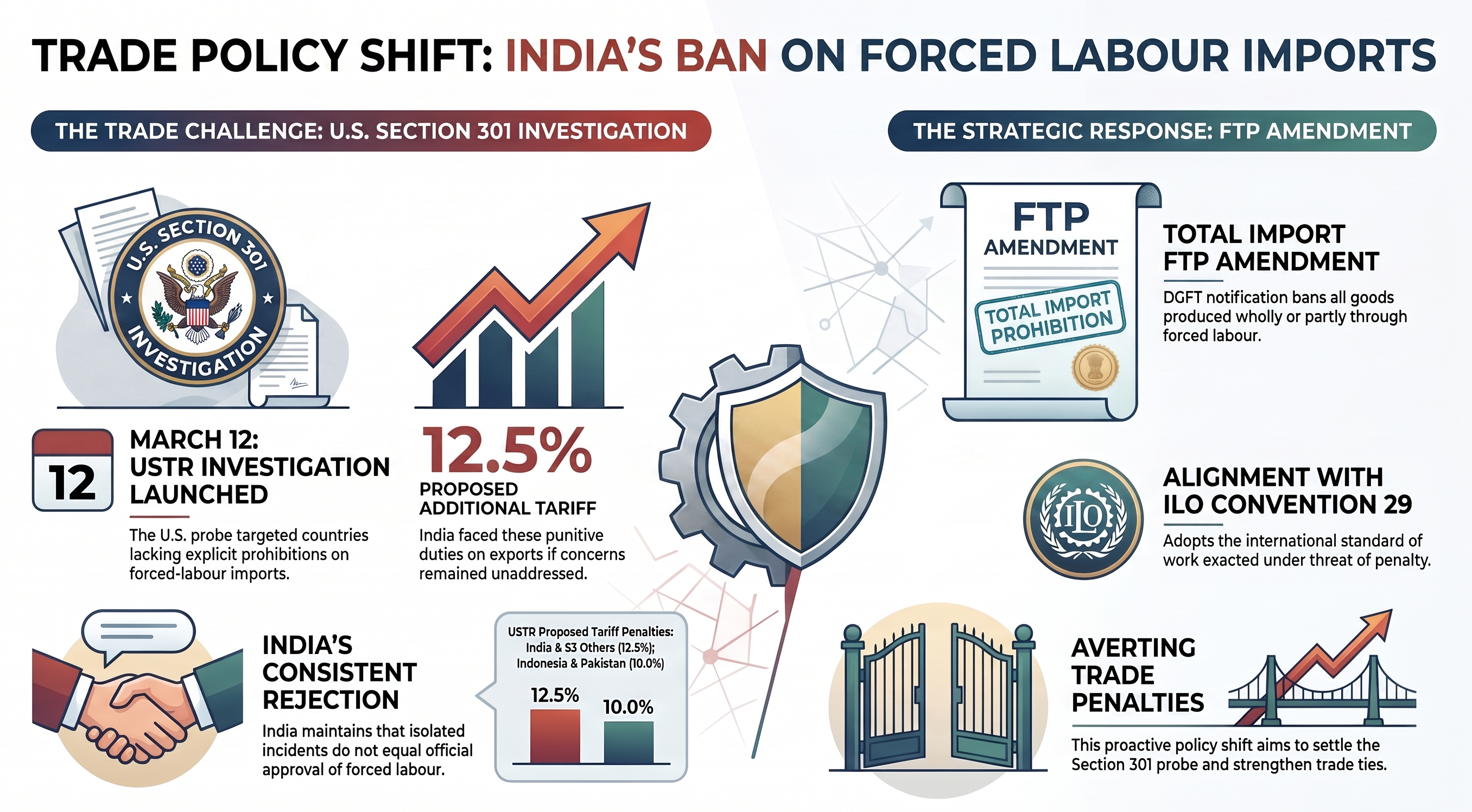
1. The Centre has banned the import of goods produced wholly or partly through forced labour, strengthening India's trade rules.
2. The move addresses concerns raised by the United States in an ongoing Section 301 investigation, which could otherwise result in an additional 12.5% tariff on Indian exports.
Details of the Notification
1. The Directorate General of Foreign Trade (DGFT) issued the notification on July 13, after approval from Commerce and Industry Minister Piyush Goyal.
2. The provision will become part of the Foreign Trade Policy (FTP) after 30 days.
3. Key provision: "The import of goods produced or manufactured, wholly or in part, through the use of forced labour is prohibited."
4. This empowers the Central government to specify such goods from time to time, following an enquiry.
5. The procedure for DGFT's enquiry into forced labour use in production will follow the Handbook of Procedures, 2023.
6. The notification adds a new paragraph to the FTP empowering the government to prohibit such imports by notification, and inserts a definition of "Forced Labour" in line with the ILO Forced Labour Convention, 1930 (No. 29).
7. As per the ILO definition, forced labour means all work or service exacted from a person under threat of penalty, and for which that person has not offered themselves voluntarily.
Background: The U.S. Section 301 Investigation
1. The investigation was launched by the Office of the United States Trade Representative (USTR) on March 12, covering 60 countries, including India.
2. It cited the absence of an explicit Indian prohibition on imports made with forced labour as one of the reasons for initiating the probe.
3. On June 2, USTR proposed an additional 12.5% tariff on goods from 54 countries, including India, over forced-labour concerns; six other countries, including Indonesia and Pakistan, face a proposed additional duty of 10%.
India's Position
1. India has consistently rejected the allegations, maintaining that the issue is being addressed as part of negotiations on a bilateral trade agreement with the U.S.
2. India has argued that the mere possibility of forced-labour-made products entering a country's territory does not amount to official approval of such practices.
3. In its submission to the USTR on May 7, India stated there was no conclusive evidence that it imports or exports goods produced using forced labour.
4. At the USTR's latest hearing on July 8, the Indian representative submitted that eliminating forced labour is a constitutional obligation of the government, and that the absence of an explicit import ban did not amount to acquiescing to or permitting forced labour in any form.
5. A final USTR verdict on the matter is still awaited.
Significance
1. The notification directly strengthens India's trade policy framework in line with international labour standards (ILO Convention No. 29).
2. It is a proactive step aimed at addressing U.S. trade concerns and potentially averting the proposed additional tariff under the Section 301 probe.
3. It reflects the broader dynamic where domestic policy changes are increasingly shaped by ongoing bilateral trade negotiations and external trade-remedy investigations.
