

Govt clears ₹7,280 crore rare-earth magnets scheme
Hindustan Times
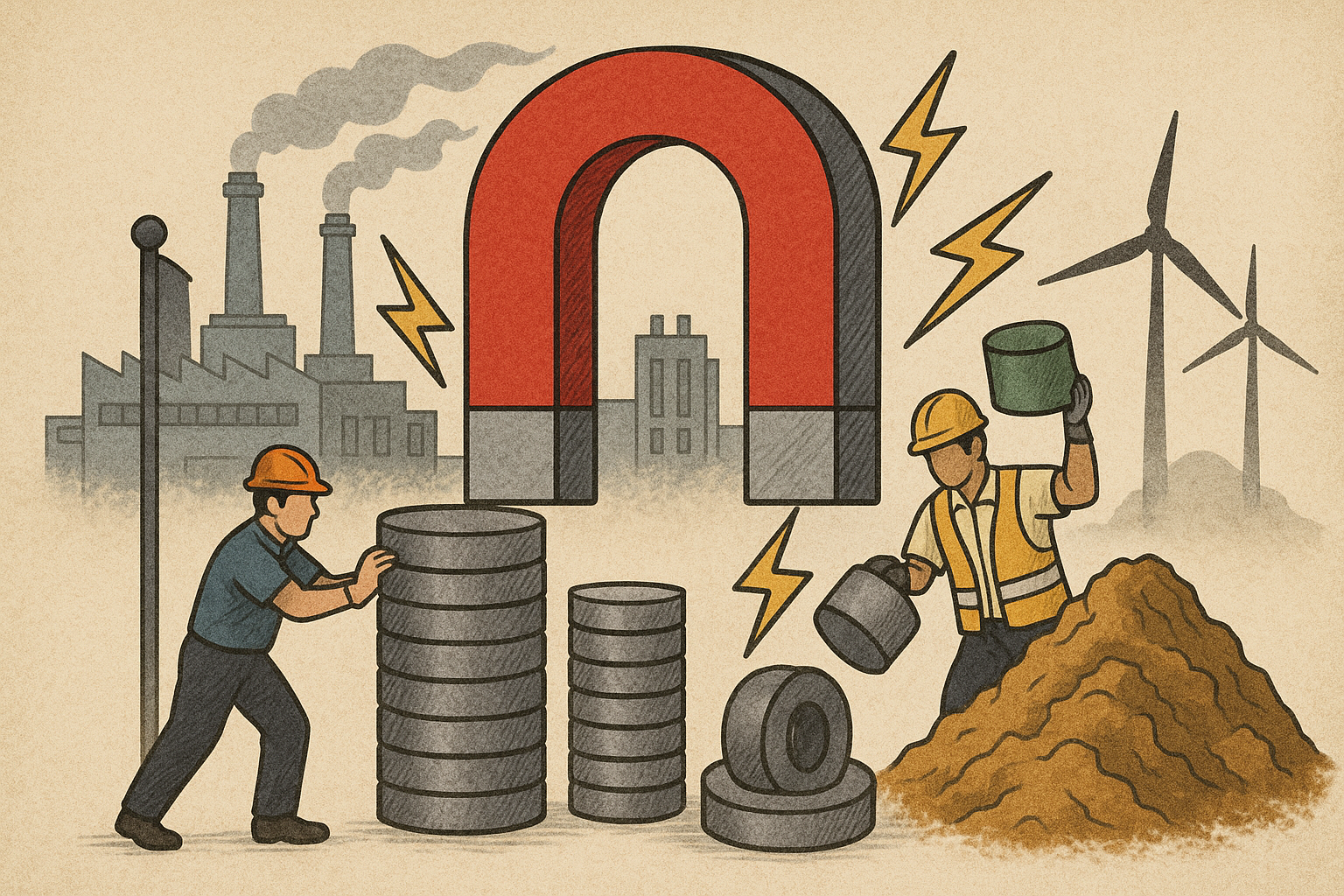
Key Arguments Presented in the Article
A. China’s dominance is a strategic threat
- China controls almost all global rare earth magnet production.
- India’s dependence exposes national security and industrial vulnerabilities, especially in defence, EVs, space, and electronics.
B. The scheme aims to build a domestic REPM ecosystem
- Five plants with combined capacity of 6,000 MT will be set up.
- The scheme will support the entire chain:
- mining → processing → magnet production → integration into advanced industries.
C. The scheme is tied to India’s national security and energy transition goals
- REPMs are essential for EV motors, drones, wind turbines, satellites, military radars, and missiles.
- The rise of global tensions makes supply chain resilience urgent.
D. Incentive structure is substantial
- Incentives amounting to ₹4,650 crore over five years.
- Additional ₹2,630 crore earmarked to ensure viability and capacity creation.
- Aim is for India to supply 4,000–5,000 MT domestically in the next decade.
E. Alignment with global geopolitics
- The scheme complements US–India critical minerals cooperation.
- The government acknowledges that global realignments are affecting trade in sensitive materials.
3. Author’s Stance
The writer adopts a cautiously optimistic, pro-policy stance, highlighting:
- the strategic necessity of reducing dependence on China;
- the contribution to high-end manufacturing;
- India’s attempts to break into global value chains.
The tone reflects approval of the government’s proactive approach while maintaining a factual and neutral reporting style.
4. Possible Biases or Limitations
A. Limited discussion of challenges
- Rare earth processing is highly polluting; environmental risks are understated.
- India has historically struggled with value-chain integration; this is not explored.
- Private sector appetite for large-scale REPM investment is uncertain.
B. Overreliance on government claims
Most data points come from official statements without independent scrutiny of feasibility.
C. China’s capability gap unaddressed
The gap between India and China in technology, R&D, refining capacity, and skilled workforce is vast, and the analysis does not highlight the enormity of the challenge.
5. Pros and Cons of the Policy
Pros
1. Strategic autonomy
- Reduces dependence on Chinese magnets critical for EVs, defence, and electronics.
2. Industrial growth
- Spurs Make in India in sectors like drones, EVs, robotics, satellites, renewable energy.
3. National security
- Essential for missile guidance, radars, jet engines, SONAR, and space systems.
4. Economic benefits
- Higher domestic value addition, job creation, and potential export opportunities.
Cons
1. Technology and capacity barriers
India lacks mature refining and magnet-making expertise; bridging the gap may take years.
2. Environmental concerns
Rare-earth mining and separation produce radioactive and toxic waste, needing regulatory clarity.
3. Capital-intensive industry
Private sector participation may be limited without long-term policy certainty.
4. Global competition
China’s deeper supply chain, cost advantages, and market control can undercut India.
5. Risk of geopolitical pushback
China may react by strategically lowering prices or restricting raw material exports.
6. Policy Implications (UPSC-relevant)
A. Industrial Policy (GS-3)
- Supports advanced manufacturing; complements PLI schemes for electronics, EVs, drones.
- Catalyses development of critical mineral value chains.
B. National Security (GS-3)
- Enhances autonomy in defence production and reduces vulnerability to supply chain shocks.
C. Geopolitics (GS-2/IR)
- Positions India as a partner in US-led counter-China supply chain realignment.
- Could strengthen agreements with QUAD on critical technologies.
D. Environment (GS-3)
- Requires strict frameworks for waste management, mining regulation, and green technology.
E. Economy (GS-3)
- Helps India enter global high-value markets worth billions annually.
7. Real-World Impact
Positive
- Boost to domestic EV and renewable sector manufacturing.
- Opportunities for India to become a global alternative to China in REPM production.
- Encourages R&D, tech transfer, and skilled manufacturing.
Negative
- High risk of project delays and cost overruns.
- Potential environmental degradation if mining/refining standards are weak.
- Global competitiveness remains uncertain.
8. Balanced Summary
The ₹7,280-crore scheme marks a major push toward strategic self-reliance in rare-earth magnets, a component central to India’s defence, technology, and clean-energy aspirations. The article foregrounds the urgency caused by China’s overwhelming dominance and the need for resilient supply chains.
While the initiative is forward-looking and geopolitically aligned with India’s long-term interests, challenges remain in terms of technology gaps, environmental safeguards, and global market competitiveness. The effectiveness of the scheme will depend on successful execution, private sector participation, and sustained policy support.
9. Future Perspectives
- Build a National Rare Earth Research Centre for refining, metallurgy, magnetics, and recycling.
- Accelerate India’s Critical Minerals Mission to secure lithium, cobalt, and rare earth ores abroad.
- Encourage global joint ventures, especially with Japan, the US, EU, and Australia.
- Develop recycling ecosystems for e-waste, EV motors, wind turbines, and electronics.
- Ensure environmental sustainability with strict mining and waste-treatment guidelines.
- Focus on workforce skilling for high-precision manufacturing.
- Pursue long-term procurement guarantees for industries adopting domestic REPMs.
India’s ability to reduce China-centric vulnerabilities will depend not merely on funding but on technological depth, environmental responsibility, and integrating into global supply chains.
