

GRAM-G vs MGNREGA
The Tribune
I. Central Issue and Framing
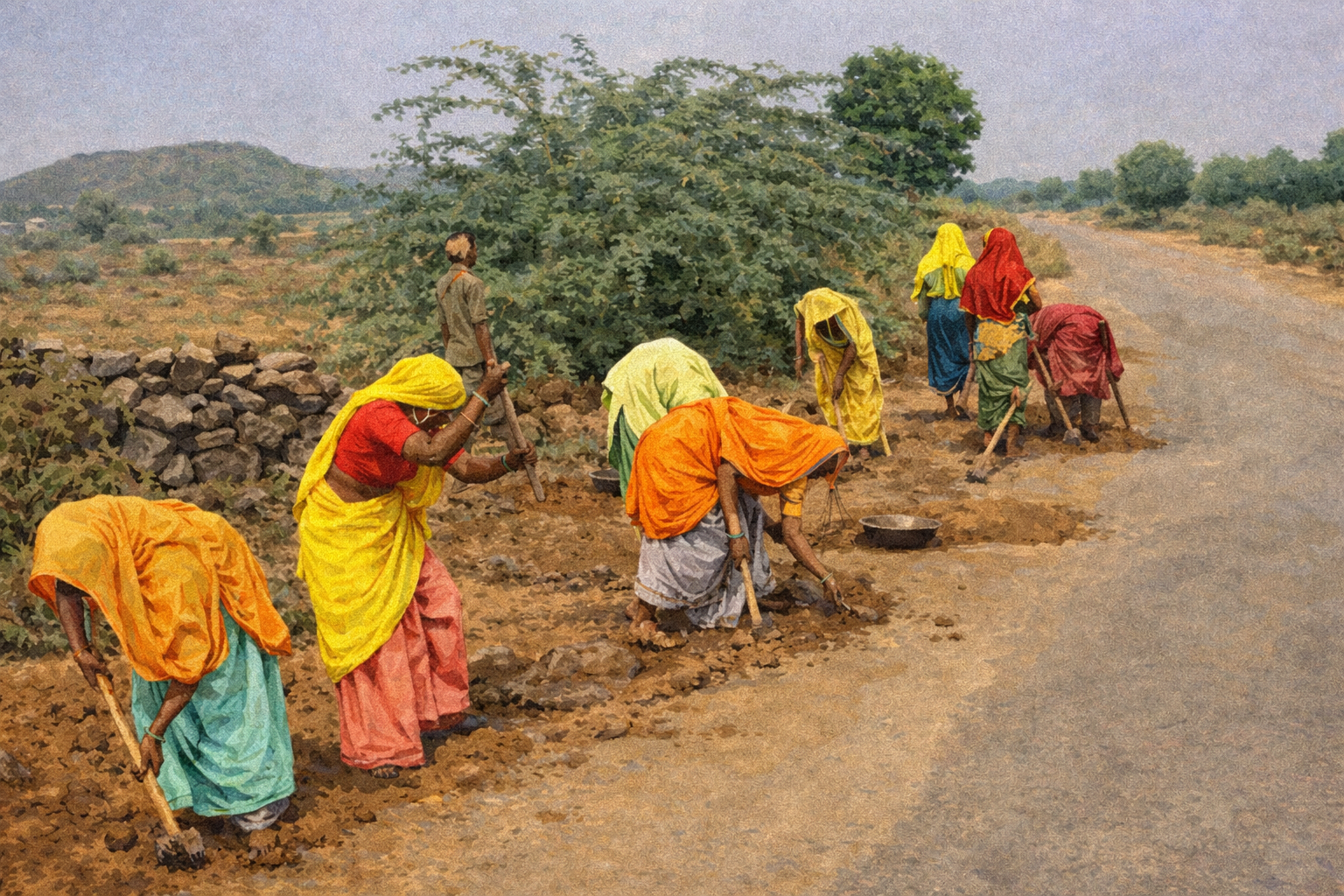
The article examines the political, institutional, and constitutional implications of replacing MGNREGA with GRAM-G (Garib Kalyan Rojgar Abhiyaan or a similarly branded alternative). The central concern is not merely administrative restructuring, but the quiet dismantling of a rights-based employment guarantee without parliamentary clarity, public debate, or legal accountability.
The framing is adversarial: the author treats the proposed shift as substitution without explanation, raising questions about democratic process, federalism, and welfare ethics.
II. Key Arguments Advanced
1. Lack of Transparency and Parliamentary Oversight
The article highlights that there has been no clear explanation—either in Parliament or policy documents—about why MGNREGA needs to be overhauled or replaced. This absence is portrayed as a serious democratic deficit.
2. Rights-Based Law vs Executive Programme
MGNREGA is a statutory, demand-driven entitlement, whereas GRAM-G is presented as an executive-designed scheme, vulnerable to budgetary discretion. The author argues that replacing a legal right with a scheme fundamentally alters the citizen–state relationship.
3. Political Messaging over Policy Substance
The renaming and restructuring are framed as political branding exercises, aimed at distancing the current government from a legacy programme while retaining surface-level welfare optics.
4. Erosion of Rural Employment Security
The article suggests that MGNREGA’s dilution or replacement would weaken the last institutional safety net for rural labour, particularly during economic shocks, climate stress, and agrarian distress.
5. Federal and Administrative Concerns
States, which play a major role in MGNREGA implementation, are shown as bystanders rather than stakeholders, raising questions about cooperative federalism.
III. Author’s Stance
The author adopts a strongly sceptical and critical stance, rooted in constitutionalism and parliamentary accountability. The emphasis is on process over intent: even if reform is needed, bypassing debate is portrayed as unacceptable.
The stance is not anti-reform, but anti-opacity.
IV. Biases and Editorial Slant
1. Pro-MGNREGA Bias
The article clearly privileges MGNREGA’s original architecture and legacy, leaving little room for acknowledging genuine implementation failures.
2. Suspicion of Executive Centralisation
There is a strong underlying bias against centrally driven, executive-led welfare redesign, reflecting a concern about shrinking legislative space.
3. Opposition-Sensitive Framing
The language occasionally mirrors opposition talking points, especially in linking welfare reform to political credit-seeking.
V. Strengths of the Analysis
1. Constitutional Lens
The article correctly frames employment guarantee as a question of rights, not charity, aligning with Supreme Court interpretations of welfare laws.
2. Democratic Accountability Focus
By foregrounding Parliament’s role, it reinforces core UPSC GS-II themes.
3. Clarity on Legal vs Scheme Distinction
The contrast between statutory entitlement and executive programme is sharply and persuasively drawn.
4. High UPSC Relevance
Directly useful for GS-II (Governance, Parliament, Welfare Schemes) and GS-III (Employment, Inclusive Growth).
VI. Weaknesses and Gaps
1. Limited Engagement with Reform Rationale
The article does not seriously engage with arguments around leakages, inefficiencies, or administrative bottlenecks in MGNREGA.
2. Absence of Empirical Comparison
GRAM-G’s design, scope, and outcomes are not systematically compared with MGNREGA.
3. Political Tone Over Policy Depth
At times, the critique leans more toward political interpretation than granular policy analysis.
VII. Policy Implications (UPSC Alignment)
GS Paper II – Polity & Governance
• Role of Parliament in welfare legislation
• Executive discretion vs statutory rights
• Federalism and Centre–State coordination
GS Paper III – Economy & Employment
• Rural employment guarantees as automatic stabilisers
• Public works and demand-side support
GS Paper IV – Ethics in Governance
• Transparency in public policy
• Ethical implications of replacing rights with schemes
VIII. Real-World Impact
If MGNREGA Is Replaced Without Legal Safeguards
• Increased discretion in work allocation
• Weaker grievance redressal
• Greater vulnerability of rural workers
If Reform Is Done Transparently
• Opportunity to improve efficiency
• Strengthened accountability
• Preservation of rights-based architecture
The article warns that process failure will undermine even well-intentioned reform.
IX. Balanced Conclusion
The article convincingly argues that MGNREGA is not merely a welfare programme but a constitutional-style social contract. Replacing it with GRAM-G—without parliamentary debate or statutory backing—risks converting a right into a favour.
While reform and modernization may be necessary, the legitimacy of welfare policy depends as much on how change is made as on what change is proposed.
X. Future Perspective
• Any overhaul must be preceded by parliamentary scrutiny
• Rights-based guarantees should not be diluted through executive substitution
• Reforms should strengthen, not weaken, demand-driven employment
• States and workers must be stakeholders, not recipients
• Welfare credibility rests on legal certainty, not branding
For UPSC aspirants, the key takeaway is this:
The GRAM-G vs MGNREGA debate is fundamentally about governance ethics, constitutional accountability, and the future of rights-based welfare in India.
