

Gravitational-Wave Astronomy: Entering the Statistical Era

Gravitational-Wave Astronomy: Entering the Statistical Era
Source: The HIndu
Context
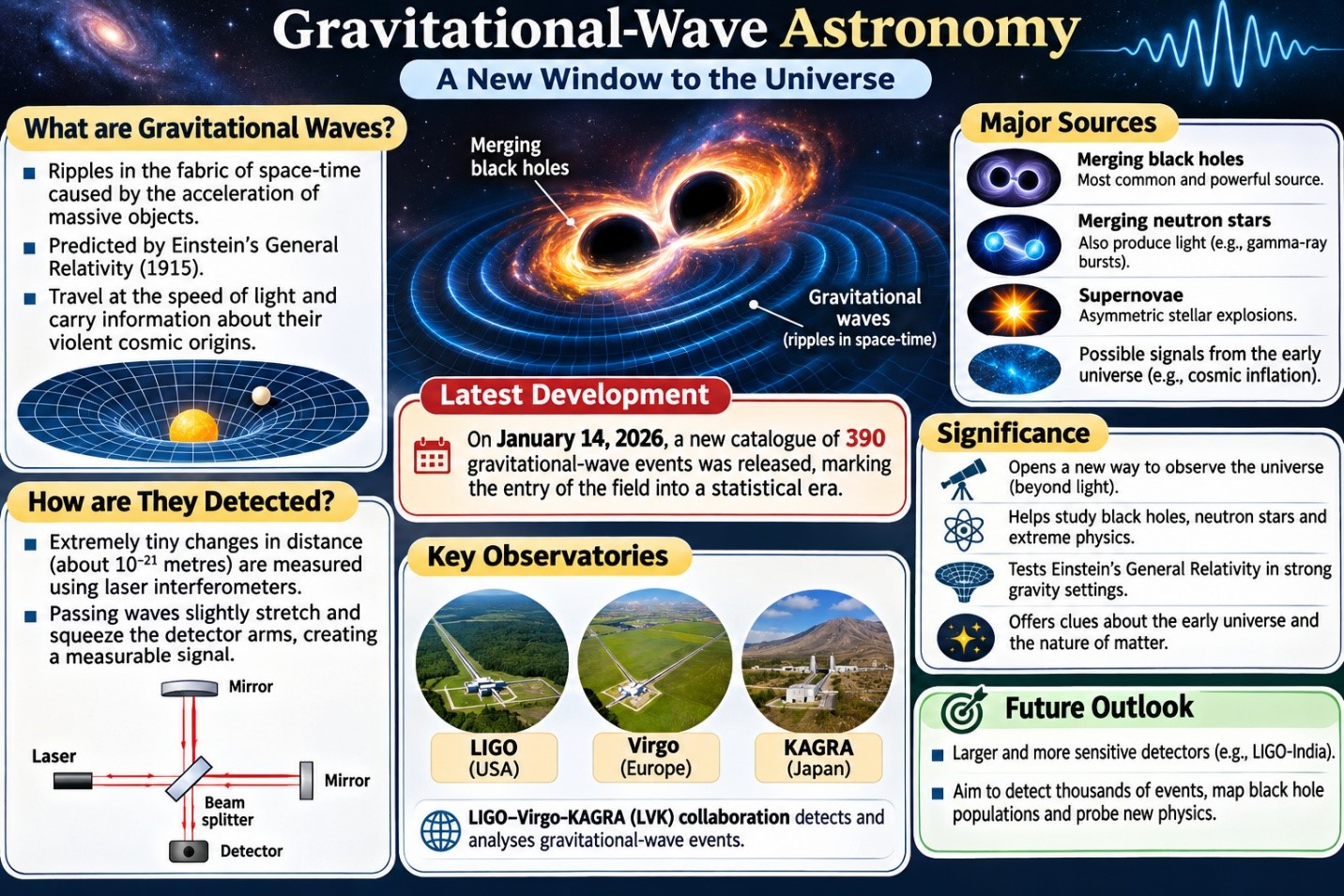
Gravitational-wave astronomy is entering its statistical era with the release of a catalogue containing 390 candidate gravitational-wave events detected by the LIGO-Virgo-KAGRA collaboration. The expanded dataset enables scientists to study black-hole populations, understand their formation and evolution, and test Einstein's General Theory of Relativity under extreme conditions.
Background: Understanding Gravitational Waves
- Definition: Gravitational waves are ripples in the fabric of spacetime produced by the acceleration of massive objects, particularly merging black holes and neutron stars.
- Origin: Predicted by Albert Einstein in 1916 under his General Theory of Relativity.
- Characteristics:
- Travel at the speed of light.
- Interact very weakly with matter and can travel across the universe with minimal obstruction.
- Stretch and compress spacetime by extremely small amounts.
- First Detection: GW150914, detected on 14 September 2015 by LIGO, provided the first direct confirmation of gravitational waves.
Detection Mechanism: LIGO
Laser Interferometer Gravitational-Wave Observatory (LIGO) detects gravitational waves through laser interferometry.
- Structure: Consists of two perpendicular arms, each approximately 4 km long, arranged in an L-shape.
- Working: A laser beam is split into two beams travelling along separate arms and reflected back by mirrors.
- Detection: A passing gravitational wave stretches one arm and compresses the other, producing a tiny change in their relative lengths.
- Measurement: This change modifies the laser interference pattern, allowing scientists to detect gravitational waves.
Major Findings from the 390-Event Catalogue
- Black Hole Population: The catalogue, approximately 70% larger than its predecessor, enables statistical analysis of black-hole masses, spins, formation and evolution.
- Mass Distribution: A higher concentration of black holes is observed around 10 solar masses, while black holes of approximately 35 solar masses show a tendency to merge with similarly massive companions.
- Black Hole Formation: The observed patterns provide insights into different formation mechanisms:
- Binary star evolution.
- Gravitational capture in star clusters.
- Sequential mergers of previously formed black holes.
- Black Hole Spin: Only around 15% of detected black holes exhibit rapid spins, providing clues about their formation history.
- Mass Gap: Observations help investigate the predicted mass gap around 44 solar masses associated with pair-instability supernovae.
- Testing Einstein's Theory: Gravitational-wave signals, particularly chirps and ringdowns, help test General Relativity under extreme gravitational conditions.
Recent Developments and India's Role
- GW250114 (January 2025): A gravitational-wave signal from two merging black holes approximately 1.3 billion light-years away. Its clear ringdown enabled precise testing of General Relativity and Stephen Hawking's black hole area theorem.
- LIGO-India: Being established at Hingoli, Maharashtra, to strengthen the global gravitational-wave detector network.
- Improves triangulation and identification of gravitational-wave sources.
- Its geographical location is expected to reduce average sky-localisation uncertainty by approximately 40%.
- The project aims to become operational by 2030, according to the provided material.
- LISA Mission: The Laser Interferometer Space Antenna, a collaboration between ESA and NASA, will use three satellites to detect lower-frequency gravitational waves, particularly from massive black-hole systems.
Significance
- Understanding the Universe: Enables large-scale studies of black-hole populations, their origins and evolution.
- Testing Fundamental Physics: Provides opportunities to test Einstein's General Theory of Relativity and theories of black-hole physics.
- Cosmological Research: Gravitational-wave observations offer an independent method of estimating the universe's expansion rate. One analysis estimated it at 71 km/s per megaparsec, with 26% improved precision over earlier gravitational-wave estimates.
Conclusion
The transition of gravitational-wave astronomy from individual discoveries to statistical analysis marks an important development in modern astrophysics. Larger observational datasets, international detector networks and future missions such as LIGO-India and LISA will deepen our understanding of black holes, spacetime and the evolution of the universe.