

Greenland Security Deal: Strategic and Geopolitical Significance

Source: The Hindu
Greenland’s Constitutional Position and the New Deal
- Greenland is a self-governing territory within the Kingdom of Denmark.
- Under the 2009 Self-Government Act, Greenland exercises extensive legislative and executive powers.
- Greenlanders retain the right to determine the island’s future, including independence.
- Defence and foreign affairs remain under Denmark, explaining why the agreement was negotiated between the US and Denmark.
- Greenland’s political consent remains important because of its extensive self-government.
- The agreement is expected to be signed at the UN General Assembly and will take effect after the required parliamentary procedures.
- Its complete text has not yet been publicly released.
What Does the Security Deal Change?
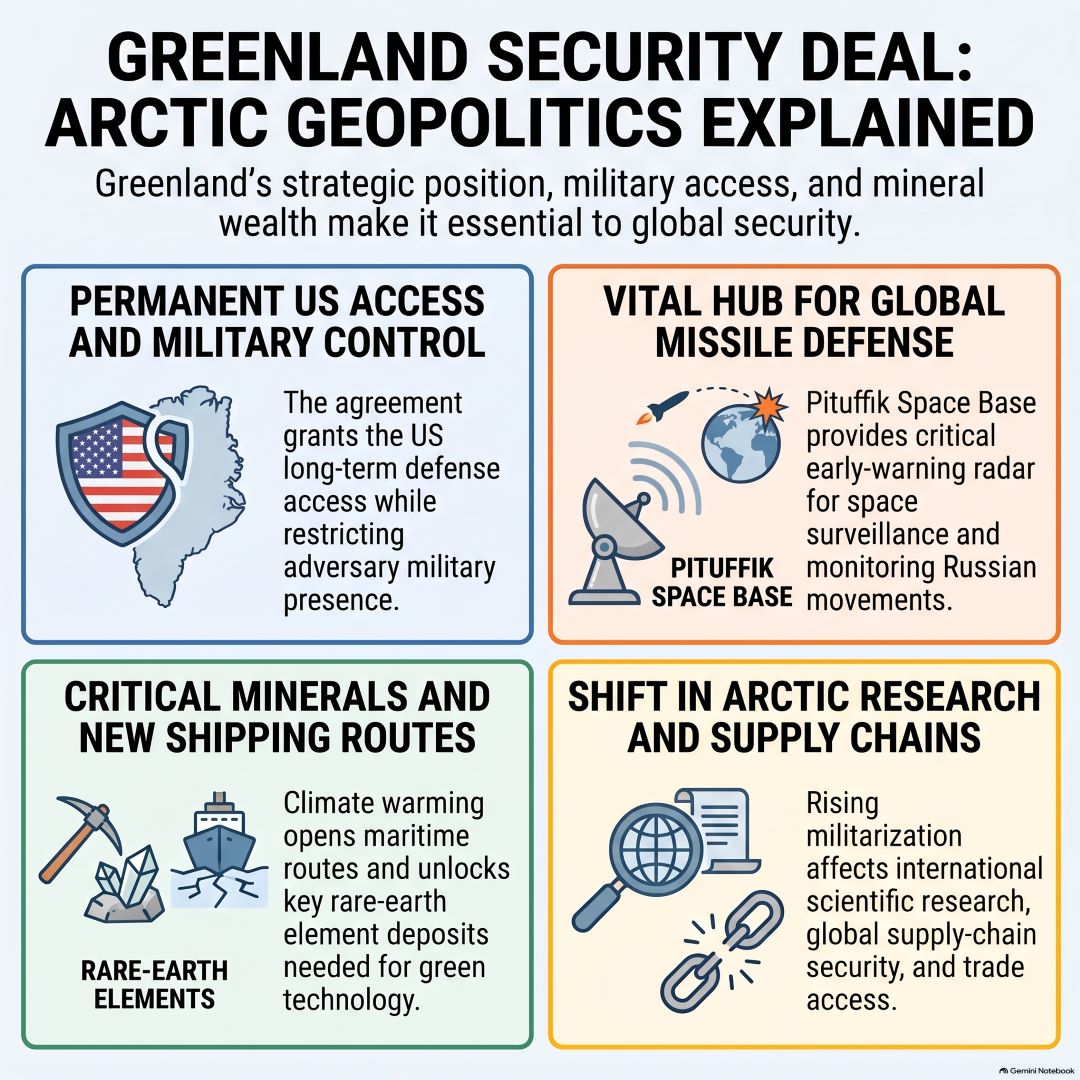
- US interpretation: President Trump described the agreement as providing permanent US security control/access and restricting adversaries from establishing military bases, maintaining military presence or making sensitive investments without US approval.
- Danish interpretation: PM Mette Frederiksen presented it as strengthening security in the Arctic and North Atlantic while reaffirming:
- Danish sovereignty and territorial integrity.
- Greenlanders’ right to self-determination.
- The US already possessed extensive military access under the 1951 US–Denmark Defence Agreement.
- Existing arrangements permitted US movement, overflight and landing in designated defence areas, but new defence areas or facilities required Danish agreement.
- The reported innovation is that US access, basing and overflight rights could become permanent, potentially continuing even if Greenland's political status changes.
- A key unresolved issue is whether new US military facilities would continue to require Danish and Greenlandic consent. The answer would determine the practical significance of the agreement.
Why Greenland Matters Strategically?
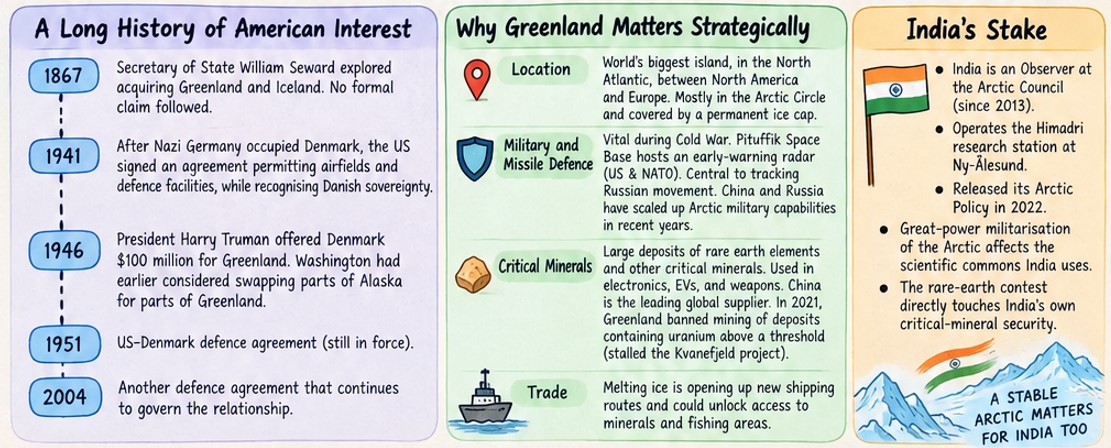
- Geostrategic location: Greenland is the world’s largest island, positioned between North America and Europe and largely within the Arctic Circle.
- Military and missile defence:
- Pituffik Space Base hosts US early-warning radar.
- Its location supports missile detection, space surveillance and monitoring of Arctic activity.
- Greenland is strategically positioned for monitoring Russian military movements across the Arctic.
- Russia–China factor: Growing Russian and Chinese activity in the Arctic has increased Greenland’s strategic importance within wider US–NATO security planning.
- Critical minerals:
- Greenland possesses deposits of rare earth elements and other critical minerals.
- These are important for electronics, EVs and defence technologies.
- China’s dominance in global rare-earth supply chains makes Greenland strategically relevant to supply-chain diversification.
- Climate change and trade:
- Arctic warming is opening previously inaccessible maritime routes and potentially increasing access to mineral and fishing resources.
- Thus, climate change is simultaneously creating new economic opportunities and intensifying geopolitical competition.
Historical Background of US Interest
|
Year |
Development |
|
1867 |
US Secretary of State William Seward explored acquiring Greenland and Iceland. |
|
1941 |
Following Nazi Germany’s occupation of Denmark, the US obtained rights for airfields and defence facilities while recognising Danish sovereignty. |
|
1946 |
President Harry Truman offered Denmark $100 million for Greenland; the US had also considered territorial exchange proposals involving Alaska. |
|
1951 |
US–Denmark defence agreement established extensive American military access in Greenland. |
|
2004 |
A subsequent defence agreement further governed US military presence. |
|
2026 |
US and Denmark announced a new Greenland security agreement amid renewed US strategic interest in the island. |
India’s Stake and Arctic Significance
- India has been an Observer in the Arctic Council since 2013.
- India operates the Himadri research station at Ny-Ålesund, Svalbard, and released its Arctic Policy in 2022.
- Greater militarisation of the Arctic could affect:
- Scientific research and access to the Arctic commons.
- Climate and environmental research.
- Emerging maritime routes.
- Global critical-mineral supply chains.
- Greenland’s rare-earth resources are particularly relevant to India’s efforts to strengthen critical-mineral security and diversify supply chains.
- The Greenland issue therefore links Arctic geopolitics, NATO security, US–Russia–China competition, critical minerals, climate change and India’s scientific interests.
