

Growth has been less strong than it seems: The misreading has complicated policy
Indian Express
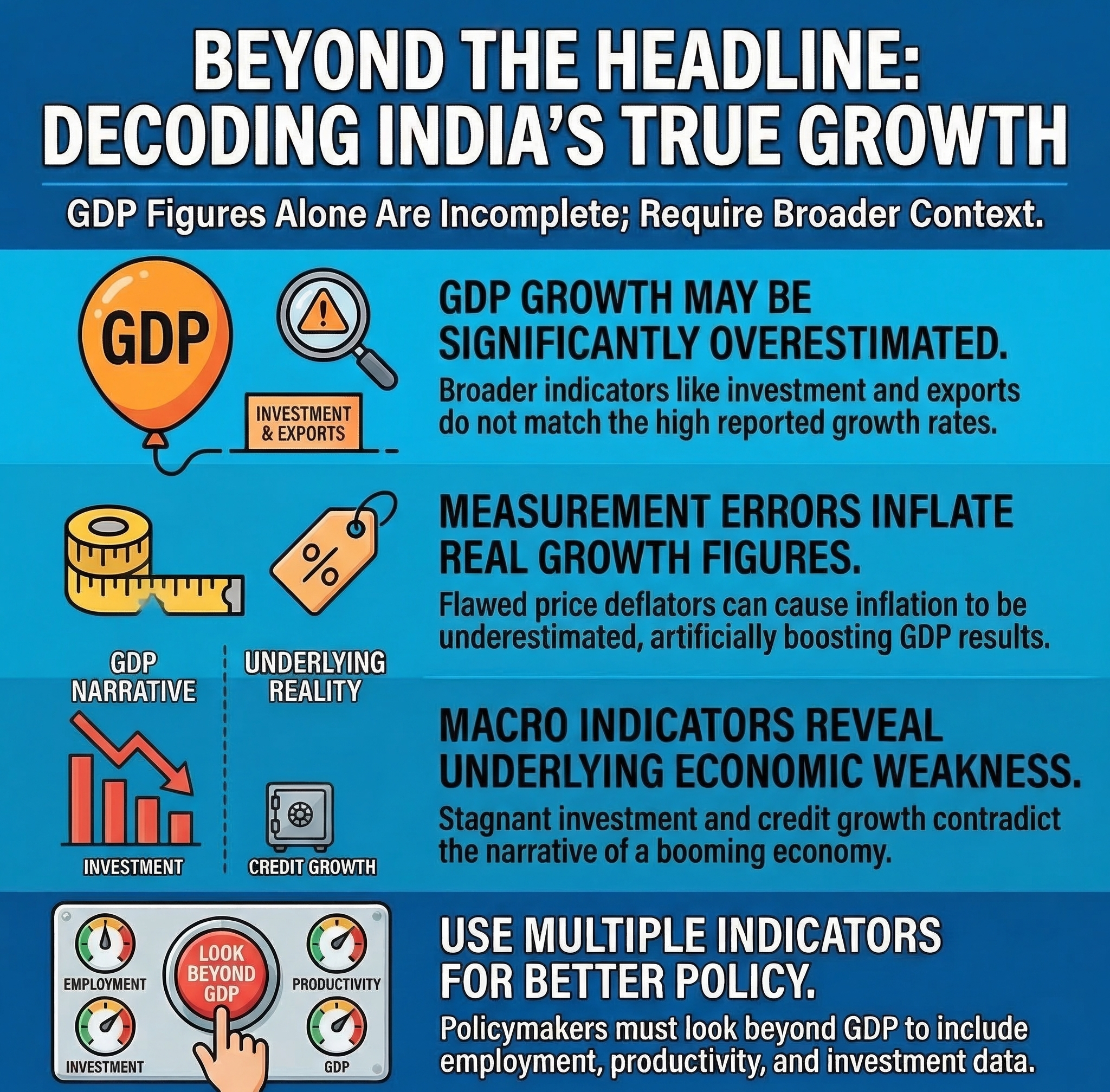
Key Arguments of the Article
Overestimation of Economic Growth
The article argues that GDP growth may have appeared stronger than the underlying economic reality. When broader macroeconomic indicators such as investment, exports, electricity consumption, and credit growth are examined, the growth trajectory appears less robust.
This discrepancy suggests that headline GDP numbers alone may not provide a complete picture of economic performance.
Role of Measurement and Deflators
A major argument presented in the article is that the methodology used to calculate real GDP, particularly price deflators, may have contributed to inflated growth estimates.
If inflation is underestimated in certain sectors, real growth figures may appear higher than actual economic expansion.
Weakness in Macro Indicators
The article highlights that several key economic indicators did not display growth patterns consistent with the reported GDP growth rates. Indicators such as investment levels, exports, and credit growth did not show the same level of expansion implied by headline GDP numbers.
This mismatch suggests structural weaknesses in economic activity.
Policy Misinterpretation
According to the authors, policymakers may have interpreted GDP data as evidence of strong economic performance. As a result, policy responses may not have adequately addressed underlying economic vulnerabilities.
Misreading macroeconomic signals can delay corrective policy actions.
Improvement in Recent Economic Trends
The article acknowledges that economic growth has shown improvement in recent years. However, the authors emphasise that earlier methodological inconsistencies complicate long-term comparisons.
Understanding the true growth trajectory requires careful interpretation of statistical data.
Author’s Stance
The authors adopt a critical analytical stance regarding official economic data and its interpretation. They argue that economic policymaking must rely on a broader set of indicators rather than focusing narrowly on headline GDP growth.
The article emphasises the importance of methodological transparency and data accuracy.
Possible Biases
Data Skepticism
The article adopts a critical view of GDP measurement, which may reflect broader debates about statistical credibility.
Methodological Emphasis
The discussion focuses strongly on technical aspects of economic measurement, potentially overlooking other explanations for macroeconomic trends.
Policy Critique
The analysis implicitly critiques policy responses that relied heavily on GDP growth indicators.
Advantages of the Analytical Approach
Encourages Comprehensive Economic Analysis
Examining multiple macro indicators provides a more balanced understanding of economic performance.
Strengthens Policy Formulation
Accurate interpretation of economic data allows policymakers to design better fiscal and monetary policies.
Promotes Transparency
Debates about statistical methodology improve accountability and credibility in economic data systems.
Highlights Structural Issues
The analysis draws attention to deeper economic challenges such as weak investment and productivity growth.
Challenges and Limitations
Complexity of Economic Measurement
GDP estimation involves multiple methodological assumptions, making precise measurement difficult.
Data Interpretation Differences
Different analysts may interpret the same data differently.
Policy Communication
Public debates over economic statistics may create confusion if not explained clearly.
Dynamic Economic Environment
Rapid structural changes in the economy can complicate statistical measurement.
Policy Implications
Strengthening Statistical Systems
Improving data collection methods and statistical transparency enhances economic policymaking.
Using Multiple Indicators
Policymakers should assess economic health using a broad set of indicators, including employment, investment, and productivity.
Improving Price Measurement
Refining price indices and deflators ensures more accurate real GDP estimates.
Enhancing Institutional Credibility
Strengthening the independence and capacity of statistical institutions is essential for maintaining trust in economic data.
Real-World Impact
If economic data is interpreted accurately:
• Better macroeconomic policy decisions
• Improved fiscal and monetary planning
• Greater investor confidence
If misinterpretation persists:
• Delayed policy corrections
• Weak economic reforms
• Reduced credibility of economic statistics
Alignment with UPSC GS Papers
GS Paper III
Indian economy, GDP measurement, macroeconomic indicators, economic policy.
GS Paper II
Institutional governance and credibility of public institutions.
GS Paper IV
Transparency, accountability, and ethical responsibility in public policymaking.
Balanced Assessment
Economic growth figures play a central role in shaping policy narratives and public perceptions. However, relying exclusively on headline GDP numbers can lead to incomplete assessments of economic health. A comprehensive analysis of macroeconomic indicators is necessary to understand the true state of the economy.
The article highlights the importance of statistical accuracy and critical economic analysis in policymaking.
Future Perspective
As India continues to evolve into a large and complex economy, improving economic measurement and data interpretation will become increasingly important. Strengthening statistical institutions, refining methodologies, and promoting transparent public debates about economic data will enhance the quality of policymaking.
For civil services aspirants and policymakers, the issue underscores the critical link between economic statistics, governance, and evidence-based policy decisions.
