

Heatwaves as Disasters: Strengthening India’s Disaster Finance

Heatwaves as Disasters: Strengthening India’s Disaster Finance
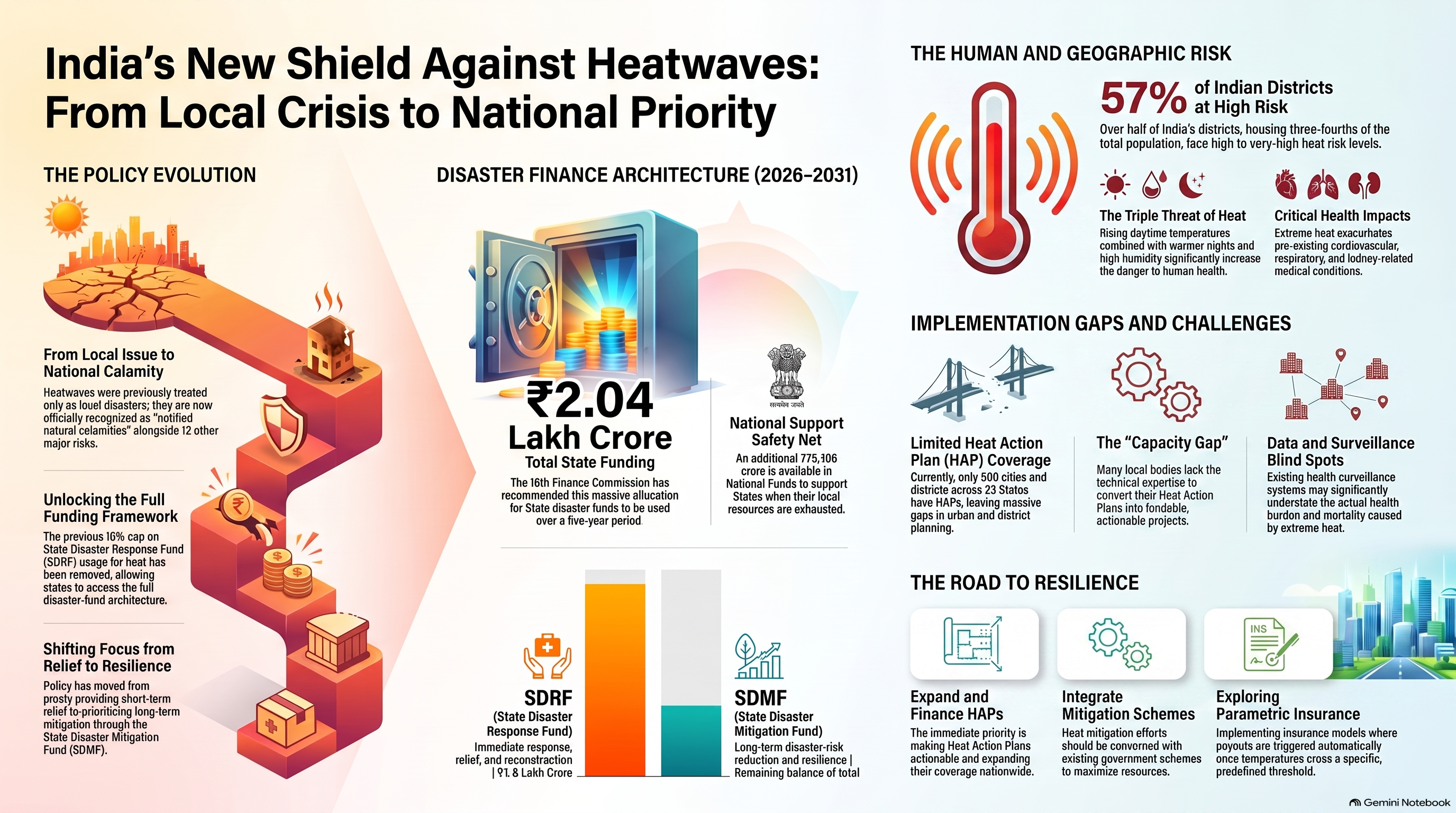
The Ministry of Home Affairs has added heatwaves and lightning to India’s list of notified natural calamities, taking the total to 14. This follows the 16th Finance Commission (FC-XVI) recommendations and allows States greater access to disaster funds for heat-related relief and mitigation.
What Has Changed?
|
Earlier |
Now |
|
Heatwave could be treated only as a local disaster |
Heatwave recognised as a notified natural calamity |
|
SDRF use subject to a 10% cap |
Eligible for the full State disaster-fund framework |
|
Focus mainly on relief |
Relief + long-term mitigation through SDMF |
Disaster Finance Architecture
FC-XVI recommended ₹2.04 lakh crore for State disaster funds for 2026–31.
|
Fund |
Purpose |
|
SDRF – ₹1.6 lakh crore |
Immediate response, relief and reconstruction |
|
SDMF – Remaining amount |
Long-term disaster-risk reduction |
|
National Funds – ₹79,406 crore |
Support when State resources are inadequate |
Why Heatwaves Matter?
- Over 57% of Indian districts, covering around three-fourths of the population, face high to very-high heat risk.
- Rising hot days, warmer nights and humidity increase health risks.
- Heatwaves can worsen cardiovascular, respiratory and kidney-related conditions.
What States Can Fund
- SDRF: Heat-related relief and compensation.
- SDMF: Cooling shelters, early-warning systems and other long-term resilience measures.
- Heat Action Plans (HAPs): Risk mapping and short-, medium- and long-term interventions.
Only around 300 cities/districts across 23 States currently have HAPs, while implementation is often constrained by inadequate funding and technical capacity.
Key Concerns
- Many local bodies lack capacity to convert HAPs into fundable projects.
- Heat-specific SDMF guidelines are still awaited.
- Existing health surveillance may understate the wider health burden of extreme heat.
- Large gaps remain in district and urban heat planning.
Way Forward
- Expand HAP coverage and make them financially actionable.
- Build technical capacity in local governments.
- Improve heat-related health and loss-and-damage data.
- Converge heat mitigation with existing government schemes.
- Explore parametric insurance, where payouts are triggered automatically when temperatures cross predefined thresholds.
Conclusion
Recognising heatwaves as notified disasters is an important shift in India’s climate-risk governance. However, funding eligibility must translate into funded projects, stronger heat planning and better health surveillance to build genuine heat resilience.
