

High Ethanol in Petrol Samples and the Ethanol Blending Programme

High Ethanol in Petrol Samples and the Ethanol Blending Programme
Source: The Hindu
Why in news?
Karnataka claims that petrol samples in the state contain up to 31.2% ethanol, far above the 20% (E20) level, and that this causes large consumer losses and raises transparency concerns. The pasted text carries no response from the Centre or the oil companies.
Key findings and claims
- The Department of Legal Metrology collected samples from various districts. Indian Oil (IOCL) samples showed 31.2% ethanol and Hindustan Petroleum (HPCL) samples 30.5%.
- Tests at NABL- and ISO-recognised labs confirmed the higher blends.
- Food, Civil Supplies and Consumer Affairs Minister Rizwan Arshad said the oil marketing companies (OMCs) did not disclose ethanol content from their in-house labs.
- He said 99% of India's 35 crore vehicles are not built for blends above 20%, and that reduced mileage causes consumer loss. The summary line gives a loss of ₹1 lakh crore, while the Minister's estimate is about ₹62,000 crore a year, so check the figure before quoting.
Karnataka's demands
- Penalise OMCs for over-blending.
- Set up an E20 spoilage fund to compensate owners for vehicle damage.
- Make ethanol blend percentage display mandatory at fuel stations, so consumers can choose.
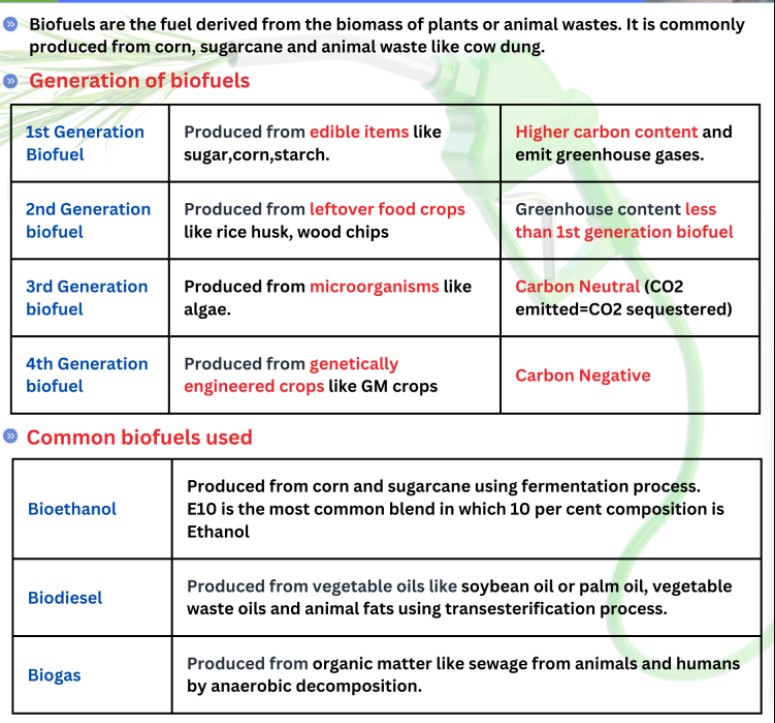
Sources of Bioethanol Production in India
|
Sources of bioethanol
- Sugarcane: juice, syrup, B-heavy molasses and C-heavy molasses. The government allowed diversion of juice, syrup and B-heavy molasses, but in December 2023 restricted it over fears of falling sugar stocks.
- Maize: its use has grown to make up for the sugarcane restrictions.
- Surplus rice and damaged grains: allowed for grain-based distilleries.
Significance of the programme
- Energy security: India imports over 88.5% of its crude oil, which leaves it exposed to events like the Russia-Ukraine war or a blockage of the Strait of Hormuz.
- Import substitution: Over ₹1.4 lakh crore was saved in the last decade. E20 is projected to save about $4 billion a year, helping the current account.
- Lower emissions: NITI Aayog estimates E20 cuts carbon monoxide by 50% in two-wheelers and 30% in four-wheelers.
Way forward
- Mandatory display of the ethanol blend at pumps and clear labelling.
- Independent, transparent testing, with results shared by OMCs and regulators.
- Offer an ethanol-free or lower-blend petrol option for older vehicles during the transition.
- A compensation mechanism for proven damage, and vehicle-makers' clarity on compatibility.
- Diversify feedstock (maize, damaged grains, second-generation sources) without hurting food security.