

Himalayan Erosion and Hidden CO₂ Release

Why in News?
- A study by researchers from IISER Pune, Wadia Institute of Himalayan Geology and IIT-Roorkee, published in Chemical Geology, has identified rapid Himalayan erosion as a significant geological source of atmospheric CO₂.
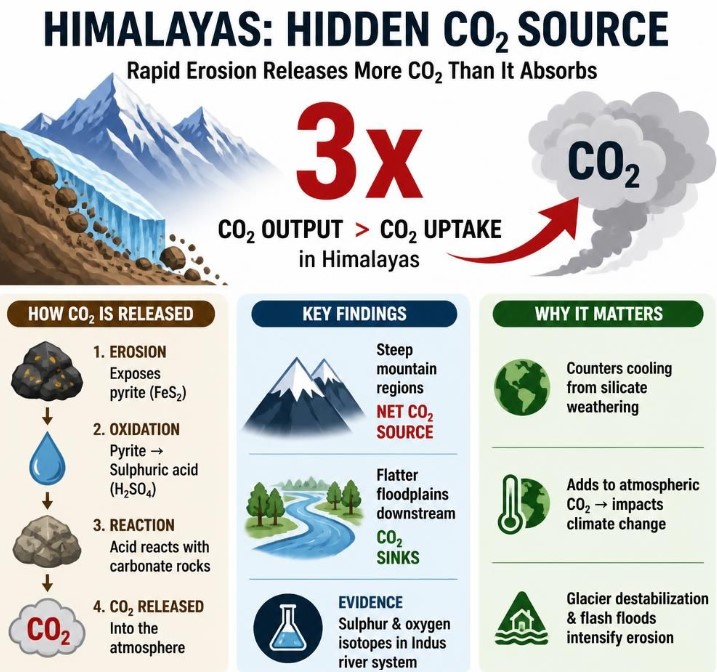
- The study focused on the upper Indus basin and found that CO₂ released through pyrite oxidation can outweigh the CO₂ absorbed through silicate weathering.
- CO₂ oxidation rates were estimated to be around three times higher than CO₂ uptake by silicate weathering in the studied region.
- The finding challenges the conventional view that intensified Himalayan erosion necessarily acts as a long-term carbon sink.
How Himalayan Erosion Releases CO₂?
- The collision of the Indian and Eurasian plates causes continuous Himalayan uplift, exposing fresh rocks and minerals to weathering.
- Normally, exposure of fresh silicate rocks accelerates silicate weathering, which removes atmospheric CO₂ and stores carbon over geological timescales.
- Rapid erosion also exposes pyrite (iron sulphide), commonly known as “fool’s gold”, to oxygen and water.
- Pyrite oxidation produces sulphuric acid, which reacts with carbonate rocks and releases CO₂ into the atmosphere.
- Thus, erosion can simultaneously:
- Remove CO₂ through silicate weathering.
- Release CO₂ through pyrite oxidation and subsequent carbonate reactions.
Silicate Weathering and the Carbon Cycle
- Silicate weathering is a major component of the long-term global carbon cycle and acts as a natural climate-regulating mechanism.
- Atmospheric CO₂ dissolves in rainwater to form weak carbonic acid, which reacts with silicate minerals.
- The weathering process produces dissolved bicarbonate and other ions that are transported by rivers to oceans.
- Carbon can eventually be stored in marine sediments and carbonate rocks for millions of years, reducing atmospheric CO₂.
- Increased temperature and rainfall generally accelerate chemical weathering, creating a long-term negative feedback on global warming.
- Himalayan uplift has historically increased exposure of fresh silicate rocks and therefore contributed to enhanced CO₂ drawdown.
Role of Glaciers and Regional Differences
- Glacial erosion intensifies the process by mechanically crushing rocks and exposing fresh mineral surfaces, including pyrite.
- Steep mountainous regions of the upper Indus basin were found to act as net CO₂ sources because pyrite oxidation can dominate the carbon cycle there.
- In contrast, flatter downstream floodplains can function as net CO₂ sinks due to greater CO₂ uptake through weathering.
- Researchers used sulphur and oxygen isotope ratios in the Indus river system to distinguish different sources of sulphate and identify the contribution of pyrite oxidation.
- The study demonstrates that the climatic impact of erosion depends on the type of minerals exposed and the subsequent chemical reactions.
Significance for Climate Change
- The findings show that mountain erosion is not simply a carbon sink; it can have opposing effects on atmospheric CO₂.
- Pyrite oxidation represents a previously underappreciated geological pathway through which erosion can contribute to long-term CO₂ release.
- The interaction between tectonic uplift, glaciers, erosion, mineral weathering and river transport is therefore important for understanding the global carbon cycle.
- Over geological timescales, such processes can influence Earth’s climate and partially offset the cooling effect traditionally attributed to enhanced silicate weathering.
- The Himalayan region consequently provides an important natural laboratory for studying interactions between geomorphology, geology and climate.
