

Himalayan glaciers losing mass yt faster rate: Study

Context:
Recent research highlights a critical acceleration in the melting of Himalayan glaciers, which are now losing ice significantly faster than in previous decades. This shift is not just a climate warning but an immediate threat to the water and economic security of nearly two billion people downstream.
Accelerating Mass Loss: Key Findings
A 2026 study led by Systemiq, in collaboration with the International Centre for Integrated Mountain Development (ICIMOD) and India's GB Pant National Institute of Himalayan Environment, reveals a stark escalation in glacier melt.
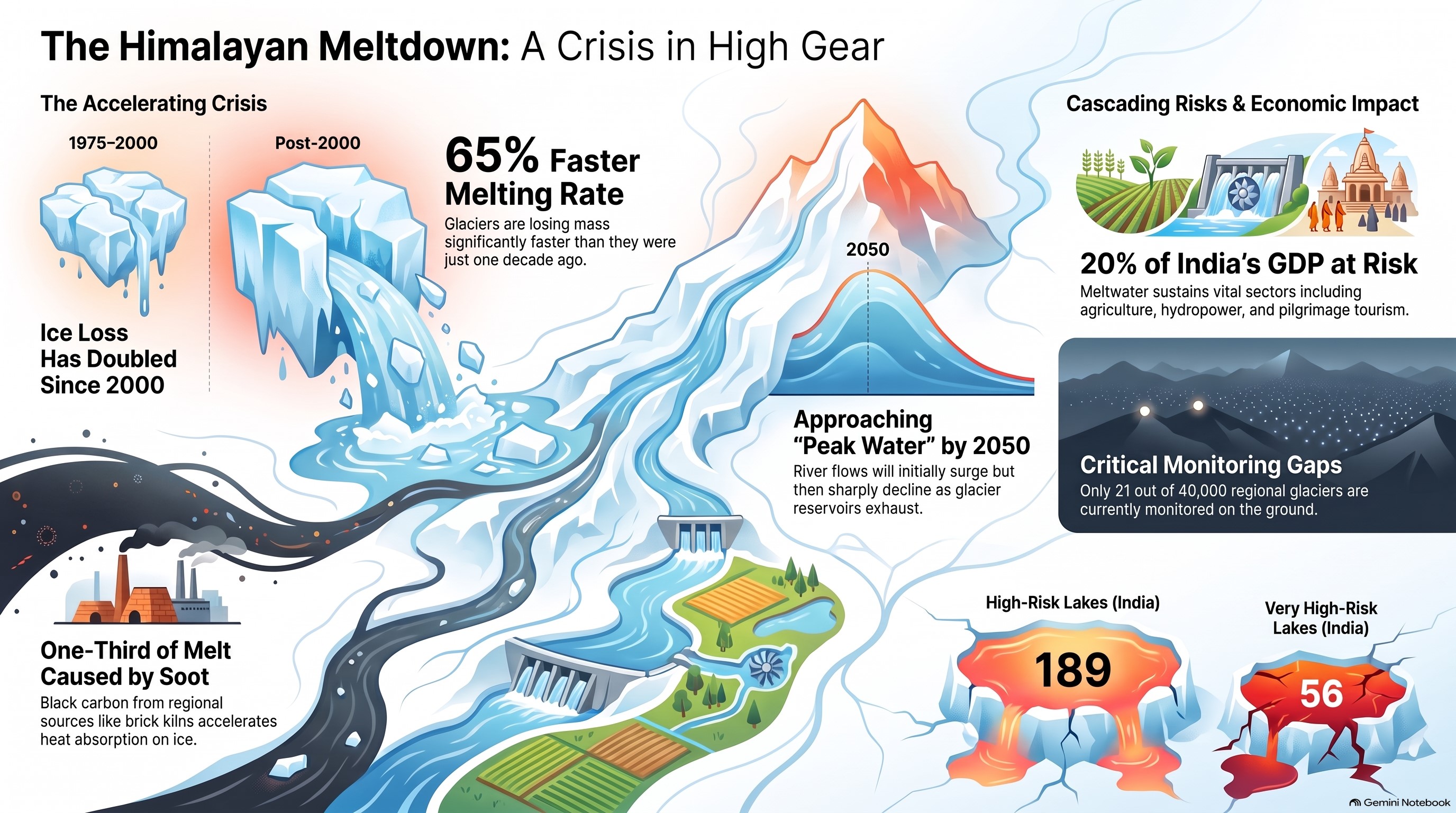
- Rate of Melting: Himalayan glaciers are losing mass 65% faster than they were just a decade ago.
- Post-2000 Acceleration: Data released by ICIMOD in early 2026 shows that ice loss rates have doubled since the year 2000 compared to the 1975–2000 period.
- The "Peak Water" Crisis: The region is approaching "peak water"—a threshold where river flows initially increase due to excessive melt but then sharply decline as the glacier "reservoirs" are exhausted. This is expected to occur by mid-century.
Primary Drivers of the Meltdown
While global temperature rise is the overarching cause, regional factors are significantly worsening the situation:
- Black Carbon: Roughly one-third of Himalayan glacier melt is now attributed to black carbon (soot).
- Shifting Monsoons: Changes in South Asian monsoon patterns are increasingly delivering rain instead of snow at high altitudes, which fails to replenish glaciers and instead accelerates surface melting.
Real Example
Brick kilns in the Indo-Gangetic plains are major regional sources of black carbon that settles on glaciers, darkening the ice and increasing heat absorption (reducing albedo).
Growing Risks & Monitoring Gaps
The physical landscape is becoming increasingly hazardous, leading to "cascading disasters."
- GLOFs and Collapses: The August 26, 2026, glacier collapse in Nepal’s Langtang Lirung triggered flash floods that killed over 1,300 people, demonstrating how destabilized ice leads to immediate tragedy.
- Vulnerable Lakes: India has identified 189 high-risk glacial lakes, with 56 classified as "very high risk".
- The Monitoring Deficit: Despite the scale of the crisis, monitoring remains dangerously limited. Out of an estimated 40,000 glaciers in the region, only about 21 are monitored on the ground in detail.
Economic Implications for India
The Himalayan water system is a vital economic pillar for South Asia:
- GDP Contribution: Meltwater supports river systems responsible for roughly 20% of India’s GDP.
- Sectoral Impact: Key sectors at risk include wheat and rice farming in the plains, hydropower generation, and the pilgrimage tourism economy.
