

HIMALAYAS' HANGING GLACIER THREAT

HIMALAYAS' HANGING GLACIER THREAT
Context
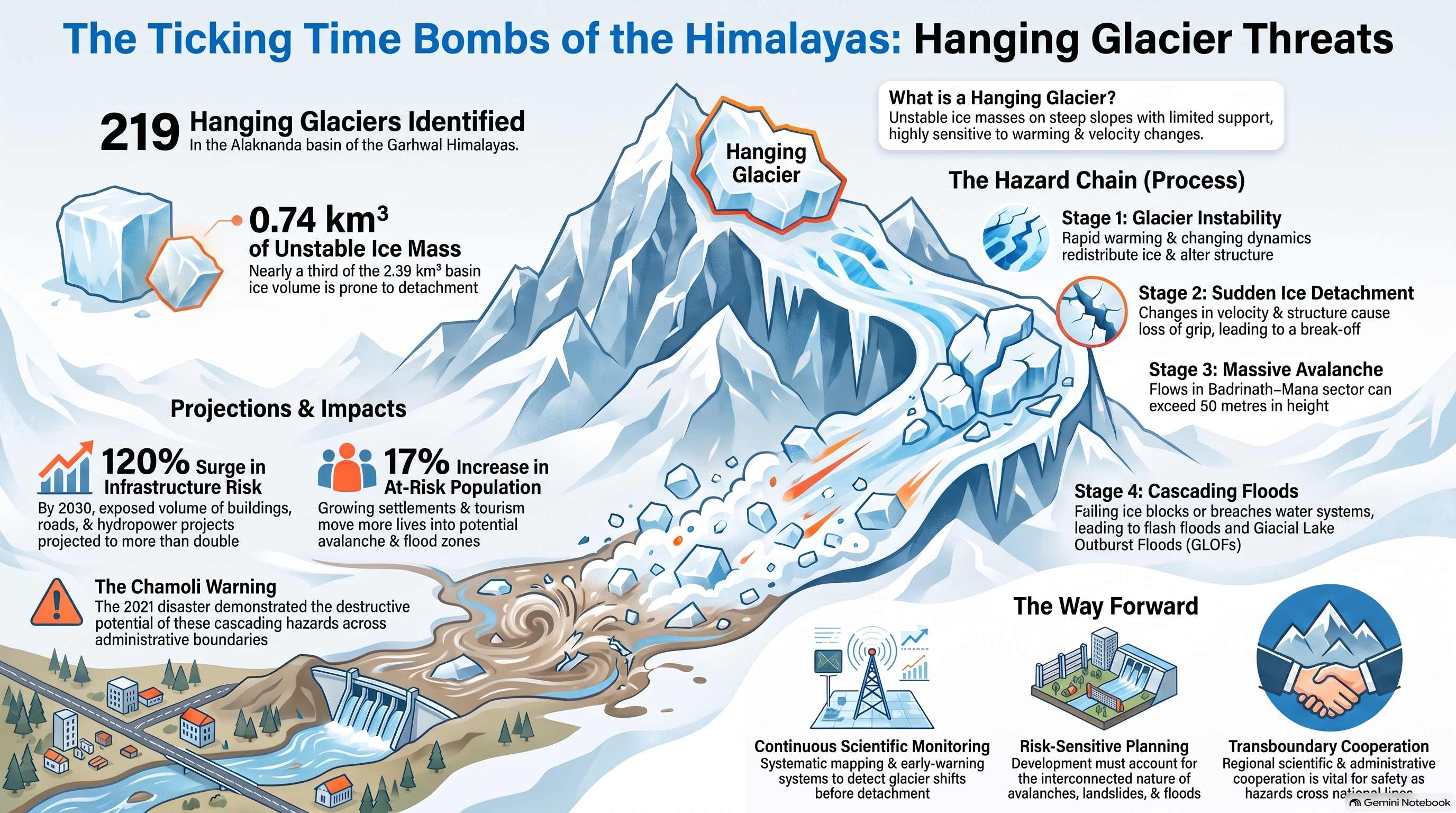
A study published in Nature has identified 219 hanging glaciers in the Alaknanda basin of the Garhwal Himalayas, highlighting growing risks of avalanches, floods and cascading disasters due to climate change.
Key Findings
|
Aspect |
Findings |
|
Location |
Alaknanda basin, Garhwal Himalayas |
|
Hanging glaciers identified |
219 |
|
Ice volume in basin |
2.39 km³ |
|
Hanging ice mass |
0.74 km³ |
|
Major risk |
Ice detachment → avalanches → floods/GLOFs |
|
Projected by 2030 |
120% rise in buildings/infrastructure and 17% rise in population at risk |
Researchers from IIT Bhubaneswar and the Indian Institute of Science, Bengaluru, found that rapid warming and changing glacier dynamics are increasing the instability of these ice masses.
What are Hanging Glaciers?
Hanging glaciers are unstable masses of ice located on steep slopes, often with limited support from the underlying terrain. Rapid changes in glacier velocity can redistribute ice and alter its structure, increasing the possibility of sudden detachment.
Hazard chain:
Glacier instability → ice detachment → avalanche → blockage/breach of water systems → flash floods/GLOFs → downstream damage
In the Badrinath–Mana sector, avalanche flows from glacier break-offs could exceed 50 metres in height.
Why It Matters?
- The 2021 Chamoli disaster demonstrated the destructive potential of cascading Himalayan hazards.
- Growing settlements, roads, hydropower and tourism infrastructure are increasing exposure in fragile mountain regions.
- Climate change is accelerating glacier retreat and destabilisation.
- Such hazards can cross administrative and national boundaries, requiring regional cooperation.
Way Forward
- Systematic mapping and continuous monitoring of hanging glaciers.
- Early-warning systems and rapid-response mechanisms.
- Risk-sensitive land-use and infrastructure planning.
- Treat avalanches, GLOFs, landslides and floods as interconnected cascading hazards.
- Strengthen scientific and transboundary cooperation.
- Address the root cause through rapid transition towards low-carbon energy.
Conclusion
The growing instability of hanging glaciers illustrates how climate change can transform natural geological features into cascading disaster risks. India needs to move from post-disaster response to anticipatory risk management through scientific monitoring, resilient infrastructure and climate-sensitive development in the Himalayas.
