

Homo Opportunisticus — The Making of Caste
The Hindu
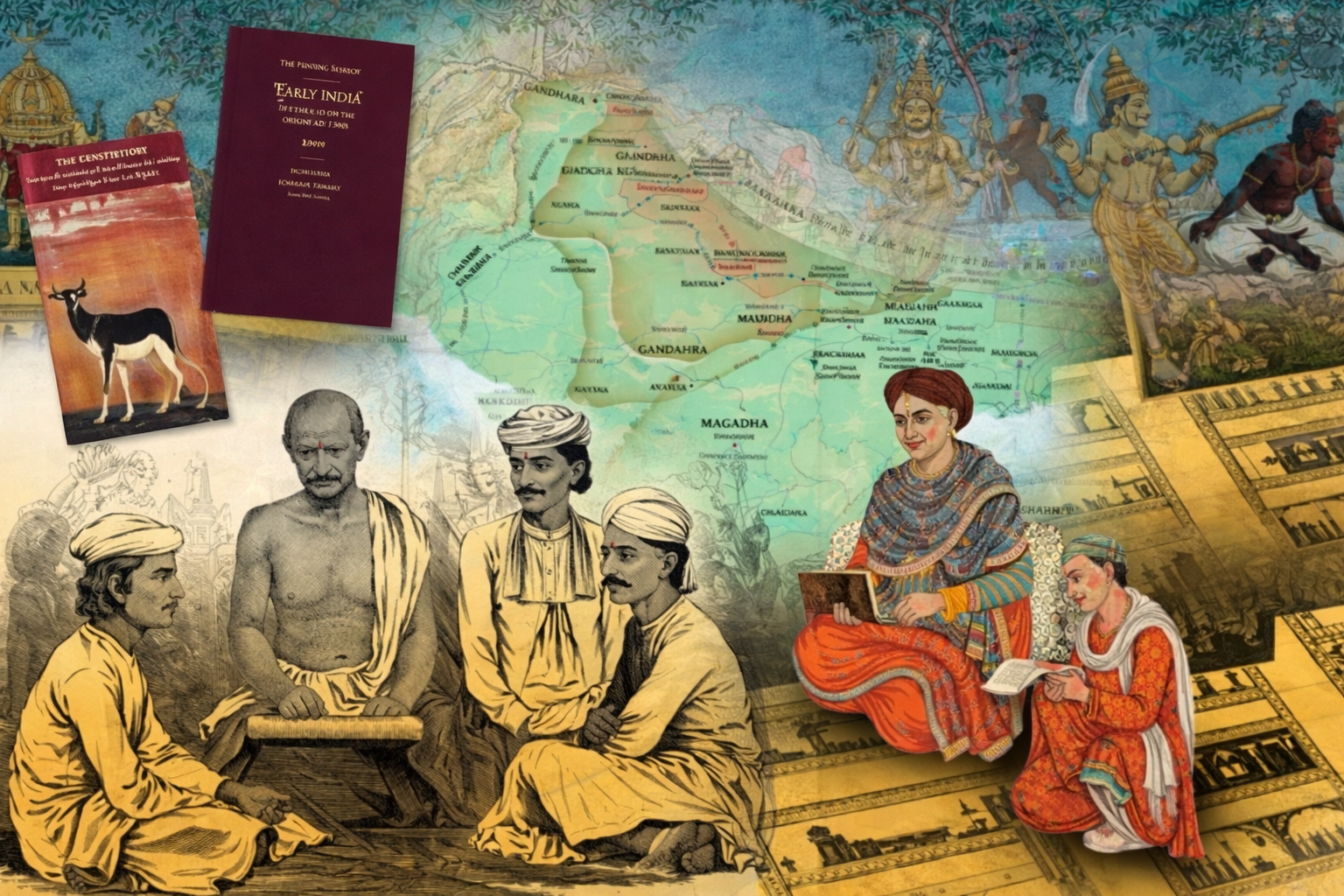
Context and Central Thesis
The article challenges essentialist and biologically deterministic explanations of caste by arguing that the origins and consolidation of caste are rooted in political contingencies, economic interests, and social strategies, rather than ritual purity, pollution, or racial difference alone. By foregrounding opportunism as a driving force, it reframes caste as a historically constructed and continuously negotiated social system.
The piece positions caste not as a static inheritance but as a dynamic outcome of power, property, and state formation.
Key Arguments Presented
1. Caste as a Product of Political Economy
The article argues that:
- Caste hierarchies emerged alongside agrarian expansion, surplus extraction, and state consolidation
- Occupational differentiation hardened into hereditary status when control over land, labour, and resources became politically valuable
- Elites used social closure to secure economic advantages
Caste is thus interpreted as an instrument of governance and resource control, not merely a religious ideology.
2. Rejection of Ritual-Only Explanations
The author contests the idea that:
- Purity–pollution alone explains caste origins
- Religious texts independently created rigid hierarchies
Instead, ritual ideology is presented as post-facto legitimisation, giving moral sanction to inequalities that were already economically and politically entrenched.
3. “Homo Opportunisticus” as an Explanatory Lens
A distinctive conceptual contribution is the idea that:
- Groups and individuals strategically adapted identities to changing power structures
- Caste boundaries were reinforced or reshaped when it served material or political interests
- Social mobility, alliance-making, and exclusion operated within caste logic
This frames caste as adaptive and opportunistic, rather than frozen.
4. Colonial Codification and Modern Reinforcement
The article highlights that:
- Colonial ethnography and census practices rigidified previously fluid identities
- Administrative classification converted social tendencies into fixed categories
- Post-colonial policies, while corrective in intent, further institutionalised caste consciousness
Thus, modern governance both challenged and deepened caste salience.
Author’s Stance
The author adopts a constructivist and materialist stance:
- Strongly anti-essentialist
- Critical of cultural or theological reductionism
- Sympathetic to sociological and historical explanations rooted in power relations
The tone is revisionist, aiming to unsettle comfortable narratives rather than reconcile viewpoints.
Biases and Editorial Leanings
1. Materialist Bias
The article:
- Privileges economic and political explanations over cultural autonomy
- Risks underplaying the independent force of belief systems and ritual practices
While corrective, this may tilt the analysis too heavily toward political economy.
2. Skepticism of Civilisational Narratives
There is:
- Implicit distrust of narratives that portray caste as timeless or uniquely religious
- Limited engagement with indigenous intellectual traditions that interpret caste differently
This may alienate readers who seek synthesis rather than rupture.
3. Modernist Reform Orientation
The article assumes:
- That exposing constructed origins weakens caste’s moral authority
- That rational-historical critique can contribute to social reform
This is normatively strong but sociologically optimistic.
Pros and Cons of the Argument
Pros
- Offers a powerful de-essentialised understanding of caste
- Integrates history, economy, and politics coherently
- Aligns well with contemporary sociological scholarship
- Helps aspirants move beyond simplistic purity–pollution answers
Cons
- Downplays lived cultural and religious meanings of caste
- Limited engagement with regional diversity of caste formation
- Abstract framing may underrepresent everyday social reproduction
Policy Implications
1. Social Justice and Affirmative Action
- Reinforces the rationale for state intervention in dismantling historically constructed inequalities
- Supports viewing caste as a structural issue rather than a cultural preference
2. Governance and Enumeration
- Raises questions about how far state classification reproduces the very identities it seeks to correct
- Calls for caution in bureaucratic reification of social categories
3. Education and Public Discourse
- Suggests the need for curriculum that presents caste as historical and political, not natural
- Encourages sociological literacy over moral binaries
Real-World Impact
- Strengthens intellectual foundations of anti-caste discourse
- Challenges narratives that normalise hierarchy as tradition
- Offers analytical tools for understanding contemporary caste politics, including mobilisation, identity assertion, and elite capture
For UPSC aspirants, it sharpens answers on caste by grounding them in historical sociology rather than moral commentary.
UPSC GS Paper Alignment
GS Paper I – Indian Society
- Caste system: origin, features, and changes
- Social stratification and mobility
- Colonial impact on Indian society
GS Paper II – Governance and Social Justice
- Affirmative action
- State and identity
- Social inclusion policies
Anthropology / Sociology Optional (Conceptual Overlap)
- Social evolution of stratification
- Constructivist vs functionalist interpretations
Balanced Conclusion and Future Perspective
The article compellingly reframes caste as a historically contingent and politically sustained system, rather than a timeless religious inevitability. By foregrounding opportunism, power, and material interest, it dismantles essentialist explanations and strengthens the case for structural reform. However, a fully rounded understanding of caste must also account for the enduring cultural meanings and everyday practices through which hierarchy is reproduced. Going forward, the value of such analyses lies not only in critique, but in informing policy, pedagogy, and public discourse that can address caste as a mutable social structure—one shaped by history, and therefore capable of transformation.
