

How CSR Is Rewriting India's Education Story?

How CSR Is Rewriting India's Education Story?
Relevance: GS Paper II (Education, Government Policies, CSR as a Governance Tool)
Why in the News?
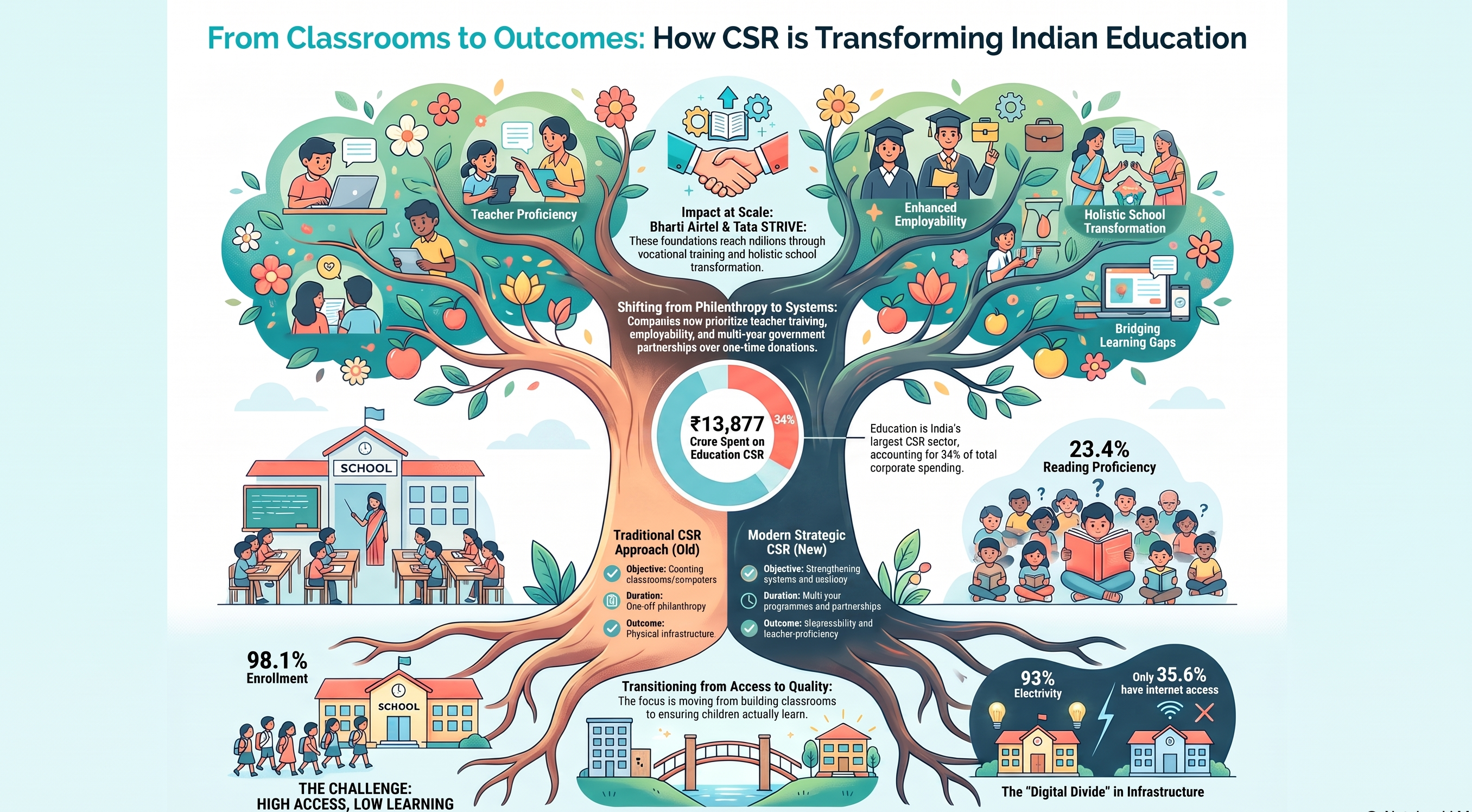
Corporate Social Responsibility (CSR) in education is shifting focus — from simply counting classrooms built, computers donated, or scholarships awarded, toward programmes strengthening government schools, training teachers, improving employability, and building long-term public-institution partnerships.
India's Education Landscape: Access vs. Learning
- Per UDISE+ 2024-25: India has 14.7 lakh schools, 24.7 crore students, and 1 crore teachers, with rural enrolment among children aged 6-14 at 98.1% and literacy among those 7+ at around 80-81%. PM SHRI Schools number 13,092, spanning 776 districts and 8,538 blocks.
- The next challenge is ensuring children actually learn. Per ASER 2024, among Class III government school students, those able to read a Class II-level text improved from 16.3% (2022) to 23.4% (2024), while those able to solve subtraction rose from 20.2% to 27.6% — encouraging gains, but underlining the distance still to be covered.
- Government initiatives like NIPUN Bharat, Samagra Shiksha, PM SHRI, and DIKSHA are addressing foundational literacy, teacher training, digital learning, and infrastructure. Under Samagra Shiksha (2018-19 to 2024-25) alone, 3,656 schools were upgraded, 9,477 covered under vocational education, 80,105 strengthened, and nearly 1.4 lakh schools covered under ICT/digital initiatives. Given the scale of the task, governments alone cannot do everything — this is where CSR is increasingly stepping in.
- Infrastructure gaps remain uneven: while 99.3% of schools have drinking water and 93.7% have electricity, only about two-thirds have computers (63.5%) or internet access (35.6%), and just 64.7% have ramps for Children With Special Needs — with dedicated CWSN toilets lagging further behind. Nearly 8% of 15-16-year-olds are no longer enrolled in school, with girls showing slightly higher non-enrolment than boys.
Scale of CSR in Education
Education has emerged as the single largest recipient of CSR funding in India. Per the latest CSRBOX report, India Inc. spent Rs 40,794 crore on CSR during FY2024-25 across more than 72,000 projects, of which education accounted for Rs 13,877 crore (34% of the total) — the biggest CSR sector. Significantly, companies are shifting away from one-off philanthropy toward multi-year programmes, government partnerships, and data-driven outcome monitoring, using CSR not to substitute public spending but to complement it — piloting new models, supporting teachers, strengthening school systems, and helping governments scale successful practices.
Case Studies
Bharti Airtel Foundation: reached over 22 lakh students across 16,000+ schools in FY2024-25 alone, with cumulative programme impact spanning 3.7 million students, 36,000+ schools, and 3.3 lakh teachers. Rather than focusing solely on infrastructure, its initiatives span teacher support, school transformation, life skills, and community engagement — including the Satya Bharti School Programme (164 rural schools across four states) and the Quality Support Programme (working with government schools across 12 states).
Tata STRIVE: focuses on youth skill development, career guidance, vocational education, and entrepreneurship, reporting cumulative outreach of more than 22.5 lakh beneficiaries — extending its focus beyond classrooms to ensure education translates into livelihoods and economic participation.
Key Takeaway
India has already built one of the world's largest education systems in terms of access. The next phase is about making that scale deliver genuinely better learning outcomes. Public investment remains the foundation, but if current trends continue, CSR could become an important catalyst in helping schools move from expanding access to improving learning quality — for students, teachers, and communities alike.
