

How India’s economy slipped to sixth largest
Indian Express
1. Core Thesis of the Article
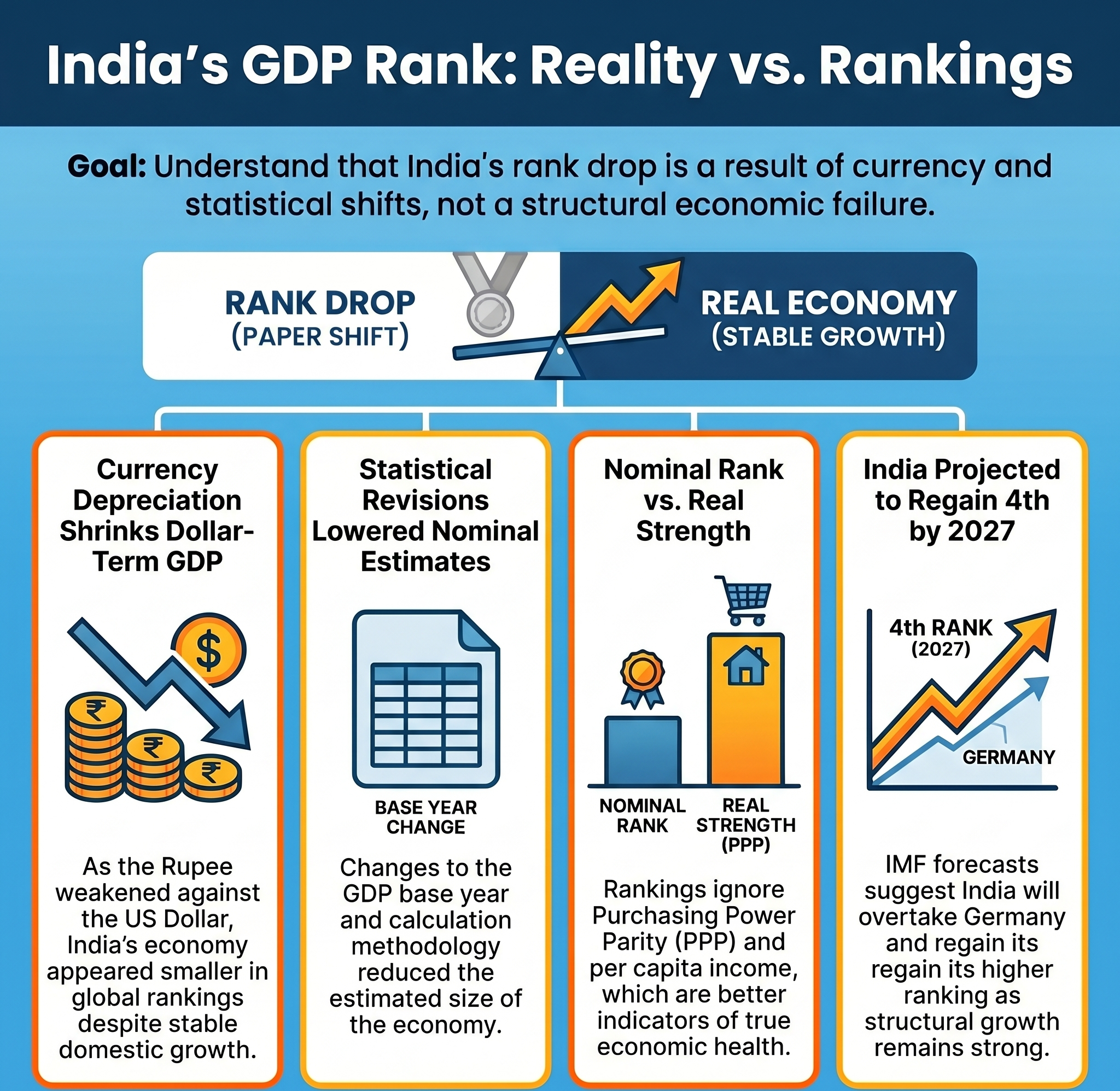
India’s fall from 4th to 6th position in global GDP rankings is not due to a collapse in real economic performance, but largely due to statistical revisions and exchange rate movements, highlighting the limitations of dollar-based GDP comparisons.
2. Detailed Breakdown of Key Arguments
(1) India’s Rank Drop: Reality vs Perception
- IMF estimates show:
- India slipped from 4th → 6th largest economy
- However:
- Domestic output has not contracted sharply
Key point:
- Ranking fall is relative and methodological, not structural collapse
(2) Role of GDP Measurement Methodology
IMF rankings depend on:
- GDP in local currency
- Conversion into USD using exchange rate
Implication:
- Even stable growth can appear weaker if:
- Currency depreciates
(3) Statistical Revision of GDP Base
- India revised GDP series (new base year)
Result:
- Earlier GDP figures were overestimated
- New estimates:
- Reduced nominal GDP size
Example:
- GDP revised downward significantly
Impact:
- Direct fall in global ranking
(4) Exchange Rate Depreciation
- Rupee weakened against US dollar
Even when:
- Dollar itself weakened globally
Effect:
- India’s GDP in dollar terms shrinks
- Countries with stronger currencies move ahead
(5) Comparative Dynamics with Japan and UK
- Japan:
- Benefited from currency and statistical factors
- UK:
- Likely to overtake India temporarily
Insight:
- Rankings are influenced by:
- External macro conditions
(6) Overemphasis on Nominal GDP Rankings
- Article cautions:
- Nominal GDP ≠ true economic strength
Better indicators:
- Purchasing Power Parity (PPP)
- Per capita income
- Growth rate
(7) Long-Term Growth Trajectory Remains Strong
- India continues:
- High growth economy
IMF projections:
- India may:
- Regain 4th position by 2027
- Overtake Germany later
(8) Structural Strengths of Indian Economy
Implicit arguments:
- Demographic advantage
- Domestic demand
- Service sector growth
(9) Global Context
- Top economies:
- US, China far ahead
- Mid-tier economies:
- Closely clustered
Meaning:
- Small changes → large rank shifts
3. Author’s Stance
- Balanced and data-driven
- Seeks to:
- Correct public misinterpretation
- Emphasises:
- Structural strength over headline ranking
Tone:
- Analytical, explanatory, cautionary
4. Biases in the Article
(1) Downplaying Symbolic Importance of Rankings
- Rankings influence:
- Investor perception
- Global influence
This aspect is under-emphasised
(2) Limited Focus on Domestic Weaknesses
- Issues like:
- Jobless growth
- Inequality
- Manufacturing gaps
not discussed
(3) Implicit Optimism Bias
- Assumes:
- Growth trajectory will continue
5. Pros and Cons of the Argument
Pros
Strong conceptual clarity
- Explains GDP measurement well
Corrects public narrative
- Avoids alarmism
Highlights currency factor
- Often ignored in media
Forward-looking perspective
- Based on IMF projections
Cons
Ignores deeper structural concerns
- Employment, productivity
Limited policy discussion
- Focus more on explanation
Underplays geopolitical implications
- Ranking affects global positioning
6. Policy Implications
(1) Focus Beyond Rankings
- Policy should prioritise:
- Real growth
- Welfare
(2) Exchange Rate Management
- Maintain:
- Stability without over-intervention
(3) Improve Data Quality
- Transparent GDP revisions
- Credible statistical systems
(4) Strengthen Economic Fundamentals
- Manufacturing push
- Export competitiveness
- Investment climate
(5) Diversify Growth Drivers
- Reduce dependence on:
- Currency-sensitive sectors
7. Real-World Impact
Short-Term
- Perception of economic slowdown
- Media and political debate
Medium-Term
- Investor sentiment fluctuations
- Policy pressure on government
Long-Term
- Minimal if fundamentals remain strong
- Rankings will stabilise with growth
8. UPSC GS Linkages
GS Paper III
- Economic growth vs development
- GDP measurement
- External sector
GS Paper II
- Role of IMF and global institutions
Essay Topics
- “Numbers vs reality in economic development”
- “Growth vs perception in global economy”
9. Critical Analytical Insight
This article highlights a key conceptual lesson:
Economic rankings are a function of both real output and financial variables like exchange rates—making them imperfect indicators of national strength.
10. Balanced Conclusion
The article effectively clarifies that:
- India’s drop in ranking is:
- Statistical, not structural
However:
- Rankings still matter for:
- Global perception
- Economic diplomacy
11. Way Forward (UPSC Ready Conclusion)
- Focus on:
- Sustainable growth
- Currency stability
- Data transparency
- Avoid:
- Over-politicisation of rankings
Final Editorial Takeaway
India’s economic strength cannot be judged solely by its rank in dollar terms. While rankings fluctuate with currency and statistical changes, the real measure lies in sustained growth, structural transformation, and improvement in citizens’ welfare.
