

How India’s ‘rooftop revolution’ is bringing power to the people
Times Of India
Key Arguments of the Article
Expansion of Rooftop Solar Adoption
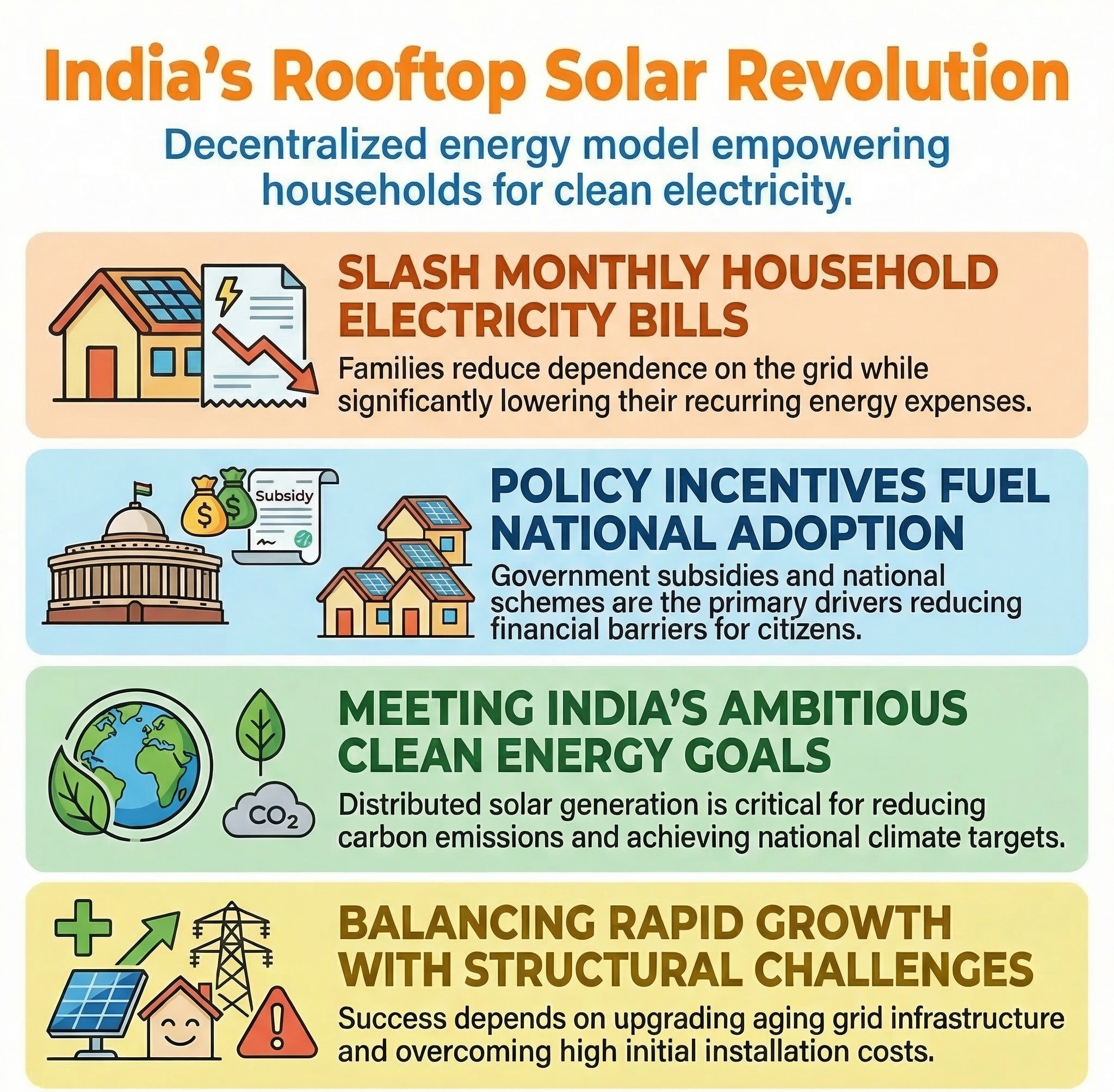
The article argues that rooftop solar installations have increased significantly since the rollout of the national scheme supporting residential solar power systems. Millions of households across India have adopted solar panels, with many beneficiaries reportedly seeing their electricity bills decline substantially.
This demonstrates the growing acceptance of decentralised renewable energy systems.
Household Energy Empowerment
A central theme of the article is the empowerment of households through energy self-generation. Rooftop solar systems allow families to reduce dependence on grid electricity and lower monthly expenses.
The article presents examples of households that have benefited from reduced electricity costs.
Government Policy Support
Government initiatives, subsidies, and policy incentives are portrayed as major drivers behind the expansion of rooftop solar adoption. These policies aim to encourage citizens to participate in the energy transition.
Public support schemes have reduced the financial barriers associated with installing solar systems.
Contribution to Clean Energy Goals
The article highlights that rooftop solar power contributes to India’s broader climate and renewable energy targets. Distributed solar generation helps reduce carbon emissions and supports India’s commitment to expanding renewable energy capacity.
State-Level Implementation and Variation
The article notes that states have played an important role in implementing rooftop solar schemes. Some states have demonstrated stronger adoption rates due to supportive policies, infrastructure readiness, and administrative efficiency.
Author’s Stance
The author adopts a largely optimistic and supportive stance toward rooftop solar expansion. The narrative emphasises the benefits of decentralised energy generation and portrays the initiative as a successful example of citizen participation in the renewable energy transition.
The tone reflects confidence in policy-driven energy reforms.
Possible Biases
Policy Optimism
The article focuses on positive outcomes of rooftop solar expansion and may underrepresent challenges such as grid integration issues, financing barriers, or maintenance concerns.
Selective Case Examples
Examples of households benefiting from the scheme may not fully reflect the varied experiences across different regions.
Limited Discussion of Structural Constraints
Issues such as uneven distribution infrastructure, regulatory barriers, and urban–rural disparities receive limited attention.
Advantages of Rooftop Solar Expansion
Energy Cost Reduction
Households can significantly reduce electricity expenses by generating their own power.
Decentralised Energy Generation
Distributed solar reduces dependence on centralised power plants and improves energy resilience.
Environmental Sustainability
Solar power contributes to reducing carbon emissions and promotes clean energy.
Reduced Pressure on Power Grids
Localised generation can reduce transmission losses and grid stress during peak demand periods.
Challenges and Limitations
High Initial Investment
Despite subsidies, installation costs remain a barrier for many households.
Grid Integration Issues
Large-scale distributed generation may create technical challenges for electricity distribution networks.
Maintenance and Technical Support
Solar systems require maintenance and technical expertise that may not always be readily available.
Uneven Adoption Across Regions
Some states have adopted rooftop solar faster than others due to administrative and infrastructure differences.
Policy Implications
Strengthening Financial Incentives
Subsidies, low-interest loans, and innovative financing models can encourage wider adoption.
Improving Grid Infrastructure
Electricity distribution networks must be upgraded to accommodate distributed energy systems.
Expanding Awareness Campaigns
Public awareness initiatives can encourage households to adopt rooftop solar technology.
Supporting Domestic Manufacturing
Encouraging domestic solar manufacturing can reduce costs and strengthen energy security.
Encouraging Urban and Rural Participation
Policies must ensure equitable access to rooftop solar systems across diverse socio-economic groups.
Real-World Impact
If rooftop solar expansion continues successfully:
• Reduced electricity costs for households
• Increased renewable energy capacity
• Reduced carbon emissions
• Greater energy security
If challenges remain unresolved:
• Slow adoption in low-income households
• Technical strain on distribution networks
• Uneven regional adoption patterns
Alignment with UPSC GS Papers
GS Paper III
Renewable energy development, climate change mitigation, energy security, and sustainable development.
GS Paper II
Government policies and programmes related to energy access and environmental governance.
GS Paper I
Human-environment interaction and sustainable resource management.
GS Paper IV
Ethical governance in promoting sustainable development and environmental responsibility.
Balanced Assessment
The expansion of rooftop solar systems represents a significant step toward decentralised energy production and citizen participation in India’s renewable energy transition. By reducing electricity costs and promoting clean energy, the initiative demonstrates the potential of policy-driven innovation in the energy sector.
However, the long-term success of rooftop solar expansion will depend on addressing financial, technical, and infrastructural challenges.
Future Perspective
India’s transition to renewable energy will increasingly rely on distributed energy systems such as rooftop solar. As technological costs decline and policy support expands, rooftop solar could become a central component of India’s energy strategy.
For policymakers and civil services aspirants, the initiative illustrates how decentralised energy solutions can simultaneously address energy access, environmental sustainability, and economic empowerment.
