

How Mining is Eating into a 2mn-year-old Site in Maharashtra
Times Of India
1. Key Arguments
A. Archaeological Significance of the Site
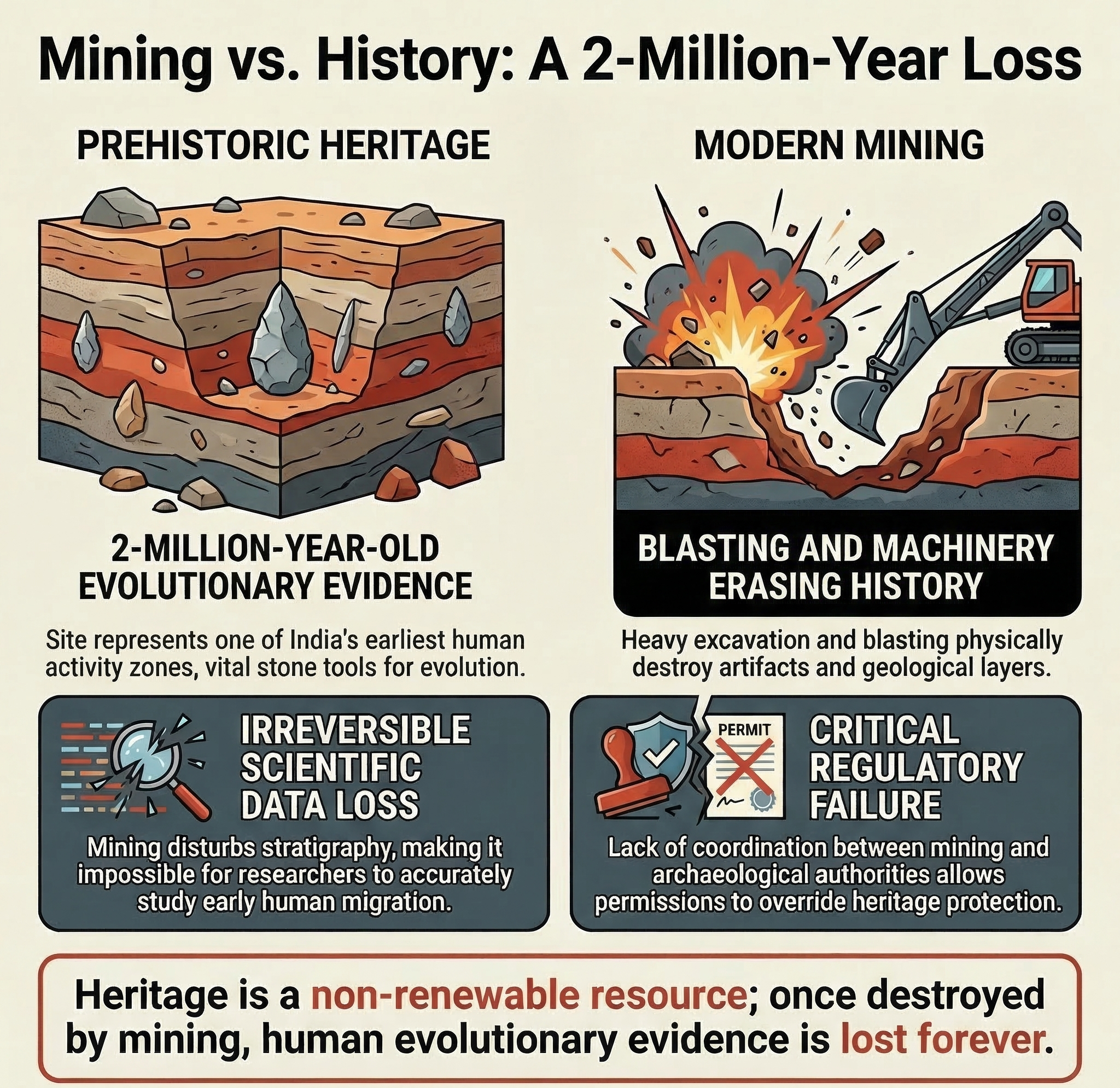
The site represents one of India’s earliest human activity zones.
Stone tools and artefacts linked to early hominin behaviour provide crucial evidence for understanding human evolution in the Indian subcontinent.
B. Mining Activities as a Direct Threat
Quarrying operations are physically destroying artefacts and geological context.
Blasting, excavation, and heavy machinery are eroding layers that hold irreplaceable historical data.
C. Administrative and Regulatory Failure
Lack of coordination between archaeology and mining authorities.
Despite known significance, permissions were granted or enforcement remained weak.
D. Conflict Between Development and Conservation
Economic interests are overriding heritage protection.
Mining supports local economy and infrastructure but at the cost of non-renewable cultural assets.
2. Author’s Stance
Conservation-centric and critical of governance lapses
Strong advocacy for heritage protection
The tone clearly prioritises preservation over extractive economic activity.
Implicit critique of state machinery
Highlights regulatory failure without directly naming accountability chains.
3. Biases and Limitations
Underrepresentation of economic compulsions
Local livelihood dependence on mining is not sufficiently explored.
Limited stakeholder diversity
Voices of miners, local communities, and industry are largely absent.
Absence of cost-benefit analysis
Does not quantitatively compare economic gains versus heritage loss.
4. Strengths (Pros)
Highlights irreversible loss
Archaeological destruction is permanent and scientifically invaluable.
Raises awareness of lesser-known sites
Focuses beyond famous heritage locations, expanding conservation discourse.
Connects development with sustainability concerns
Places mining within a broader environmental and cultural framework.
5. Weaknesses (Cons)
One-dimensional narrative
Primarily conservation-focused without balancing developmental needs.
Lack of policy detail
Does not elaborate on specific legal provisions (AMASR Act, EIA norms).
Limited national comparison
Could have contextualised with similar cases across India.
6. Policy Implications
A. Strengthening Legal Protection
Strict enforcement of heritage laws (AMASR Act, Antiquities laws)
Buffer zones and no-mining zones around archaeological sites.
B. Inter-Departmental Coordination
Integration between Archaeological Survey, State Departments, and Mining Authorities
Mandatory clearance from archaeological bodies before mining approvals.
C. Heritage Impact Assessment (HIA)
Parallel to Environmental Impact Assessment (EIA)
Assess cultural and archaeological risks before project approval.
D. Community-Based Conservation
Involving local populations in preservation efforts
Alternative livelihood models to reduce mining dependence.
E. Digital Documentation
3D mapping and archiving of sites
Mitigating loss through technological preservation.
7. Real-World Impact
Cultural Loss
Irreversible destruction of human evolutionary evidence
Loss of knowledge about early human migration and adaptation.
Scientific Impact
Breakdown of archaeological context
Disturbs stratigraphy, making research unreliable.
Economic Trade-off
Short-term gains vs long-term heritage tourism potential
Missed opportunities for sustainable cultural tourism.
Environmental Impact
Land degradation and ecological imbalance
Mining adds to deforestation, soil erosion, and pollution.
8. UPSC GS Paper Linkages
GS Paper I (History & Culture)
- Prehistoric cultures (Paleolithic age)
- Conservation of cultural heritage
GS Paper III (Environment & Economy)
- Mining impacts
- Sustainable development
- Environmental governance
GS Paper II (Governance)
- Policy implementation gaps
- Role of institutions in heritage protection
Anthropology Optional (Paper I)
- Human evolution
- Prehistoric archaeology and tool traditions
9. Balanced Conclusion
The issue reflects a classic development vs conservation dilemma.
While mining contributes to economic growth and livelihoods, the destruction of a 2-million-year-old archaeological site represents an irreversible loss that outweighs short-term benefits.
10. Future Perspective
Towards sustainable extraction models
Mining policies must integrate heritage sensitivity.
Institutional strengthening
Clear accountability mechanisms for violations.
Mainstreaming heritage in development planning
Archaeology should be treated as a critical national resource.
Technological and participatory conservation
Use of digital tools and community involvement for long-term preservation.
Final Insight
Unlike minerals, heritage cannot be regenerated—its loss is permanent and civilisational.
