

How the Law Measures Up Against the Digital Threat of Doxxing

How the Law Measures Up Against the Digital Threat of Doxxing
Relevance: GS Paper II (Fundamental Rights, Privacy, IT Law) | GS Paper III (Cyber Security)
Why in the News?
Following the Jantar Mantar protests, reports emerged that women who expressed political opinions had their personal details circulated online, exposing them to abuse and harassment — reviving debate on "doxxing." Though not a term recognised by any statute, this is not a legal vacuum: Indian law has long protected the interests doxxing threatens — privacy, dignity, reputation, personal security, and, in appropriate cases, the uninhibited exercise of free speech.
The Constitutional Foundation
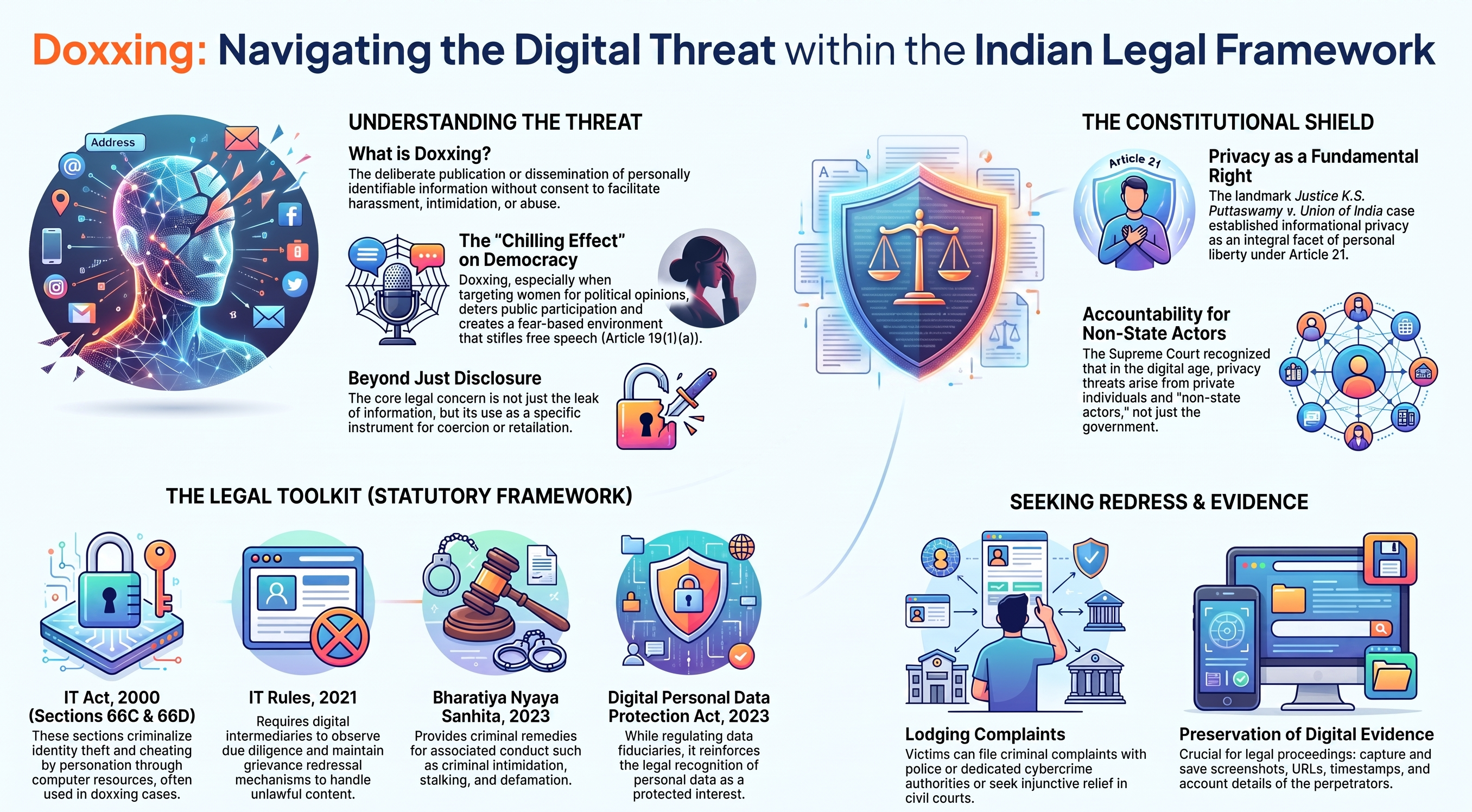
· Doxxing refers to the deliberate publication or dissemination of another person's personally identifiable information without consent, ordinarily with the object, or foreseeable consequence, of facilitating harassment, intimidation or abuse.
· The legal concern lies not merely in the disclosure of information but in its use as an instrument of coercion or retaliation. The constitutional foundation for addressing such conduct lies in the Supreme Court's landmark decision in Justice K.S. Puttaswamy v. Union of India, which recognised privacy as a fundamental right under Article 21 and held that informational privacy is an integral facet of personal liberty.
· Equally significant was the Court's recognition that in the digital age, privacy threats increasingly arise not merely from the state but also from non-state actors.
Privacy, Free Speech, and Democratic Participation
Doxxing is not merely an episode of unpleasant online behaviour — it is capable of impairing individual autonomy and personal security. Where the targets are women expressing political opinions, the constitutional implications become more pronounced. The prospect of being publicly identified and subjected to coordinated harassment can deter others from participating in democratic discourse, producing what constitutional jurisprudence describes as a chilling effect upon the exercise of speech. Article 19(1)(a) guarantees the freedom to criticise governments, political movements and public causes — what it does not protect is the transformation of political disagreement into a campaign that deliberately compromises another individual's privacy or personal safety.
The Existing Legal Framework
Although Indian law does not presently criminalise doxxing as a distinct offence, existing statutory provisions may, depending on the facts of a given case, furnish both civil and criminal remedies:
- Under the Information Technology Act, 2000, Section 66C criminalises identity theft, while Section 66D addresses cheating by personation through computer resources.
- Sections 67 and 67A may become relevant where dissemination of personal information is accompanied by publication or transmission of obscene or sexually explicit material, depending on the conduct alleged.
- Under the IT (Intermediary Guidelines and Digital Media Ethics Code) Rules, 2021, intermediaries must observe due diligence, maintain grievance redressal mechanisms, and comply with lawful directions — the statutory immunity available under Section 79 of the IT Act remains conditional on compliance with these obligations.
- Depending on the facts, conduct associated with doxxing may also attract provisions of the Bharatiya Nyaya Sanhita, 2023, relating to criminal intimidation, stalking, or defamation.
- The Digital Personal Data Protection Act, 2023, principally regulates processing of digital personal data by data fiduciaries, and so does not directly govern every instance of one individual publishing another's personal information online. Nevertheless, it reflects Parliament's recognition that personal data is a legally protected interest, reinforcing the broader constitutional commitment to informational privacy.
Legal Remedies
Where the facts disclose a criminal offence, complaints may be lodged with police or cybercrime authorities. Civil courts, and in appropriate cases constitutional courts, may grant injunctive relief directing removal of unlawful content or restraining its continued dissemination. Depending on the nature of the injury, remedies founded in defamation or other civil causes of action may also be available. In practical terms, preservation of digital evidence — including screenshots, URLs, timestamps and account details — often assumes considerable importance in establishing the factual foundation of any subsequent legal proceedings.
The Larger Constitutional Question
Doxxing ultimately presents a constitutional question as much as a technological one. Democracies depend not merely upon the formal guarantee of free speech, but upon conditions in which citizens may participate in public life without fearing that expressing a political opinion will result in exposure of their personal lives to an anonymous digital mob. Indian law possesses constitutional principles, statutory remedies and judicial powers capable of addressing the unauthorised disclosure of personal information — the more pressing challenge lies in ensuring these are invoked with sufficient promptness and effectiveness
