

How to Define an Ancient Hill Range? By Protecting a Delicate Balance
Indian Express
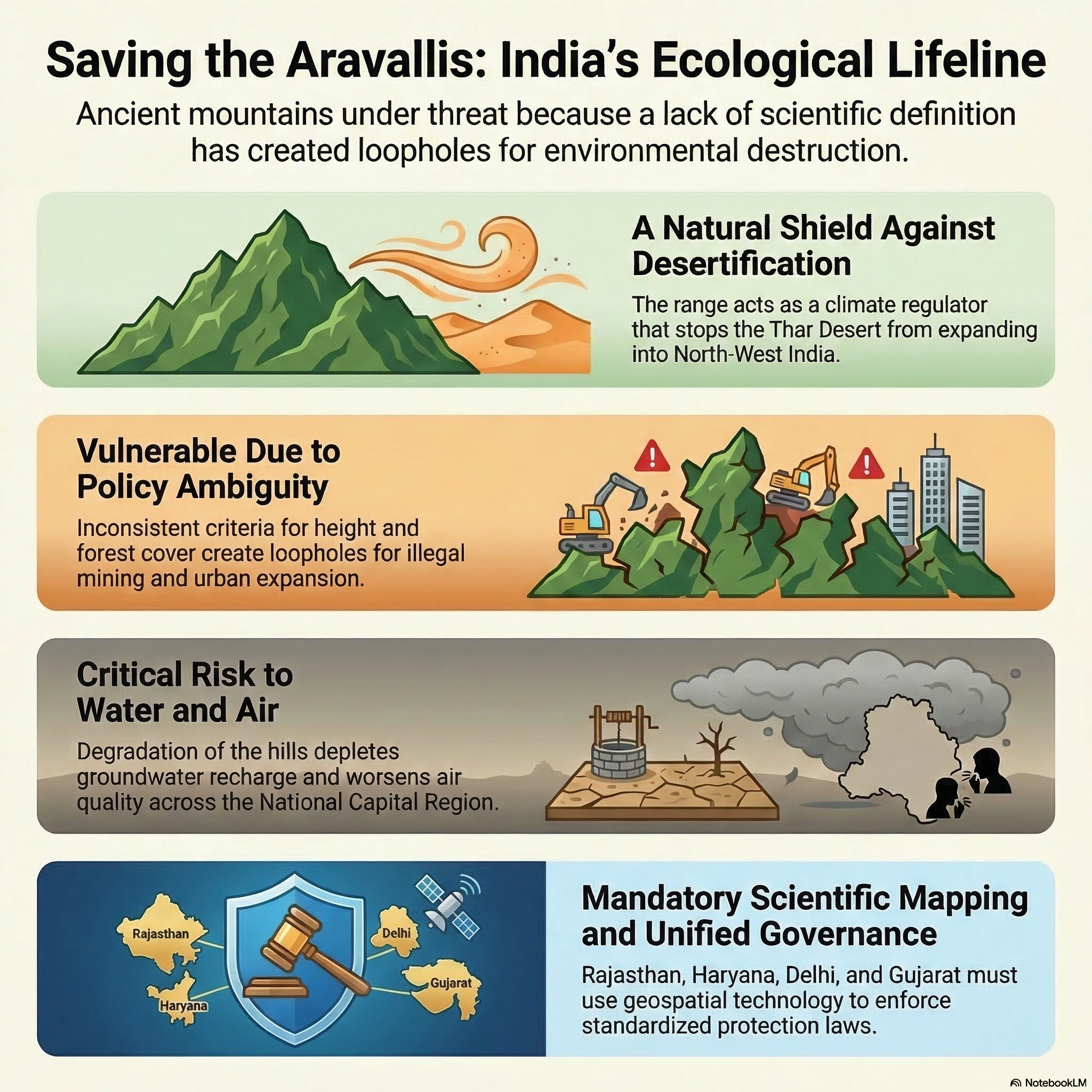
1. Key Arguments
A. Ambiguity in Defining the Aravallis
Lack of a uniform scientific and administrative definition has created policy loopholes.
Different criteria (height, geology, forest cover) have been inconsistently applied, leading to confusion.
B. Environmental Significance of the Aravallis
The Aravallis act as an ecological barrier and climate regulator.
They prevent desertification, recharge groundwater, and support biodiversity in north-west India.
C. Mining and Urbanisation Pressures
Arbitrary definitions have enabled mining and real estate expansion.
Large stretches have been excluded from protection, facilitating environmental degradation.
D. Institutional and Policy Failures
Fragmented governance between states and central agencies.
Lack of coordination among Forest Survey of India (FSI), state governments, and judiciary has weakened enforcement.
E. Need for Scientific and Legal Clarity
Revisiting definitions using modern tools and uniform criteria is essential.
Geospatial mapping, ecological parameters, and legal backing must guide classification.
2. Author’s Stance
Environment-centric with institutional critique
Strong advocacy for ecological protection
The author prioritises conservation of the Aravallis as a critical environmental asset.
Critical of policy inconsistency
Highlights bureaucratic inertia and lack of scientific rigor in governance.
3. Biases and Limitations
Limited developmental perspective
Economic needs such as construction, infrastructure, and mining livelihoods are underrepresented.
Over-reliance on institutional failure narrative
Less attention to political economy factors and local governance complexities.
Insufficient socio-economic context
Impact on local communities dependent on land and resources is not deeply analysed.
4. Strengths (Pros)
Highlights governance gaps clearly
Focuses on definitional ambiguity as a root cause of policy failure.
Strong ecological reasoning
Emphasises the Aravallis’ role in preventing desert expansion and maintaining climate stability.
Timely intervention
Relevant amid increasing urbanisation and environmental degradation in NCR and Rajasthan.
5. Weaknesses (Cons)
Limited policy detailing
Does not fully elaborate on actionable frameworks for redefining and protecting the range.
Absence of comparative insights
No reference to how similar ecological regions are managed globally.
Narrow focus on definition
Other factors like enforcement capacity and corruption are not deeply explored.
6. Policy Implications
A. Standardised Definition Framework
Adopt a multi-criteria approach
Combine geological history, ecological function, and topography.
B. Strengthening Legal Protection
Bring clarity under environmental laws
Integration with Forest Conservation Act, Environment Protection Act, and land-use regulations.
C. Use of Technology
Geospatial mapping and remote sensing
Accurate identification and monitoring of hill ranges.
D. Inter-State Coordination
Unified governance mechanism
Coordination among Rajasthan, Haryana, Delhi, and Gujarat.
E. Regulation of Mining and Urban Expansion
Strict zoning and enforcement
Ban or regulate activities in ecologically sensitive zones.
7. Real-World Impact
Environmental Consequences
Desertification risk increases
Loss of Aravalli cover may allow Thar desert expansion towards NCR.
Water Security
Decline in groundwater recharge
Impacts agriculture and urban water supply.
Air Quality
Loss of natural barrier worsens pollution in NCR
Dust storms and particulate matter increase.
Economic Trade-offs
Short-term gains vs long-term sustainability
Mining and real estate vs ecological stability.
8. UPSC GS Paper Linkages
GS Paper I (Geography)
- Physiography of India (Aravalli range)
- Environmental geography
GS Paper III (Environment & Economy)
- Environmental degradation
- Mining impacts
- Sustainable development
GS Paper II (Governance)
- Policy coordination
- Centre-State relations in environmental regulation
9. Balanced Conclusion
The challenge lies in reconciling scientific accuracy with governance practicality.
While redefining the Aravallis is necessary, it must be accompanied by strong enforcement and balanced developmental planning.
10. Future Perspective
Towards evidence-based environmental governance
Use of scientific data and technology in policymaking.
Integrated regional planning
Holistic approach covering ecology, economy, and society.
Strengthening institutional accountability
Clear roles and responsibilities across agencies.
Sustainable development pathway
Balancing conservation with livelihood needs.
Final Insight
Protecting the Aravallis is not just about defining a hill range, but about safeguarding an ecological lifeline for northern India.
