

How UGC rules prioritise quick justice
The Hindu
Core Arguments of the Article
1. Background: Judicial Push and Regulatory Response
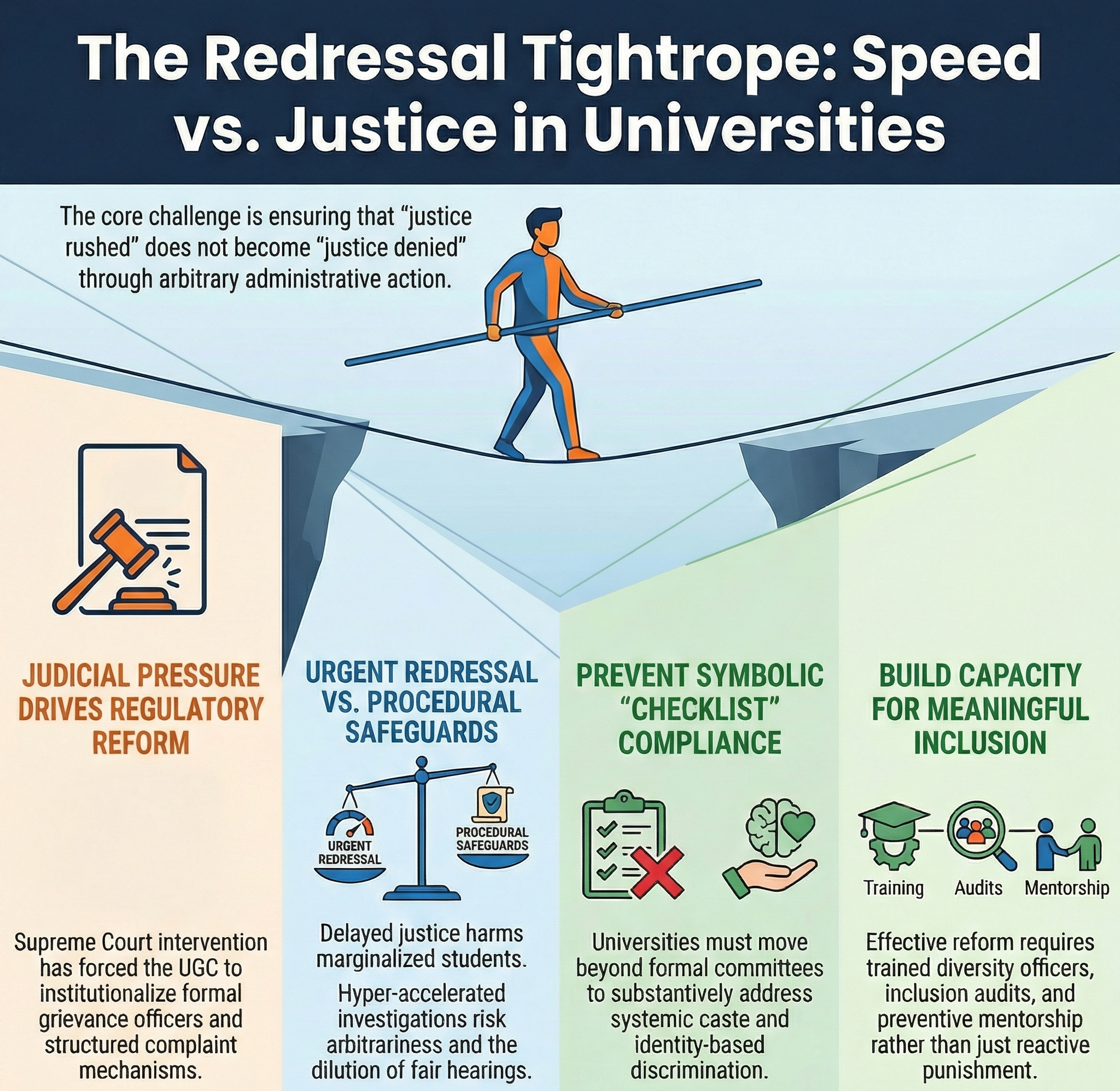
The Supreme Court’s intervention and public protests compelled the UGC to operationalise anti-discrimination norms more stringently. The regulations seek to institutionalise grievance officers and structured complaint mechanisms.
The author frames this as a response to systemic failures in addressing caste- and identity-based discrimination.
2. The Central Tension: Speed vs Due Process
The article’s central argument is that while timely justice is essential, accelerated grievance redressal may dilute procedural safeguards.
Quick investigations, immediate interim measures, and administrative action without layered review may risk arbitrariness.
3. Institutional Capacity Concerns
Universities, particularly public institutions, often lack trained personnel and procedural clarity. The new rules may burden institutions with compliance pressures without strengthening capacity.
4. Risk of Symbolic Compliance
The author warns that institutions might comply formally—through committees and documentation—without substantively addressing discrimination.
This may convert a moral and structural issue into a bureaucratic checklist.
5. Social Justice Imperative
The article recognises that students from marginalised communities—particularly from rural, linguistic, and caste backgrounds—face layered vulnerabilities. For them, delayed justice effectively becomes denial of justice.
Thus, urgency is morally justified.
Author’s Stance
The tone is cautious but sympathetic to the objective of anti-discrimination.
The author does not oppose the regulation per se; rather, the critique lies in its execution design. There is an emphasis on balancing urgency with fairness and ensuring enforcement does not become mechanical.
The ideological orientation is rights-based with institutional realism.
Possible Biases
1. Procedural Conservatism
There appears to be greater anxiety about institutional overreach than about historical discrimination patterns.
2. Administrative Lens
The article evaluates reforms largely from a governance standpoint, less from lived experiences of victims.
3. Skepticism of Regulatory Centralisation
Implicit concern exists about top-down regulation affecting university autonomy.
Pros of the Regulation (As Identified and Implied)
Strengthened Accountability
Creates formal grievance redressal structures.
Timely Response Mechanism
Prevents prolonged administrative silence.
Judicial Alignment
Brings regulatory framework in sync with constitutional mandates of equality and dignity.
Symbolic Assurance
Signals to marginalised students that the state acknowledges institutional discrimination.
Cons and Risks
Dilution of Due Process
Hasty investigations may compromise fairness.
Institutional Over-Correction
Fear of penalties may encourage defensive administration.
Bureaucratisation
Risk of committees functioning as compliance bodies rather than justice forums.
Capacity Deficit
Many institutions lack trained inquiry officers and diversity sensitisation mechanisms.
Policy Implications
Strengthening Internal Complaints Infrastructure
Institutions require trained diversity officers, legal literacy workshops, and clear procedural manuals.
Balancing Autonomy and Oversight
UGC must ensure regulatory clarity without micromanaging institutional functioning.
Data Transparency
Periodic public disclosure of complaint statistics and outcomes can improve credibility.
Preventive Framework
Beyond redressal, policies must focus on sensitisation, inclusion audits, mentorship support for first-generation learners.
Appellate Mechanisms
Clear appellate structure is essential to avoid concentration of power at one level.
Real-World Impact
If implemented effectively:
• Improved trust in institutional grievance systems
• Reduction in overt discrimination
• Stronger campus inclusion climate
If poorly implemented:
• Administrative overload
• Defensive institutional culture
• Litigation increase
• Erosion of academic autonomy
UPSC GS Paper Alignment
GS Paper II
Issues relating to education policy, constitutional safeguards for SCs/STs/OBCs, role of statutory bodies like UGC, judicial activism, governance reforms.
GS Paper I
Social justice, caste discrimination, role of educational institutions in social transformation.
GS Paper IV
Ethics in public administration, fairness, accountability, balancing compassion with procedural integrity.
Balanced Assessment
The article rightly identifies a structural dilemma: justice delayed is injustice, but justice rushed can become injustice of another kind.
Higher education institutions operate at the intersection of constitutional morality and academic autonomy. Regulations must protect vulnerable students without converting campuses into overregulated compliance zones.
Future Perspective
India’s demographic and social transformation depends significantly on equitable higher education access.
The next phase of reform should move from reactive grievance handling to preventive inclusion frameworks—diversity audits, faculty sensitisation, transparent reporting, and independent review bodies.
For civil services aspirants, this debate exemplifies governance trade-offs: speed versus fairness, regulation versus autonomy, and symbolism versus structural reform. It reflects broader state capacity challenges in translating constitutional ideals into institutional practice.
