

Human Noise Forces Himalayan Monal to Change Its Calls

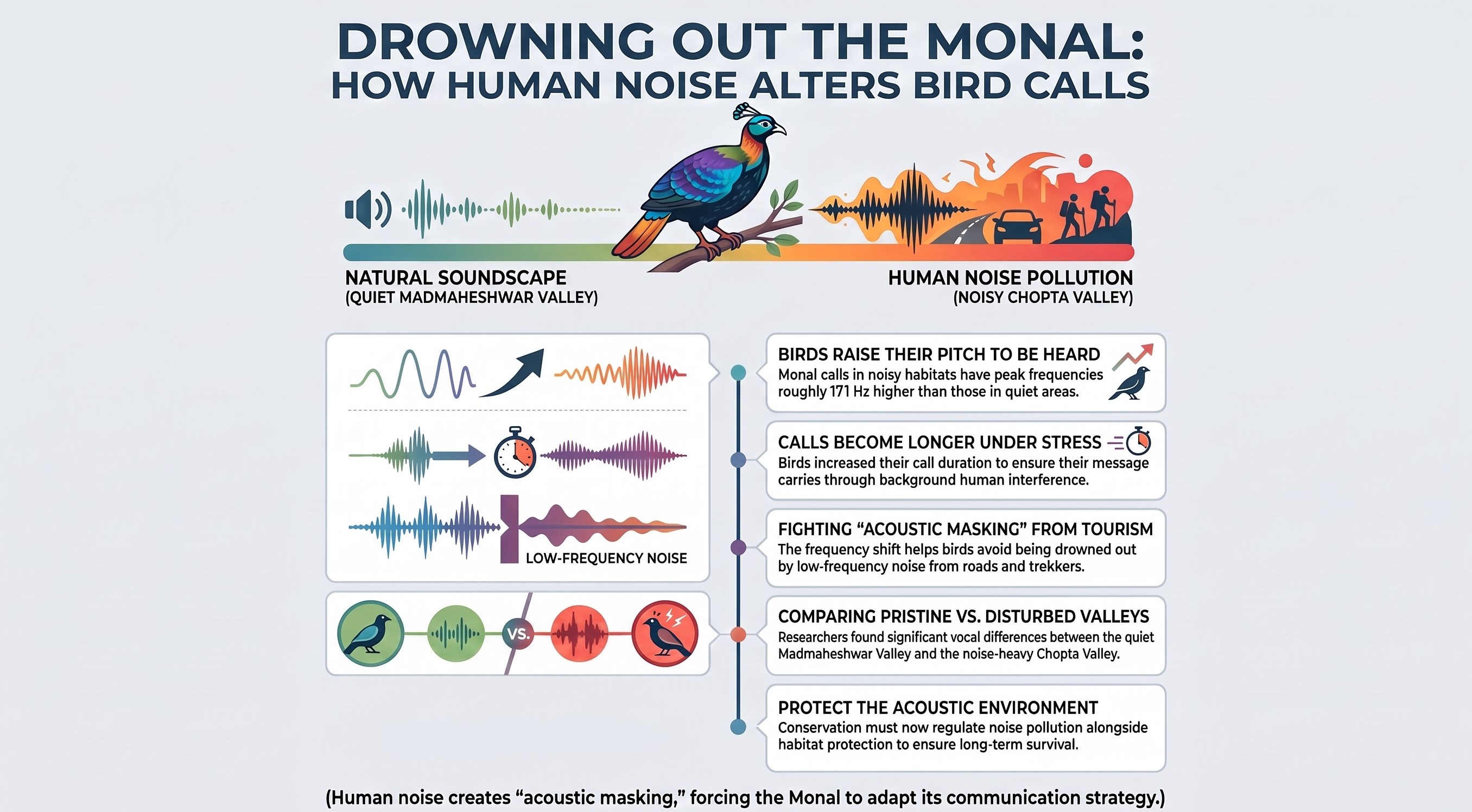
Source: The Hindu
Why in News?
- A study by researchers from Hemvati Nandan Bahuguna Garhwal University (HNBGU), published in Behavioural Processes in August 2025, examined the impact of human-generated noise on the communication of the Himalayan Monal.
- It provides the first evidence of noise-induced vocal changes in a Himalayan galliform.
- Researchers compared monal calls from:
- Madmaheshwar Valley — relatively undisturbed habitat.
- Chopta Valley in Kedarnath Musk Deer Sanctuary — exposed to greater human noise from roads, pilgrims, trekkers, tourists and birdwatchers.
- Recordings were collected from April 2023 to June 2024, mainly during peak calling periods in mornings and evenings.
- A total of 719 calls were analysed using directional microphones and AudioMoth acoustic recorders.
Impact of Human Noise on Monal Communication
- Birds exposed to higher levels of anthropogenic noise showed:
- Higher peak frequencies in their calls.
- Slightly longer call duration.
- At the median level, peak frequency in the natural habitat was around 171 Hz lower than in the noisy habitat.
- The effect was particularly strong at the upper end of the vocal range.
- At the highest analysed frequency band, the statistical model explained about 73.4% of the variation in peak frequency.
- The upward shift in frequency is interpreted as a strategy to reduce “acoustic masking” by low-frequency human-generated noise.
- Increased call duration may represent another mechanism to maintain communication when background noise interferes.
- These changes demonstrate vocal flexibility, although the study did not establish their effects on mating success, breeding behaviour or long-term survival.
Behavioural Ecology and Social Norms
- Human-generated noise is an important form of habitat disturbance because many birds depend on acoustic communication for:
- Mate attraction and reproduction.
- Territorial defence.
- Maintaining contact between individuals.
- Detecting environmental threats.
- Persistent anthropogenic noise can interfere with these signals and potentially alter normal behavioural patterns.
- Himalayan habitats are increasingly exposed to noise from tourism, transportation and other human activities.
- The monal’s ability to modify its calls indicates short-term behavioural adaptation, but repeated or prolonged acoustic disturbance could impose ecological costs.
- Such effects may extend beyond the Himalayan Monal to other wildlife species that rely on sound for communication.
Conservation Significance and Way Forward
- The Himalayan Monal is the state bird of Uttarakhand and an important representative of Himalayan biodiversity.
- Conservation strategies should therefore address not only habitat destruction and physical disturbance but also acoustic pollution.
- Sensitive monal habitats should be identified and monitored for anthropogenic noise levels.
- Unnecessary vehicle noise, loud tourist activity and other avoidable sources of disturbance should be regulated, particularly during important breeding and calling periods.
- Noise management can be incorporated into tourism and protected-area management plans.
- Further research is needed to determine whether altered vocal behaviour affects reproduction, social interactions, population dynamics and long-term survival.
- Protecting the acoustic environment is an emerging dimension of wildlife conservation, alongside protection of physical habitats.
