

In Great Nicobar, a shifting of the green goalposts
Hindustan Times
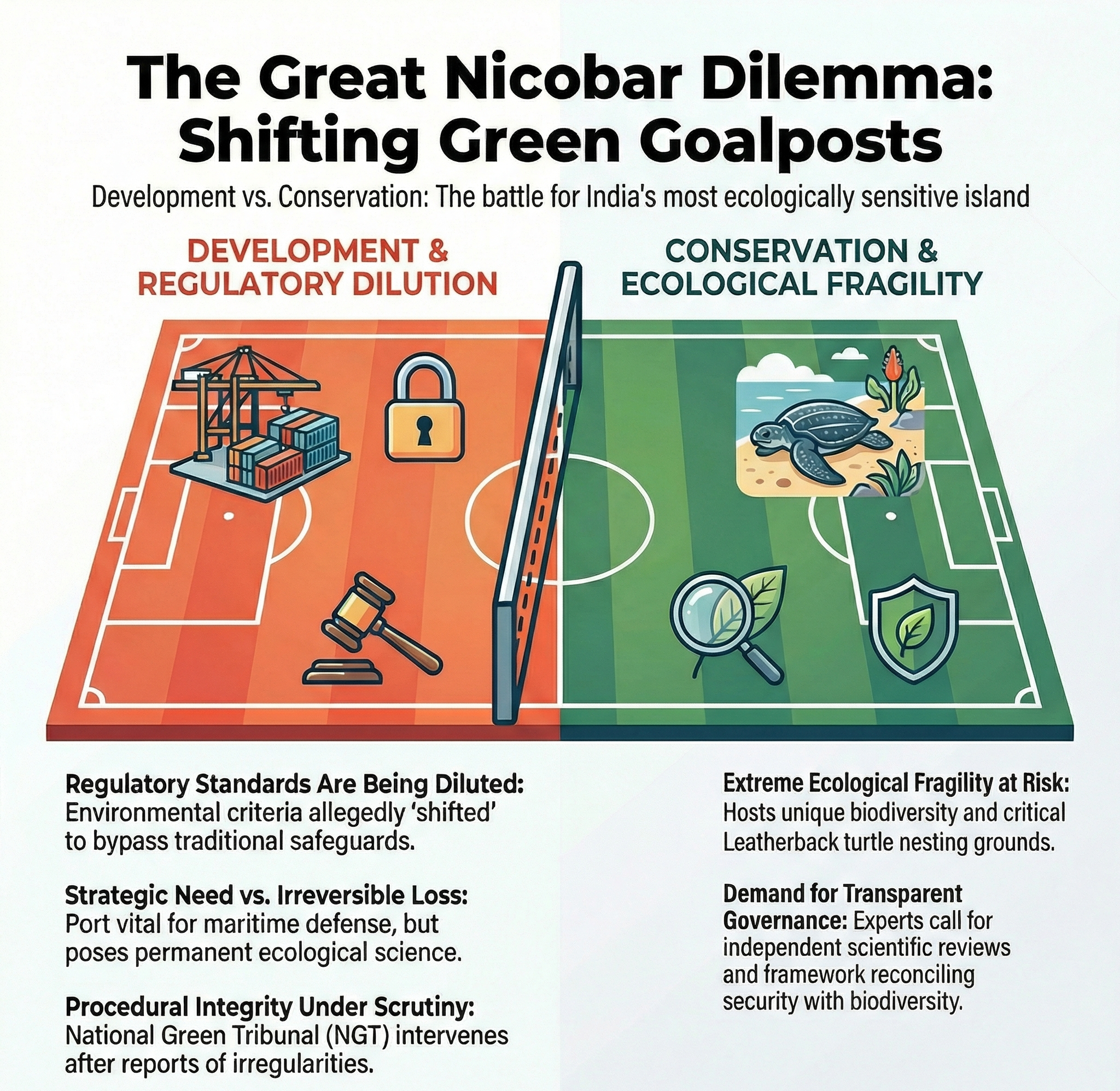
Core Theme of the Article
The article critically examines the environmental clearance granted to the Great Nicobar infrastructure project, particularly the Galathea Bay port development. It argues that regulatory standards were allegedly diluted or reinterpreted to facilitate approval, raising concerns about environmental governance, scientific integrity, and procedural propriety.
The central claim: environmental safeguards appear to have been relaxed to accommodate strategic infrastructure objectives.
Key Arguments Presented
1. Questionable Environmental Clearance Process
The National Green Tribunal’s intervention and subsequent proceedings suggest procedural irregularities in the grant of clearance.
2. Shifting Regulatory Standards
The article alleges that environmental criteria were adjusted or selectively interpreted to enable project approval.
3. Ecological Fragility of Great Nicobar
The island is ecologically sensitive, hosting leatherback turtle nesting grounds and unique biodiversity.
4. Strategic Justification vs Environmental Costs
While the project is strategically significant (transshipment port, defense relevance), the environmental risks are presented as substantial and potentially irreversible.
5. Precedent Risk
If standards are diluted in one high-profile project, it could set a broader precedent for weakening environmental governance.
Author’s Stance
The tone is investigative and cautionary.
• Critical of regulatory dilution
• Skeptical of executive justification
• Emphasises ecological science and rule-based governance
The stance leans toward environmental protection over strategic urgency.
Possible Biases and Framing
Environmental Protection Bias
The article foregrounds ecological risks more prominently than economic or strategic benefits.
Procedural Integrity Bias
Assumes that any deviation in clearance norms may reflect institutional compromise.
Understated Strategic Imperative
Limited engagement with India’s maritime and Indo-Pacific strategic needs.
These biases reflect an environmental governance perspective rather than partisan alignment.
Strengths of the Article
• Highlights environmental rule-of-law concerns
• Connects project approval with institutional accountability
• Emphasises biodiversity conservation
• Raises questions of regulatory transparency
Limitations
• Limited exploration of geopolitical context (Indo-Pacific competition)
• Underdeveloped cost-benefit analysis
• Does not quantify projected economic gains
• Does not deeply discuss rehabilitation and mitigation measures
Policy Implications
1. Environmental Governance Reform
Strengthen transparency in Environmental Impact Assessment (EIA) processes.
2. Independent Scientific Review
Institutionalise external peer review in ecologically fragile zones.
3. Strategic-Environmental Balance
Develop a framework for reconciling national security infrastructure with biodiversity protection.
4. Institutional Accountability
Clarify roles of NGT, MoEFCC, and state agencies in approval processes.
Real-World Impact
Short Term
• Increased scrutiny of mega infrastructure projects
• Possible delays or conditional approvals
Medium Term
• Stricter compliance norms
• Higher project costs due to environmental safeguards
Long Term
• Strengthened environmental jurisprudence
• Institutional tension between development and conservation
UPSC GS Alignment
GS Paper I
• Biodiversity and ecological conservation
• Coastal and island geography
GS Paper II
• Environmental governance
• Role of NGT
• Separation of powers and regulatory oversight
GS Paper III
• Infrastructure development
• Environmental Impact Assessment
• Sustainable development
• Maritime strategy and port-led growth
Essay Relevance
• “Development vs environment: a false binary?”
• “Strategic imperatives and ecological ethics”
Balanced Editorial Assessment
The article rightly underscores the importance of procedural integrity in environmental decision-making. In ecologically sensitive zones such as Great Nicobar, precautionary principles must guide policy.
However, national security and maritime competitiveness also demand infrastructure expansion. The debate should not be framed as environment versus development, but as development with enforceable safeguards.
Future Perspective
India’s path forward requires:
• Transparent environmental clearance mechanisms
• Climate-resilient and biodiversity-sensitive infrastructure design
• Integrated island development plans
• Scientific accountability alongside strategic planning
If regulatory standards are perceived as flexible or negotiable, institutional credibility suffers. If environmentalism becomes absolutist, strategic imperatives may be compromised.
Final Editorial Judgment:
The real issue is not whether Great Nicobar should develop, but whether development respects ecological science and constitutional governance. Sustainable statecraft lies in balancing both without shifting goalposts.
