

In-Kind Welfare Transfers and Living Standards in India

In-Kind Welfare Transfers and Living Standards in India
Source: Sarvekshana, National Statistical Office (NSO) Subject: Indian Economy / Poverty / Inclusive Growth
Why in News?
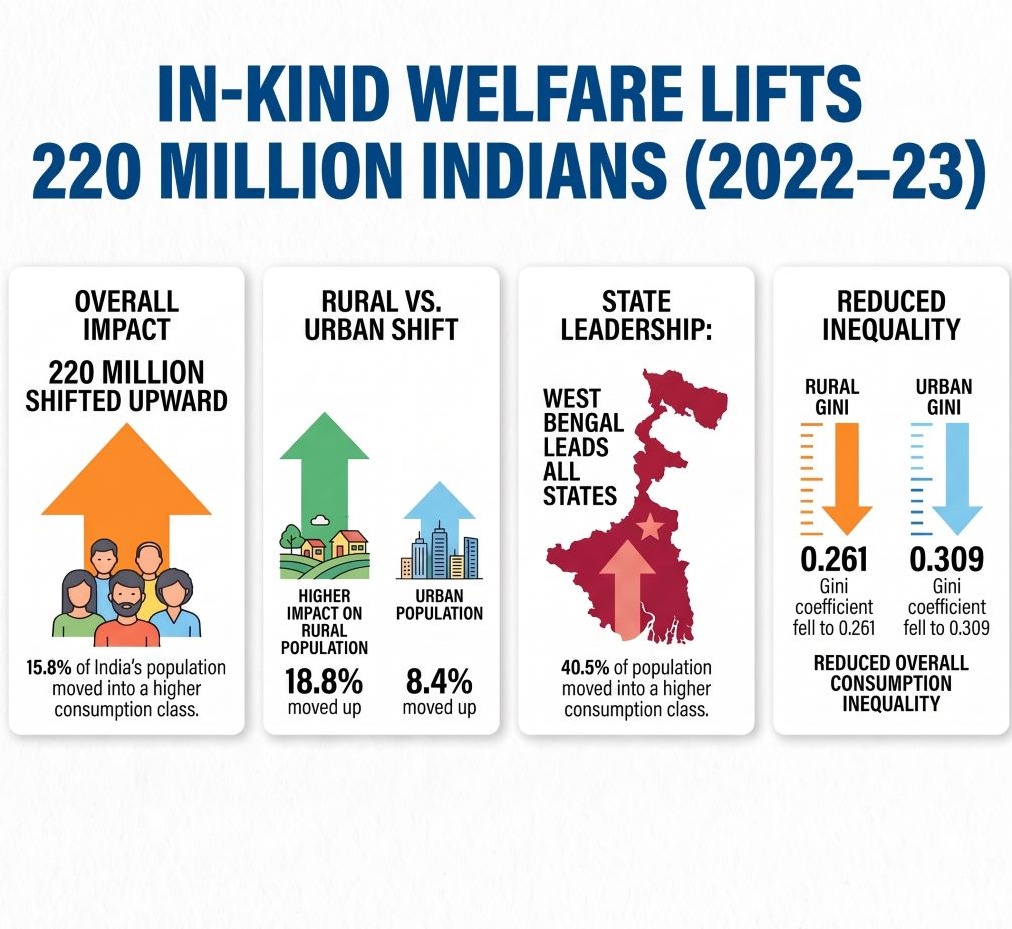
A study published in the 121st edition of Sarvekshana found that free and subsidised goods provided through government welfare schemes improved the measured consumption levels of approximately 220 million Indians in 2022–23.
Key Findings
- Beneficiaries: 15.8% of India’s population moved into a higher consumption class after the value of in-kind transfers was included.
- Rural–urban difference: 18.8% of the rural population and 8.4% of the urban population moved into a higher consumption class.
- Top-performing state: West Bengal recorded the highest improvement, with 40.5% of its population moving into a higher consumption class.
- Other states: Chhattisgarh (29.2%), Assam (29.0%), Karnataka (28.4%) and Uttar Pradesh (22.7%) featured among the leading states shown in the report.
- Distributional impact: The largest improvements occurred among poorer consumption groups, indicating the progressive nature of welfare transfers.
Types of In-Kind Transfers
- Food grains supplied through the Public Distribution System (PDS), along with pulses, sugar, salt and edible oil.
- Educational benefits such as school uniforms, shoes, bicycles, tablets and laptops.
- Other free or subsidised goods distributed through government welfare schemes.
Impact on Inequality
- The rural Gini coefficient declined from 0.266 to 0.261 after accounting for in-kind transfers.
- The urban Gini coefficient declined from 0.314 to 0.309.
- These changes indicate a modest reduction in consumption inequality.
Methodology
- The study used unit-level data from the Household Consumption Expenditure Survey (HCES) 2022–23.
- Households were ranked by monthly per capita consumption expenditure (MPCE) and divided into 12 consumption classes.
- Researchers added the estimated value of free and subsidised goods to household consumption and measured movement into higher classes.
Significance
- Poverty reduction: In-kind transfers improve access to essential goods and may reduce the effective cost of living for poorer households.
- Food and educational security: Benefits such as food grains, uniforms and bicycles support nutrition and school participation.
- Inclusive growth: The greater impact on poorer consumption groups suggests that welfare schemes can reduce consumption disparities.
- Poverty measurement: Including the value of transfers provides a more complete picture of household living standards than cash expenditure alone.
Limitations
- Moving into a higher consumption class does not necessarily mean that a household has permanently escaped poverty.
- Benefits distributed regardless of income, such as some bicycles or electronic devices, may also reach better-off households.
- The study measures the estimated consumption value of transfers; it does not by itself establish their long-term impact on nutrition, education or income.
Conclusion
In-kind welfare transfers can improve household consumption and reduce inequality, particularly among poorer sections. However, sustained poverty reduction requires these transfers to complement employment generation, quality public services and opportunities for higher incomes.