

In-situ development vital for slum rehabilitation
The Statesman
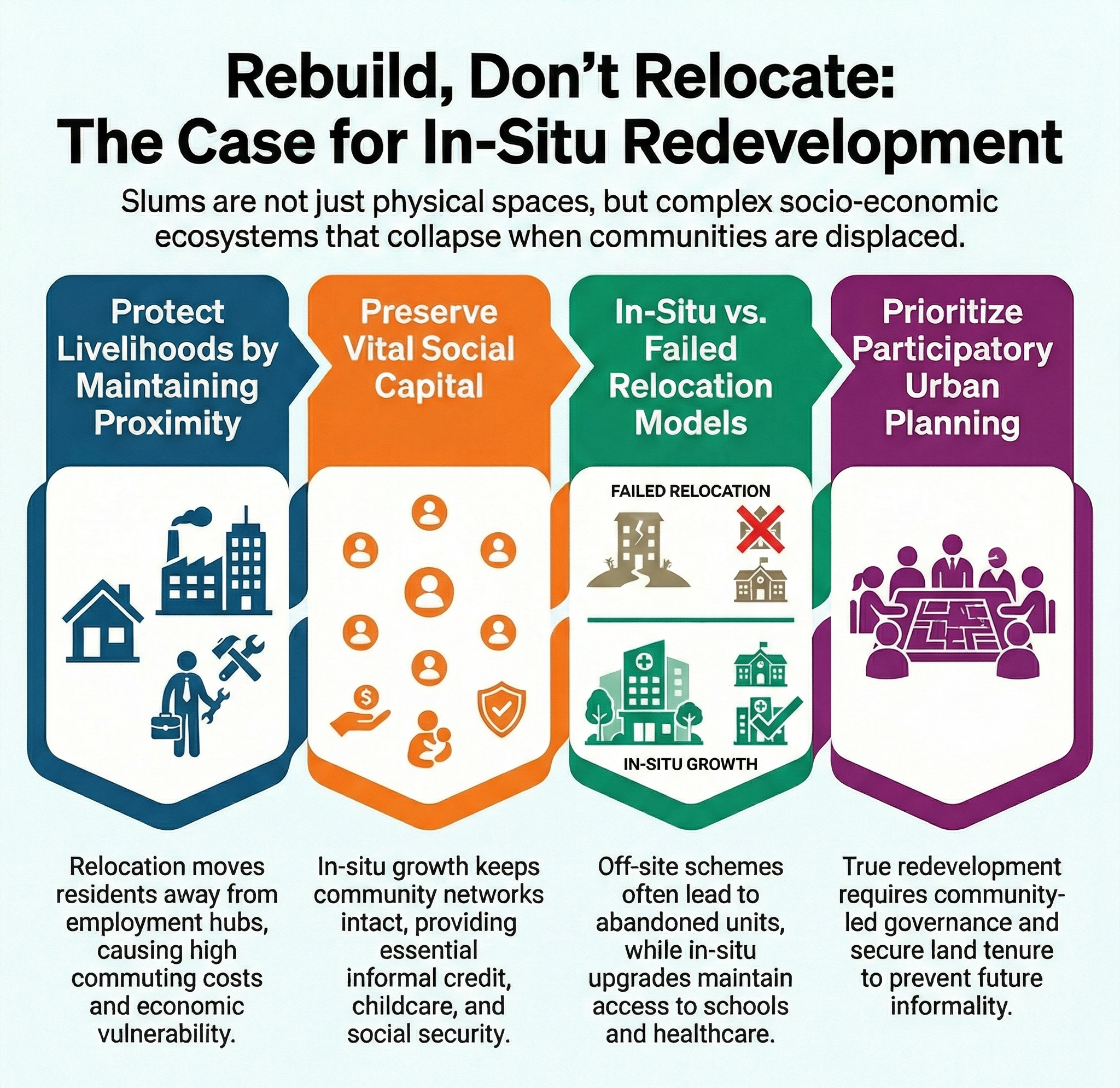
Core Theme of the Article
The article argues that in-situ slum redevelopment, rather than relocation-based rehabilitation, is essential for equitable and sustainable urban development. It critiques displacement-centric approaches and advocates for community-integrated housing models that preserve livelihoods, social networks, and access to services.
The central claim: rehabilitation must improve lives without uprooting communities.
Key Arguments Presented
1. Displacement Disrupts Livelihoods
Relocation projects often move slum residents far from employment hubs, increasing commuting costs and economic vulnerability.
2. Social Capital is Undervalued
Forced relocation fragments community networks that provide informal credit, childcare, and social security.
3. In-Situ Redevelopment Preserves Economic Integration
Upgrading housing within existing locations maintains proximity to jobs, schools, and healthcare.
4. Mixed Outcomes of Relocation Models
The article suggests many off-site rehabilitation schemes have led to underutilised or abandoned housing units.
5. Inclusive Urban Planning Required
Slum redevelopment must be participatory and responsive to ground realities.
Author’s Stance
The tone is rights-oriented and urban reform-centric.
• Strongly supports in-situ redevelopment
• Critical of top-down relocation models
• Emphasises social justice and inclusivity
The article aligns with urban equity frameworks.
Possible Biases and Framing
Pro-In-Situ Bias
The article foregrounds in-situ redevelopment without deeply analysing cases where relocation was unavoidable.
Equity-Centric Lens
Economic efficiency arguments for relocation are underemphasised.
Normative Planning Bias
Assumes participatory models will consistently deliver better outcomes.
These biases stem from social-justice planning perspectives.
Strengths of the Article
• Integrates housing with livelihood concerns
• Recognises importance of informal economy
• Highlights social networks as economic assets
• Emphasises human-centric urbanisation
Limitations
• Limited discussion of land scarcity constraints
• Does not quantify financial feasibility
• Underexplores developer-state incentive structures
• Limited engagement with environmental risks in certain slum areas
Policy Implications
1. Strengthen PMAY-Urban In-Situ Component
Greater allocation toward in-situ vertical redevelopment.
2. Participatory Urban Governance
Institutionalise community consultation mechanisms.
3. Integrate Housing with Transport and Livelihood Planning
Transit-oriented development to reduce displacement risks.
4. Reform Land and Property Laws
Enable clear tenure security to prevent future informality.
5. Urban Local Body Capacity Building
Strengthen municipal planning and execution capabilities.
Real-World Impact
Short Term
• Slower but socially sensitive redevelopment
• Reduced resistance from communities
Medium Term
• Improved urban productivity through livelihood continuity
• Enhanced social cohesion
Long Term
• More inclusive urban growth
• Reduced re-slumification cycles
UPSC GS Alignment
GS Paper I
• Urbanisation
• Migration and informal settlements
GS Paper II
• Urban governance
• Role of municipalities
• Social justice
GS Paper III
• Inclusive growth
• Housing policy
• Infrastructure development
GS Paper IV
• Human dignity
• Participatory governance
Essay Relevance
• “Inclusive urbanisation as a development imperative”
• “Cities as engines of growth and inequality”
Balanced Editorial Assessment
The article effectively highlights the human cost of relocation-centric rehabilitation. Urban policy must recognise that slums are not merely physical spaces but socio-economic ecosystems.
However, in-situ redevelopment is not universally feasible. Dense metropolitan land markets, environmental hazards, and infrastructure limitations may necessitate hybrid approaches.
Future Perspective
India’s urban future depends on:
• Integrating housing with employment geography
• Preventing informal expansion through affordable rental housing
• Using GIS-based planning for equitable land allocation
• Balancing redevelopment with environmental resilience
If urban planning prioritises people over plots, slum rehabilitation can become a pathway to inclusive growth. If treated as a real estate exercise, social fragmentation may deepen.
Final Editorial Judgment:
In-situ redevelopment is not merely a housing solution—it is a socio-economic strategy. Its success will depend on participatory governance, financial viability, and long-term urban planning coherence.
