

India and the EU — a fit partnership in a divided world
The Hindu
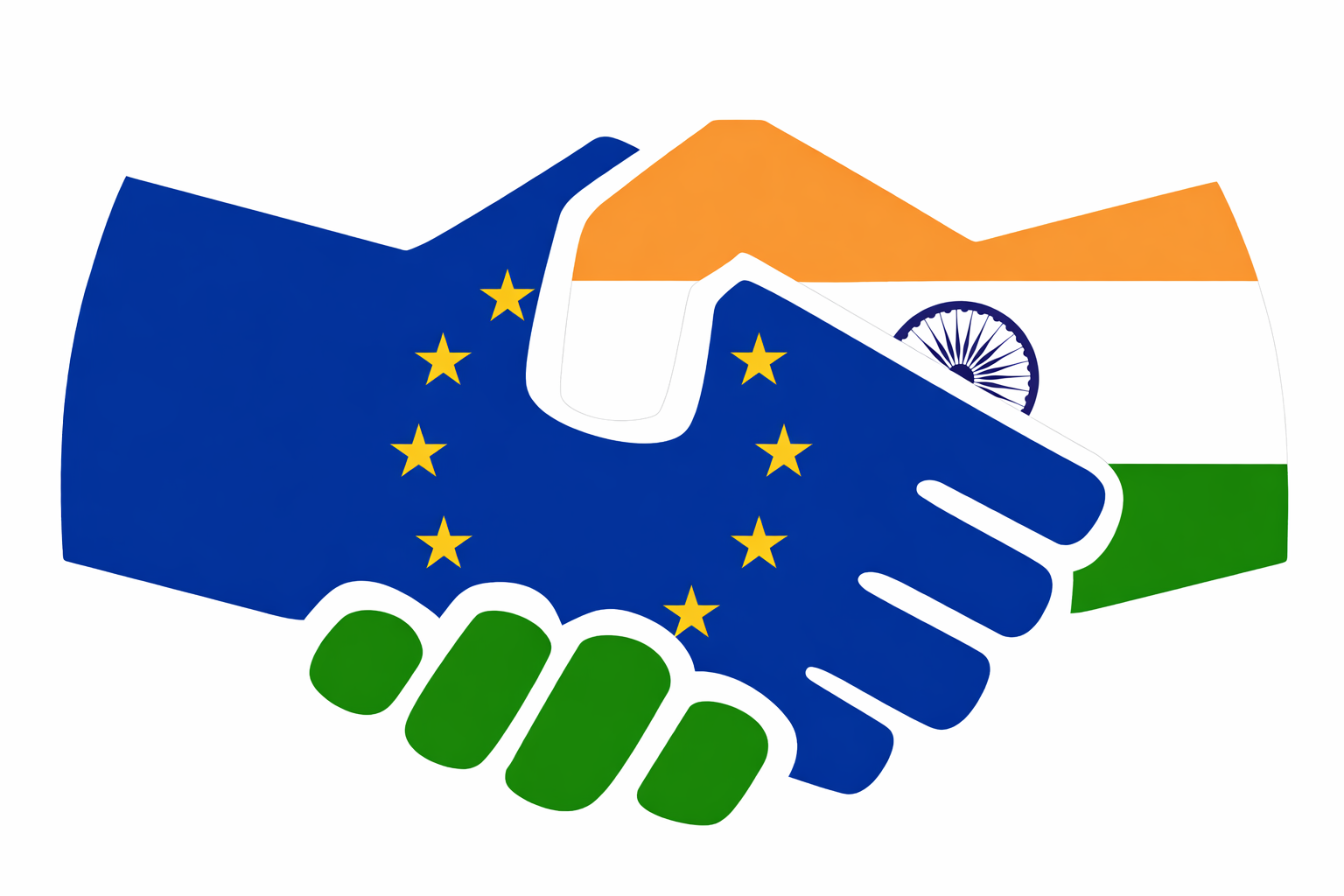
Central Theme of the Article
The article argues that India–European Union relations have reached a strategic inflection point, driven by geopolitical fragmentation, declining faith in traditional alliances, and the shared pursuit of strategic autonomy. It presents the partnership as both timely and necessary in a world marked by uncertainty, power rivalry, and transactional diplomacy.
Key Arguments Presented
Geopolitical convergence amid global disorder
The article situates India–EU ties within a fractured global order where alliances are no longer dependable and strategic autonomy has become central to foreign policy.
FTA as a geopolitical instrument, not just a trade deal
The long-pending India–EU Free Trade Agreement is framed less as a commercial arrangement and more as a tool of strategic alignment, economic resilience, and diversification.
Complementary economic strengths
India’s large market and manufacturing ambitions align with Europe’s technological depth, capital, and regulatory expertise.
Climate and CBAM as friction points
The EU’s Carbon Border Adjustment Mechanism is identified as the most serious irritant, with India viewing it as a non-tariff barrier undermining free trade gains.
Strategic and defence cooperation as underexplored terrain
Beyond trade, defence co-production, maritime security, and Indo-Pacific coordination are highlighted as critical but underdeveloped pillars.
Strategic autonomy as shared doctrine
Both India and the EU seek to reduce over-dependence—on China for markets, Russia for energy, or the US for security—making autonomy a unifying principle.
Author’s Stance
The stance is strongly constructive and forward-looking.
• Advocates deeper India–EU alignment
• Treats existing differences as negotiable, not structural
• Positions the partnership as a model for principled multilateralism
The article clearly supports strategic pluralism over bloc politics.
Editorial Biases and Assumptions
Normative multilateralism bias
Assumes that shared values and norms will translate smoothly into policy alignment, underplaying internal EU divisions.
FTA-centric optimism
Overestimates the transformative potential of the FTA without fully acknowledging political economy constraints on both sides.
Soft-pedalling power asymmetry
Downplays the EU’s regulatory dominance and India’s defensive trade posture.
Strengths of the Argument
• Correctly links economics with geopolitics
• Recognises climate policy as a strategic, not technical, issue
• Avoids binary US–China framing
• Emphasises autonomy rather than alliance dependency
Weaknesses and Gaps
• Limited discussion on implementation challenges of CBAM mitigation
• Understates bureaucratic inertia within EU institutions
• Insufficient attention to India’s domestic political economy resistance to FTAs
• Defence cooperation remains aspirational rather than operational
Policy Implications
Foreign Policy
India must treat Europe as a strategic pole, not merely a trade partner.
Trade Policy
FTA negotiations require balancing export access with protection of vulnerable domestic sectors.
Climate Diplomacy
India needs a calibrated response to CBAM—through negotiation, equivalence frameworks, or climate finance demands.
Defence and Security
Co-production and maritime coordination can reduce dependence on traditional suppliers.
Real-World Impact
Short Term
• Renewed momentum in FTA negotiations
• Diplomatic signalling of strategic convergence
Medium Term
• Diversification of supply chains
• Enhanced regulatory alignment in select sectors
Long Term
• Emergence of India–EU as a stabilising axis in a multipolar world
• Reduced exposure to coercive economic dependencies
UPSC GS Paper Linkages
GS Paper II (International Relations)
• India–EU relations
• Strategic autonomy
• Multilateralism and global governance
GS Paper III (Economy)
• Trade agreements
• Climate policy and carbon markets
• Manufacturing and supply chains
Essay Paper
• “Strategic autonomy in an era of fractured alliances”
• “Trade as an instrument of foreign policy”
Concluding Assessment
The article convincingly argues that India and the EU are natural strategic partners in an era of uncertainty, bound less by ideology and more by converging interests. While optimism is justified, success will depend on hard compromises, institutional follow-through, and mutual sensitivity to domestic constraints.
Future Perspective
If managed pragmatically:
• India–EU ties can redefine middle-power diplomacy
• The partnership can serve as a template for non-coercive global cooperation
If mishandled:
• Regulatory friction and mistrust could reduce engagement to symbolism
