

India Becomes Top Remittance Recipient Country, Adding Over 137 Billion Dollars, Says UN Report
The Statesman
1. Core Issue and Context
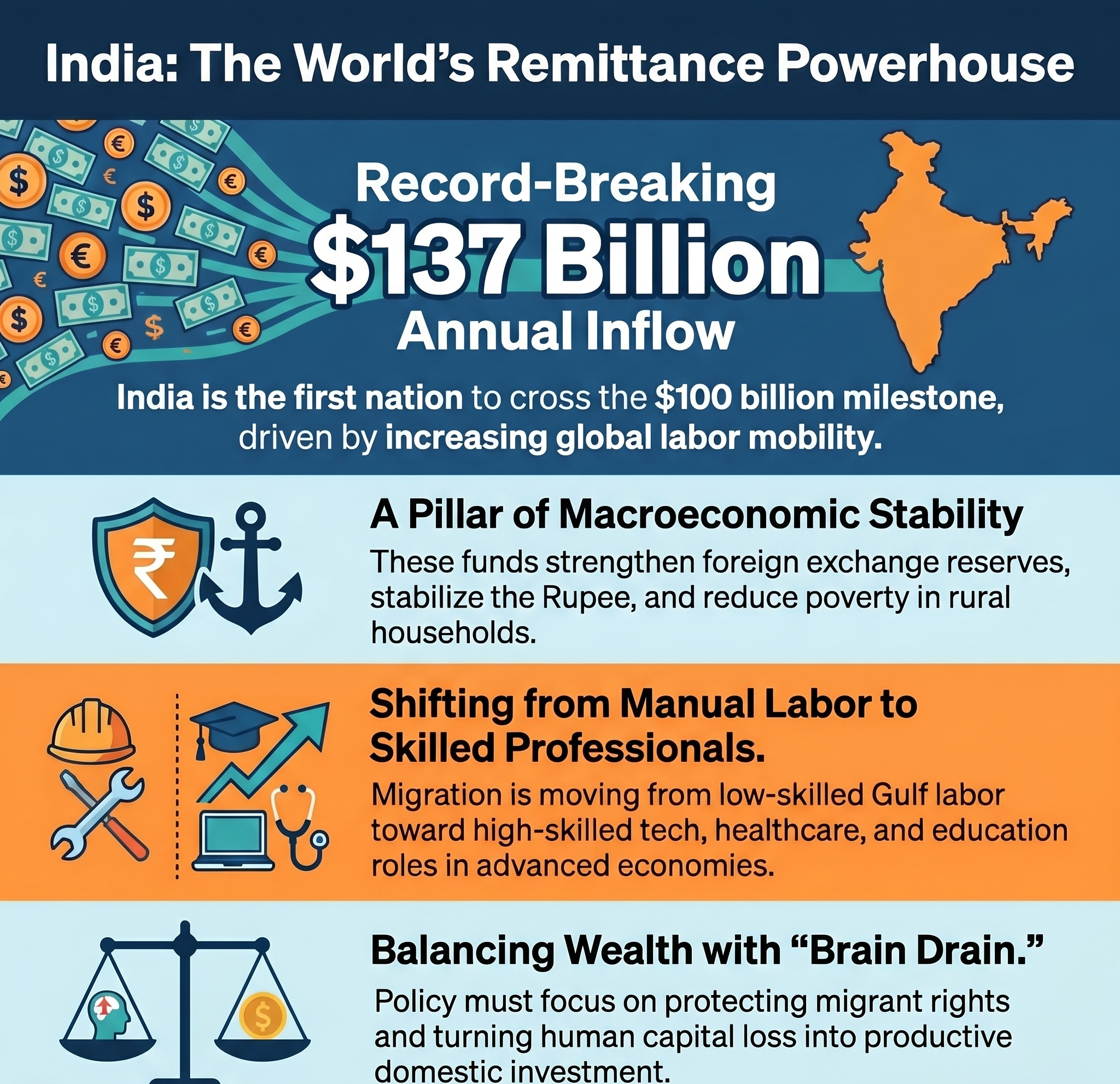
The article highlights India’s emergence as the world’s largest remittance recipient country, receiving more than 137 billion dollars in remittances according to a UN migration report.
Remittances refer to money sent by overseas migrants to their families or communities in their home country. India’s position reflects:
The scale of the Indian diaspora
Increasing global labour mobility
Growing participation of skilled and semi-skilled Indians in international economies
The report also places India within the broader global migration and economic landscape.
2. Key Arguments in the Article
India dominates global remittance inflows
India crossed the 100-billion-dollar mark and reached over 137 billion dollars
It remained significantly ahead of countries like Mexico, Philippines, and France
Demonstrates the economic strength and spread of the Indian diaspora
The article presents remittances as a major economic achievement and source of external financial stability.
South Asia remains a major remittance hub
South Asia is expected to experience strong remittance growth
India, Pakistan, and Bangladesh remain central recipients
This reflects:
High migration intensity
Labour export dependence
Strong overseas workforce networks
Global migration patterns are changing
The article notes:
Rising international mobility of students and workers
Increasing role of skilled migration
Expansion of migration corridors beyond traditional destinations
India’s migration profile is increasingly shifting from low-skilled Gulf migration toward skilled professional and educational mobility.
Indian diaspora contributes to global economic sectors
The report emphasises:
Contribution of Indians in technology, education, and professional services
Growing importance of skilled migrants in advanced economies
This strengthens India’s soft power and economic linkages globally.
3. Author’s Stance
Broadly positive and celebratory
The article adopts an optimistic tone and frames remittances as:
An indicator of India’s global economic presence
A source of national economic resilience
A reflection of diaspora success
There is limited critical examination of the social or structural implications of migration dependence.
4. Underlying Biases
Economic success bias
The article largely treats high remittance inflows as an unquestioned economic success.
Less attention is given to:
Brain drain
Migration vulnerabilities
Social costs of labour migration
Diaspora-centric nationalism
The report implicitly celebrates:
Indian global mobility
Diaspora achievements
India’s international influence
This creates a positive national narrative around migration.
Limited labour rights perspective
The article does not deeply discuss:
Exploitation of migrant workers
Poor working conditions abroad
Vulnerability of low-skilled migrants
5. Pros (Positive Dimensions)
Strengthening foreign exchange reserves
Remittances:
Improve balance of payments
Support currency stability
Enhance external sector resilience
India benefits significantly from steady inflows during global economic uncertainty.
Household welfare improvement
Remittances support:
Education
Healthcare
Housing
Consumption expenditure
They often improve living standards in migrant-sending regions.
Reduction in poverty
Migration-generated income can:
Reduce rural distress
Increase financial inclusion
Create upward social mobility
Diaspora-driven soft power
Indian communities abroad:
Strengthen diplomatic influence
Promote trade and investment networks
Enhance India’s global image
Counter-cyclical economic support
Remittances often remain stable even during crises, making them more reliable than volatile capital flows.
6. Cons and Concerns
Brain drain
Large-scale migration of:
Doctors
Engineers
Researchers
Skilled professionals
may weaken domestic human capital capacity.
Migration dependency
Some regions become economically dependent on external remittance income rather than local productive growth.
Vulnerability of migrant workers
Many overseas workers face:
Poor labour protections
Wage exploitation
Unsafe working conditions
Legal insecurity
Especially in Gulf economies.
Social costs of migration
Long-term migration may create:
Family separation
Emotional stress
Social fragmentation
particularly in rural households.
Regional inequalities
Benefits of remittances are unevenly distributed across states and communities.
7. Policy Implications
Need for comprehensive migration policy
India requires:
Better migration governance
Bilateral labour agreements
Protection mechanisms for workers abroad
Skill development expansion
Focus should be on:
Global employability
High-skill migration
Language and technical training
Leveraging diaspora capital
Government can encourage:
Diaspora investments
Technology transfer
Startup collaborations
Knowledge partnerships
Financial inclusion and productive utilisation
Policies should encourage remittances toward:
Productive investments
Entrepreneurship
Local development
rather than only consumption.
Protection of migrant rights
Need for:
Labour diplomacy
Welfare mechanisms
Legal assistance abroad
Crisis evacuation systems
8. Real-World Impact
Macroeconomic stability
Remittances:
Strengthen forex reserves
Support current account balance
Reduce external financing pressure
Regional economic transformation
States like:
Kerala
Punjab
Telangana
Andhra Pradesh
have experienced major socio-economic changes due to migration income.
Changing aspirations and mobility patterns
Migration has become linked with:
Education aspirations
Professional mobility
Global middle-class identity
Rise of skilled migration
India is increasingly supplying:
IT professionals
Healthcare workers
Students
Financial experts
to global economies.
9. UPSC GS Paper Linkages
GS Paper III (Economy)
Relevant themes:
Remittances and balance of payments
Migration economics
Forex reserves
External sector stability
GS Paper II (International Relations)
Relevant themes:
Indian diaspora
Labour diplomacy
Global migration governance
GS Paper I (Society)
Relevant themes:
Migration
Urbanisation
Social transformation
Family structures
Essay & Ethics Relevance
Themes:
“Migration and development”
“Globalisation and identity”
“Human mobility in a globalised world”
10. Critical Examination from UPSC Perspective
Remittances are both strength and vulnerability
India’s remittance dominance demonstrates:
Global competitiveness of Indian labour
Strong diaspora networks
However, overdependence on external labour markets exposes India to:
Global recessions
Immigration restrictions
Geopolitical instability
Shift from low-skilled to high-skilled migration
India’s migration profile is changing:
Earlier dominated by Gulf labour migration
Increasingly driven by skilled professionals and students
This transition may improve:
Income quality
Knowledge transfer
Global influence
but also intensify brain drain concerns.
Migration as development strategy
For many Indian households, migration acts as:
Informal social security
Poverty alleviation mechanism
Mobility pathway
This reflects gaps in domestic employment generation.
11. Balanced Conclusion
The report highlights India’s remarkable position as the world’s leading remittance recipient, reflecting the global reach and economic contribution of the Indian diaspora.
Remittances have become:
A pillar of macroeconomic stability
A driver of household welfare
A source of global economic integration
However, beneath this success story lie important structural concerns:
Brain drain
Labour exploitation
Regional inequalities
Dependence on overseas opportunities
12. Future Perspective
India’s future migration and remittance strategy should focus on:
Safe and legal migration pathways
High-skill workforce development
Diaspora engagement policies
Stronger migrant welfare mechanisms
Productive utilisation of remittance income
Ultimately, the long-term goal should not merely be becoming the largest remittance recipient, but transforming global Indian mobility into sustainable national development, innovation, and human capital advancement.
